Impact of AI on the Way Students Learn
What we know so far about how students are actually using AI today, and the approaches that work when it comes to responsible AI use.


AI in education is not going away, and neither are the confronting questions that come with it: according to RAND research, in May 2025, 48% of students used AI for homework help, which rose to 62% in December 2025 – even though 67% of students recognized that using it could harm their critical thinking.
While the question has become how AI is being used in education (and not whether), the impact of AI on learning is still in its early days. Yet as leading educators such as Sir Anthony Seldon have declared, AI is “the most transformative innovation to impact education ever”, posing “the biggest challenge to young people’s safety and mental health, to intellectual rigour and to the integrity of assessment”.
Less than five years after ChatGPT was released, it’s worth examining what we know so far about the impact of AI on the way students learn. By the end, you’ll understand how students are using AI today, and the approaches that actually work when it comes to responsible AI use.
TL;DR
While AI provides students with faster access to information and personalized pacing, as well as immediate feedback and more accessible learning materials, there are also some obvious risks. Namely, an over-reliance on shortcuts can hide gaps in students’ actual understanding of material, and AI hallucinations can leave students learning something that isn’t true. Although it is still early days when it comes to measuring the impact of AI on student learning, what already seems to matter most is whether students use AI to build their own intelligence or use it as an intellectual crutch.
How Students Are Actually Using AI Today
This UNESCO video explores how AI is transforming classrooms: "We need to model how to use these tools well; otherwise, we’re setting our students up for failure."
The most noticeable way that AI is changing how students learn is that it is accelerating the speed at which they can access information. Unlike a human teacher who has a finite amount of energy and time, AI tools can adapt lessons to mirror a student’s preferred speed, give students instant corrections and explanations, and break down difficult problems.
On the one hand, this highly personalized and scalable tutoring is often treated as a welcome addition to the classroom. Yet there are also new challenges around the temptation of leaning too heavily on cognitive shortcuts: using AI too much can ‘vaporize’ long-term learning, leading to a hoop-jumping culture where quick answers lead to certain grades without long-term comprehension or retention of information.
There are also new questions around academic integrity, and how to encourage students to use AI as a thought partner that cannot replace their own individual creativity and critical thinking. One of the key areas is knowing how exactly AI helped a student with an assignment, and a 2025 USC report explained the difference between two types of help.
The first is “executive help”, or getting AI to do the task for you and offloading the cognitive work to AI. This can be helpful for those with executive dysfunction (the mental blocks making it hard to start tasks or organize thoughts). An example could be: “I need to write an essay about President Obama. Can you give me 3 different angles or bullet-point outlines to help me choose a direction?"
Instrumental help, on the other hand, is about using AI as a learning tool but still doing the majority of the work yourself. An example could be: “Here is my essay on President Obama. Am I spelling the name Michelle correctly?”
Ultimately, as USC researcher Stephen J. Aguilar argues: “Generative AI is here and already having an impact. What matters now is whether we use it to deepen learning or to avoid it.”
How AI Is Changing the Way Students Learn
Students tend to be the early adopters of AI: by January 2023, only two months after ChatGPT was released, almost 90% of college students surveyed were using it for homework help, and this AI literacy means that there can be a disconnect between students and teachers.
After all, Cengage’s 2025 AI in Education report, 65% of higher ed students thought they knew more about AI than their instructors, and 45% wanted their professors to use AI skills in relevant courses.
Benefits of AI in Student Learning
There are specific ways in which most students are turning to AI.
Finding an explanation when they hit a wall
Before AI, if a student didn’t understand a complex issue in class, they had to either find time with their teacher to ask them afterward, or get a tutor or classmate to explain, which isn’t always an available option. AI gives them another way to dig deeper into the material and take as long as they need to get as many explanations as they need.
George Mason University says this can “keep the student from becoming bored and losing interest. It can help them stay more engaged, excited, and motivated to learn so that they can achieve their goal of increasing their knowledge base. The interactive nature of chatbots is another feature that can enhance student engagement and increase motivation.”
Getting feedback while the work is still in progress
AI can come up with practice questions from teacher-approved notes or give feedback on a draft, or, if allowed, tools like the GPTZero Grammar Checker or Grammarly Grammar Checker can help students catch mistakes they might otherwise miss. While it’s still up to the student to take on board and integrate the feedback, the tool helps them to optimize the way they express their idea.
Making the material easier to access
Translation, captions, and text-to-speech can help students access material that would otherwise be difficult to use, although the right level of support can depend on what is being taught: translating a science explanation could help a student understand the lesson, while translating their answers in a language assessment could bypass the skill you're assessing.
This demonstrates several key benefits of AI in student learning, which Discovery Education highlights, including:
- Personalized pacing: Gives students more time with a concept or a new challenge on their own schedules.
- Immediate feedback: Students can get feedback while they’re still working, giving them a chance to revisit a mistake or revise a draft.
- More accessibility: Translation, captions and read-aloud features can make learning materials easier to access for students with different needs.
Challenges and Risks of AI in Student Learning
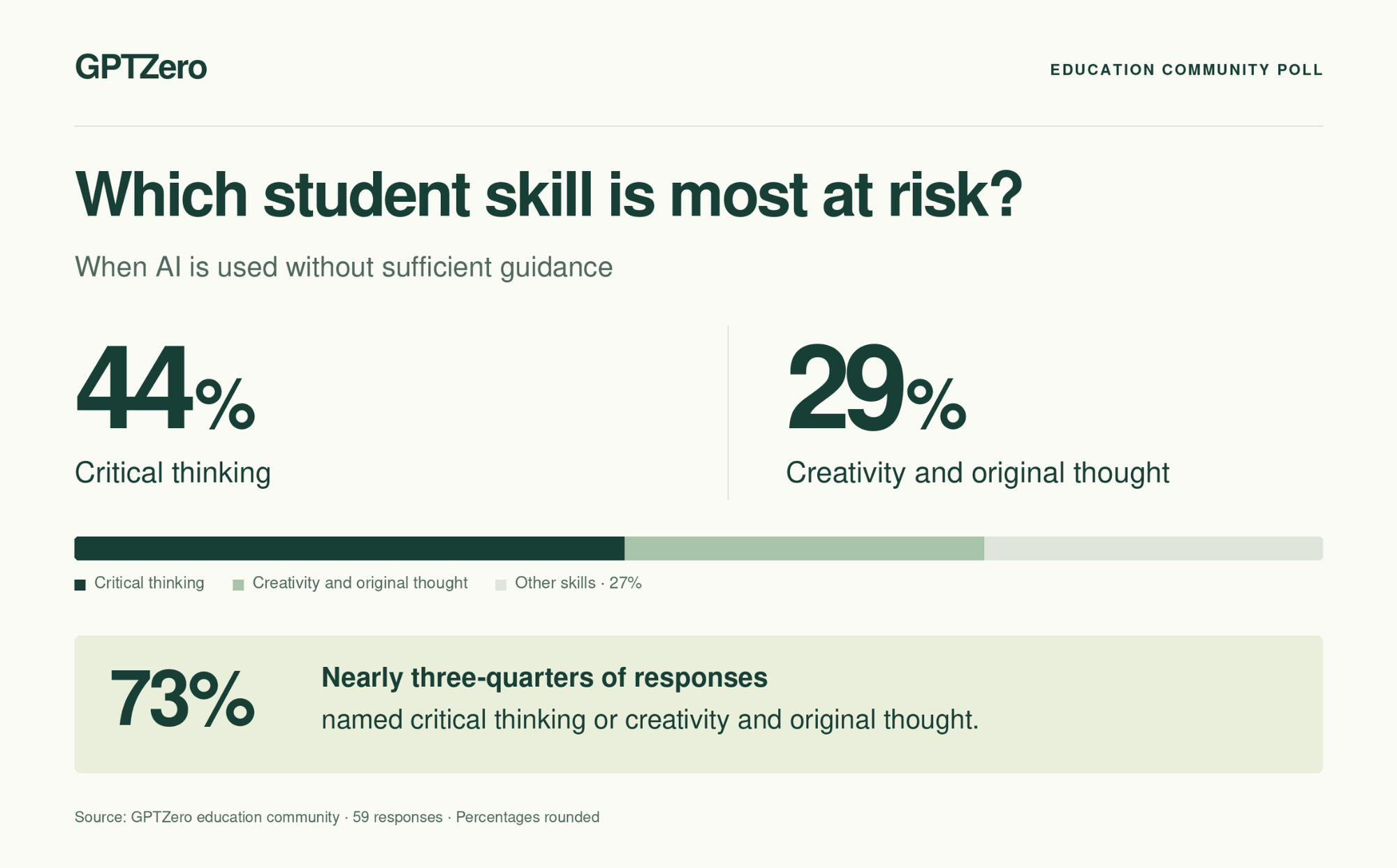
Which student skill is most at risk when AI is used without sufficient guidance? When we asked the GPTZero education community, critical thinking was the most common answer, selected by 44%, while creativity and original thought followed at 29%. Together, these two options accounted for nearly three-quarters of responses.
Shortcuts can hide gaps in understanding
When students turn to AI for every answer, they can miss the practice that helps them learn how to solve problems themselves: the assignment gets finished, but the gaps in understanding can remain.
“Fifteen-year-olds in high-income countries are now 18 months behind their 2015 counterparts in literacy, knowledge and reasoning skills,” says Alice Thomson in The Times. “Pupils are getting AI to do their work, and so are becoming more stupid just when they need to be smarter to handle this new technology.”
Students can end up learning something that isn’t true
AI can produce false explanations and invent references, often with the same confidence it uses for accurate information. Such errors, known as hallucinations, can leave a student studying an incorrect explanation or citing a paper that doesn’t actually exist.
GPTZero’s hallucination detector can help flag potentially fabricated citations. Students should then open the original source, check that it exists and read what it actually says. Finding a reference is only the beginning of checking a claim.
Students can end up relying on technology more than themselves
A hint can help them work through a problem, but having completed work just handed over can make it easier to skip any intellectual heavy lifting, as is explored at the start of this TED talk.
Drawing on years in the classroom, Professor Amy Bruckman examines how teaching is already changing in the age of AI, and what the future of education might look like for students and educators alike.
In her talk, Professor Amy Bruckman explains how a student who admitted to submitting an AI-written assignment just could not explain his thinking or demonstrate even a basic understanding of even the most introductory material from the first few weeks of the course.
She sees two problems coming together: weak study habits that some students developed during the pandemic, which was swiftly followed up by sudden access to AI, which offers a “constant temptation” to complete assignments without doing the work needed to learn.
This is an international issue. As education consultant Kapila Mediliyegedara describes here, “Last week a Year 11 student handed me a GCSE Physics practice paper that scored 94%. I asked her to explain her own answer to the second question. She couldn't. She'd used AI to write it — not to help her think, to think for her…. I'm seeing this constantly now.”
He continues, “We've handed teenagers the most powerful thinking tool ever built, at the exact moment their ability to think independently is falling off a cliff. I'm not anti-AI. Every student I tutor will use it for the rest of their life. Banning it isn't the answer — and it's not even realistic. But there's a real difference between AI that does the thinking and AI that sharpens it.”
AI in Education at a Glance: Benefits vs. Drawbacks
Academic Integrity and AI Detection
While an AI detector can give teachers a reason to look more closely, its result cannot say for sure whether a student has broken the rules. Human writing can be flagged by mistake, while AI-generated writing sometimes can be missed. A plagiarism checker looks for matches with existing sources, which answers a different question.
At GPTZero, we recommend considering the result alongside the student’s research notes and version history, and also giving them a chance to explain their work and how they used any permitted tools.
Keeping a record as the work develops can make these conversations easier, and for Google Docs, GPTZero’s AI detector extension includes Writing Replay and a Writing Report, showing exactly how a document came together.
What Actually Works: Institutional and Classroom Approaches
Design AI-proof assignments
We’ve talked about designing AI-proof assignments, which comes down to getting specific on the structure, using timely content, including reflective components, and encouraging the demonstration of a documented process.
“There is no point assigning homework or coursework that can be done in a few minutes by ChatGPT or Claude,” continues Alice Thomson’s for The Times. “Instead, if pupils are told to research Henry VIII’s wives or First World War poetry, they should be questioned orally in class the next day…. Italy and France have always relied on oral testing in exams at both school and university to prevent cheating.”
She points out that MIT (“which tops the world league table of universities”) is planning “to rebuild education with oral tests, in-person project work and social components in every subject.”
Show students what responsible AI looks like
The best way to do this is to work through an example together: show students how to explain where they're stuck and ask for a hint, then discuss whether the response was helpful. Follow this with a similar problem they tackle independently, so you can see what they understood.
Explain the rules before the assignment begins
A blanket ban doesn't teach students how to use AI responsibly when assistance is allowed: they need examples of what they can and can't do, and how to cite any help. Our guides to creating a school AI policy and developing AI policies for universities offer starting points.
Teachers also need time to learn the tools and discuss what's working. As educator Starr Sackstein shares: “While AI can provide personalized feedback and support, it cannot replace the essential human element of teaching. Teachers play a vital role in mentoring, motivating, and inspiring students… No technology can replace a good teacher.”
Conclusion
These days, completed work on its own doesn’t necessarily reflect a student’s learning progress. While an assignment might be finished, can the student explain their reasoning or try a similar problem without AI? Asking these questions can help reveal what they understand and where they still need support.
For teachers, this means showing students what responsible AI looks like, explaining the rules before the assignment begins, and encouraging a documented process. AI can offer an explanation, a hint, or feedback on a draft but the deeper level of comprehension still needs to belong to the student.
FAQs
How is AI changing the way students learn?
AI gives students much quicker access to information, as well as explanations tailored to their own pace, and feedback while their work is still in progress. Translation, captions, and text-to-speech can also help students access material that would otherwise be difficult to use.
What are the main risks of AI in student learning?
Students can miss the practice that helps them solve problems themselves, rely on AI for answers, or learn something that isn’t true. This is because AI can produce false explanations and invent references, while completed assignments can hide gaps in understanding.
How can teachers check whether students understand AI-assisted work?
Ask students to explain their reasoning or try a similar problem without AI. Research notes and version history can also give teachers more context about how the work developed. Students should have a chance to explain their work and how they used any permitted tools.