How to Talk to Parents About AI Use in the Classroom
Our guide for educators on explaining classroom AI use, addressing parents’ concerns, and handling suspected AI-generated work.


Most parents are finding that schools are not communicating with them about generative AI, as 83% reported to Common Sense Media. And yet more teachers and students are using AI in the classroom, with the Center for Democracy & Technology sharing that 85 percent of teachers and 86 percent of students report using AI in the past school year.
While AI use continues to grow, policies are still catching up. At the same time, parents are asking teachers to justify how AI is being used, and this potentially awkward conversation becomes especially difficult when a student’s work has been flagged for AI use.
In conversations with the GPTZero educator community, teachers described parent pushback as one of the hardest parts of handling suspected AI use. This guide gives you a practical framework for explaining classroom AI use, responding to common parent concerns, and discussing suspected AI-generated work without turning a detection result into an accusation.
TL;DR
Speaking to a parent about AI starts with being able to list exactly which AI tools you use, why you use them, and what students are allowed to do with AI in your classroom. During the conversation with the parent, it helps to listen first so you can get to the heart of their specific concern, then to explain your classroom AI policy and your safeguards before leaving room for further questions. If the issue is around suspected cheating, it’s critical to treat AI detection as one data point and not a reason for automatic punishment.
Why parents have questions about AI in the classroom
This back-to-school series from CBS Mornings looks at what parents should know about artificial intelligence when it comes to their kids.
Last year, CRPE revealed that only 16% of parents surveyed had a detailed understanding of AI, and a third said they knew general information about AI, but not the details. All they are sure of is their questions about whether AI is actually supporting their child’s learning.
Our own survey shows learning is at the heart of many of these questions: 43% identified students becoming overly reliant on AI as the concern parents raise most often, while 19% chose AI replacing important learning or writing skills. Together, those two learning-related concerns accounted for 62% of responses.
Worried your child’s homework doesn’t sound quite like them? This guide on how to check if your child is using AI for homework explains what to look for and what to do next.
Privacy and data security were selected by 5% of respondents, while 2% chose unequal access to AI tools. Although these were less commonly selected as the single concern parents raise most often, schools still need clear answers about both.
Some teachers also see the equity issues in AI literacy, like one teacher from our GPTZero community who said:
“My school district is trying to make sure kids know how to use AI, because we have a lot of second-language learners and people whose parents don't speak English. They're at a disadvantage when using AI – and AI is fully aware that if you're not savvy enough to ask it the right questions, then it's not going to work for you.”
A framework to express your AI position
To address any parent’s concerns, you first need to be firm on knowing how to articulate your own AI use in the classroom. Before the conversation, write down which tools you use, the learning purpose behind each, whether AI is allowed on assignments, and how students share any AI assistance.
The need for this kind of specificity also came through in our own surveys. When we asked what would help teachers have more productive conversations with parents about classroom AI, the two leading answers were practical examples of permitted and prohibited use, selected by 29%, and evidence showing how AI affects learning, selected by 28%. The difference between them was just two responses. A further 13% said more training on AI tools and their limitations.
It’s also worth checking your school’s AI policy and know which questions need to go to an administrator, IT lead, or privacy officer.
A straightforward school-wide AI policy was selected by another 20% of respondents in our own surveys. Taken together, practical examples, evidence and a clear policy made up 76% of responses, suggesting that teachers need concrete answers more than general talking points.
Taking all of that information, it’s helpful to sum up your stance in a brief sound bite, such as:
I use approved AI tools such as [examples] when they support a specific learning goal, but students still need to do the thinking, check the output, and declare how they used the tool.
Parents don’t need you to explain at length how LLMs work or what the school’s policy is around technology. At the heart of it, they’re looking to have their concerns heard and validated.
Showing parents what an AI tool actually does, what the student sees, and what the teacher still controls can make the conversation much more concrete. A high school teacher from our GPTZero community described it this way:
“One of the things I find very helpful is that when we use AI in those classes and students are there, we're able to share some of the material with either parents or students if we want to. So they can see they can see things as well, not just on our end, but that we have found that being open with students and having students see their own growth as well helps”.
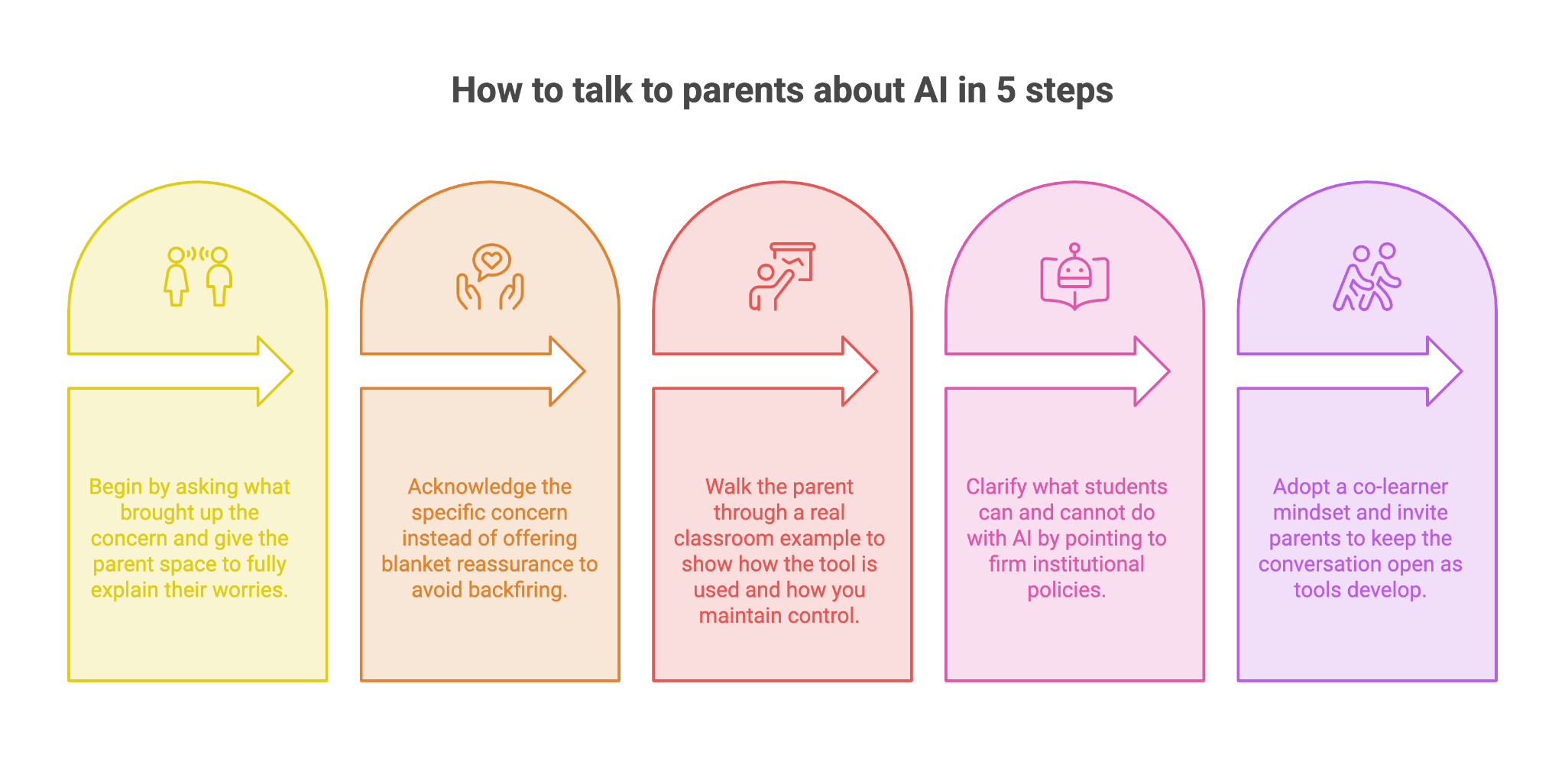
How to talk to parents about AI in 5 steps
1. Prioritize listening before explaining
When parents feel like they are truly being listened to, they are less likely to go on the attack, so it can help to begin by asking what brought up the concern. Give the parent space to fully explain what it is they are worried about.
What this can sound like
“Thanks for raising this. Can you tell me what specifically concerns you about how AI is being used?”
2. Validate the specific worry
Sometimes, blanket reassurance like “there’s nothing to worry about” ends up backfiring as it fails to validate what the parent is feeling. Instead, try something along the lines of: “I get why you’re concerned about XYZ.”
What this can sound like
“I understand why you’re concerned about [AI replacing your child’s own work / them becoming too dependent on AI / how their data is being used]. That’s something I can assure you we take very seriously too.”
3. Walk them through exactly how AI is used
Once you’ve heard what they’re really worried about, bring them through a real classroom example of how AI is used, so the parent can see exactly what the tool brings to the table and how you still have control over your classroom.
It can help to share the growing importance of AI literacy, which as the European Institute of Innovation and Technology (EIT) described, is “quickly becoming as important as reading, writing, and even basic digital skills”.
What this can sound like
“In this class, we might use AI to [practice giving feedback / explore different ways to explain a concept]. For example, [brief classroom example]. The purpose is to help students practice [learning goal], rather than have AI do that work for them.”
4. Make it clear what students can and cannot do with AI
This is where a strong AI policy comes in handy, as you can point to firm boundaries around what AI is and isn’t allowed for at your institution. For example, maybe a grammar checker is allowed, but submitting purely AI-generated work is not.
If you need help creating a policy for your institution, check out our guide here.
What this can sound like
“Students can use AI for [specific permitted uses], but they still need to [complete the core task themselves]. They’re also expected to follow our classroom policy and be transparent about when and how they have used AI.”
5. Keep the conversation open with a ‘co-learner’ mindset
We are just at the start of how AI is going to change work and life, and writer and technologist Baratunde Thurston recommends parents take a curious outlook about AI alongside their kids so that they are on the learning journey together:
“We are all entering a world for which we are woefully underprepared. Approach it with humility - kids will respect you more for being honest about learning together.”
What this can sound like
“We’re still learning what responsible AI use looks like as these tools develop, and I want to keep this conversation open. If you have questions or notice something that concerns you, please bring it to me so we can look at it together.”
Common parent concerns, and how to respond
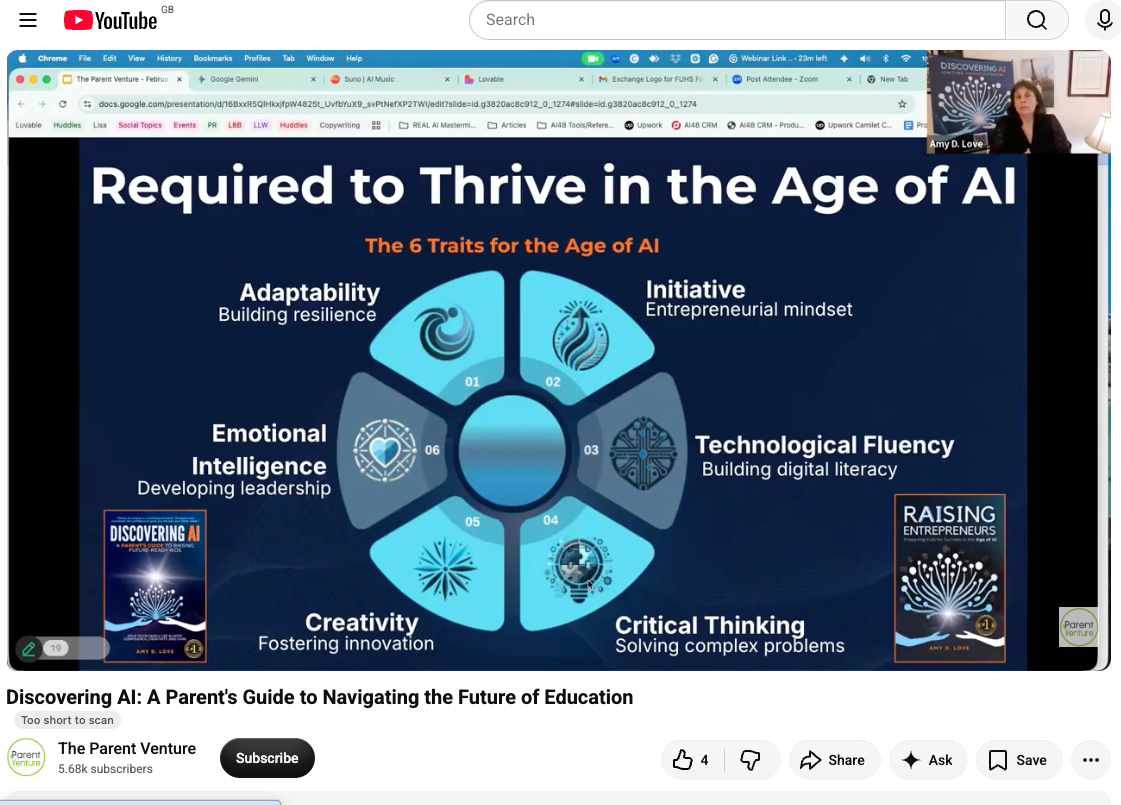
Making a case for using AI in the classroom often links back to AI literacy and the role it will play in future employability. When it comes to the bigger picture of where AI in education is heading, this video by Amy D. Love, founder of ‘Discovering AI’, outlines how:
“In the age of AI… the reality is now knowledge is now universally accessible to anyone with broadband. Are you adaptable enough to know that when your job changes, because now AI can do this function, that you can add value in this way, or do you lack the resilience and can only do what you were trained for? Every role is currently being rewritten as it relates to AI. Are you able to take initiative and show entrepreneurial mindset?”
It shows how AI literacy is about preparing students for a world where AI is going to be part of how they work and learn. The tools will evolve, but the real issues are knowing when to use AI, how to question output, and how to keep developing the skills AI can’t replace. This bigger-picture view can be helpful when explaining to parents why learning to use AI responsibly now matters for students later on.
The hard conversation: AI detection, cheating, and false accusations
It can be an especially challenging conversation if it starts after a student’s work has been flagged by an AI detector, as one teacher from the GPTZero community shared:
“Well, it's an awkward conversation… [parents] don't want to hear that their kid used ChatGPT. That's the most difficult part of it. And so I have to be really careful about how I word it”.
An AI detection result should not be presented as proof that a student cheated, because no detector is perfect, and human writing can produce a false positive. The result should be reviewed alongside the assignment policy, highlighted passages, previous writing, drafts, version history, source notes, and the student’s explanation of their process.
A stronger explanation might sound like this:
The result from the AI detector got us to look more closely at their work, so we are going deeper into the student’s writing process and giving them an opportunity to explain their work. We never make a decision from a single score alone.
Parents should know what the review process is, who makes the final decision, and how they or their child can respond. All of this helps to protect students from an automatic accusation while still allowing educators to dig deeper genuine concerns.
If a student’s work raises questions, use our AI detector to examine the document-level result and highlighted passages alongside drafts, version history, previous writing and the student’s explanation of their process.
Conclusion
Talking to parents about AI starts with listening to their specific concern before sharing your specific classroom policy, which ideally outlines exactly what students can and cannot do with AI. These conversations can be tricky when a student’s work has been flagged, and an AI detection result should never be treated as proof on its own: instead, it is a reason to look more closely at the student’s process. Our AI detector and Writing Replay tool can help you examine this process alongside the other evidence you already have.
FAQs
What if my child gets accused of using AI when I know they didn’t?
If a student has been flagged for AI cheating, this guide shows them to respond by gathering the right evidence, as well as using GPTZero’s Writing Report to prove their authorship.
Is my child allowed to use AI for homework?
It depends on the policies within your child’s particular school or classroom, as some teachers allow AI for certain tasks but not for others. Parents and students should check the assignment instructions and ask the teacher for guidance when needed.
How is my child’s data protected when AI is used?
Schools should use approved tools and limit the personal information students enter. Parents can ask which tool is being used and who to contact with privacy questions.
Why do parents have questions about AI in the classroom?
AI use has expanded faster than many school communication policies, and parents are trying to get their head around how it influences their child’s learning journey. Many have received little information from schools about how the technology is being used, and are coming from a position of wanting to fill gaps in their own knowledge around AI.