Composition Writing: A Step-by-Step Guide
Composition writing is a general term describing the practice of organizing your thoughts on a topic of interest into a written piece that develops a narrative or an idea from beginning to end.

Composition writing is a foundational skill for all students. This term gets used very loosely, which is why it can be confusing to understand what we're talking about when we say composition writing. Sometimes it means a short essay, sometimes it means a presentation, and sometimes it can just be a reference to the craft of writing and organizing thoughts. This guide defines it as "the creation and organization of a written paper or an essay on a topic in a field of study such as literature, history, or sociology."
You will be asked to write a composition in primary school and all the way through college, mostly in your English classes and exam prompts. Knowing how to write one well is a skill that will serve you well throughout your academic career.
In this guide, we cover what composition writing is, how it differs from essay writing, the standard structure, a step-by-step writing process, and some examples and tips to help you get over common hurdles.
TL;DR
- A composition is a well-organized piece of writing that develops an idea or a topic from start to finish.
- There are four classical types of compositions. They are description, narration, exposition, and argumentation.
- Compositions have a standard structure made up of an introduction, three body paragraphs, and a conclusion.
- All good compositions are organized, unified, and have a coherent story or narrative, and are supported with evidence.
What Is Composition Writing?
A composition takes a single topic and develops it through a structured narrative or explanation. The word comes from the Latin componere, which means to put together. At its core, composition writing is about putting ideas together into a unified whole with a beginning and an end.
Purpose
Composition writing builds your foundational skills as a writer. It teaches you how to organize your thoughts and communicate them to your reader. If you're presenting an opinion in your composition, this type of writing will allow you to practice defending your claims, which is a very important skill that applies to all essay writing.
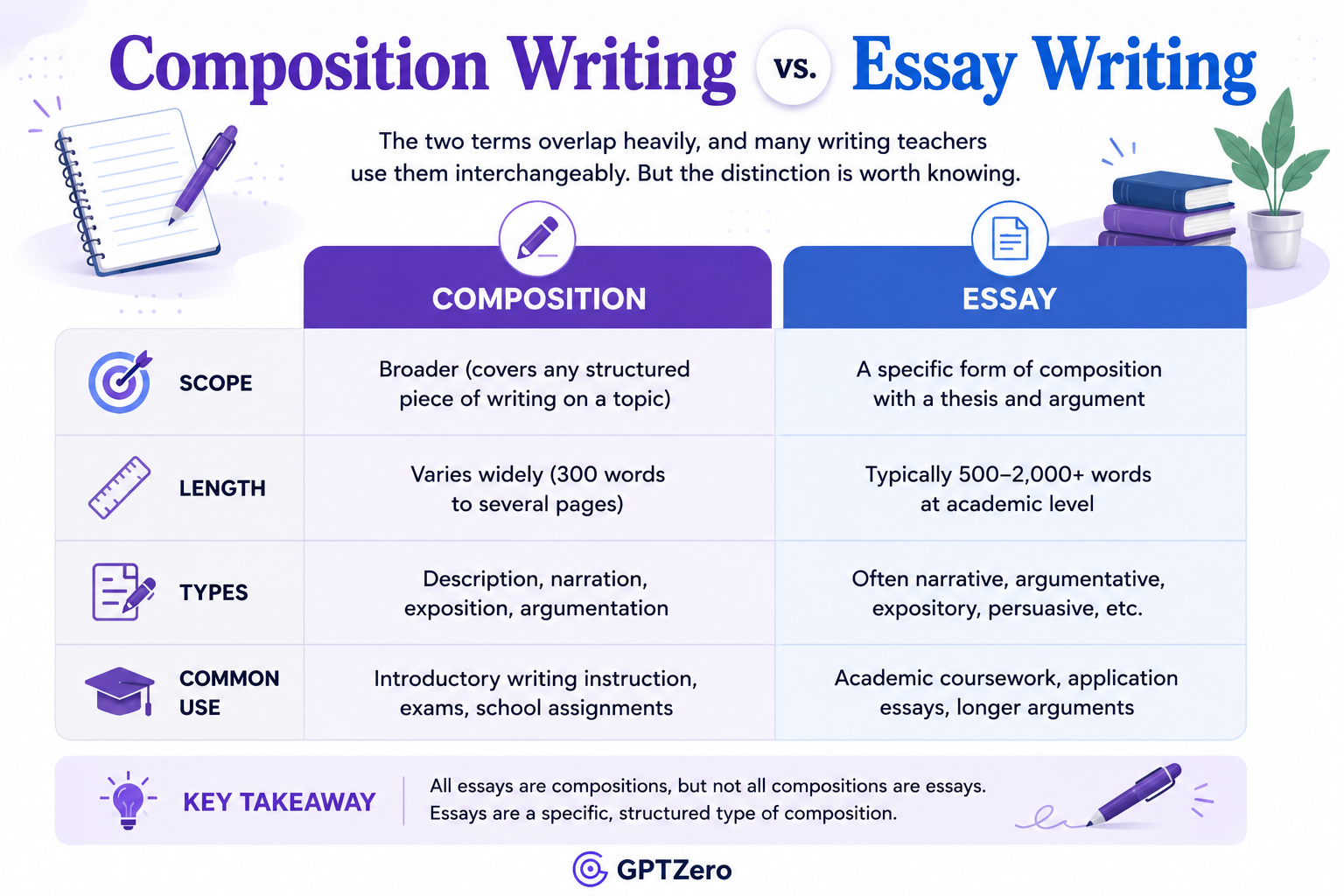
Composition Writing vs. Essay Writing
The two terms overlap heavily, and many writing teachers use them interchangeably. But the distinction is worth knowing.
For a deeper look at the longer academic form, see our guide on how to write an essay.
Structure of Composition Writing
Most compositions follow a three-part structure: an introduction, connective body paragraphs, and a conclusion.
Introduction
Your introduction should open with a hook that pulls the reader in. Consider using a striking detail or starting with a question. Briefly introduce your topic and end with your thesis statement that announces what the main idea is and how the composition is going to develop.
Body paragraphs
The number of body paragraphs can range, with the standard being three. Each body paragraph develops one main supporting point and opens with a topic sentence. Your body paragraphs should contain evidence, examples, and a clear link to your main idea or thesis. Pay close attention to the transitions between ideas and paragraphs. Remember, a composition is about how you put things together, so a clear and logical flow is important.
Conclusion
Your conclusion will restate the thesis in light of what you have discussed in your body paragraphs. In this area, you can briefly summarize the main supporting points of your composition and leave the reader with the final thought. You can talk about the wider implications or a question worth thinking about.
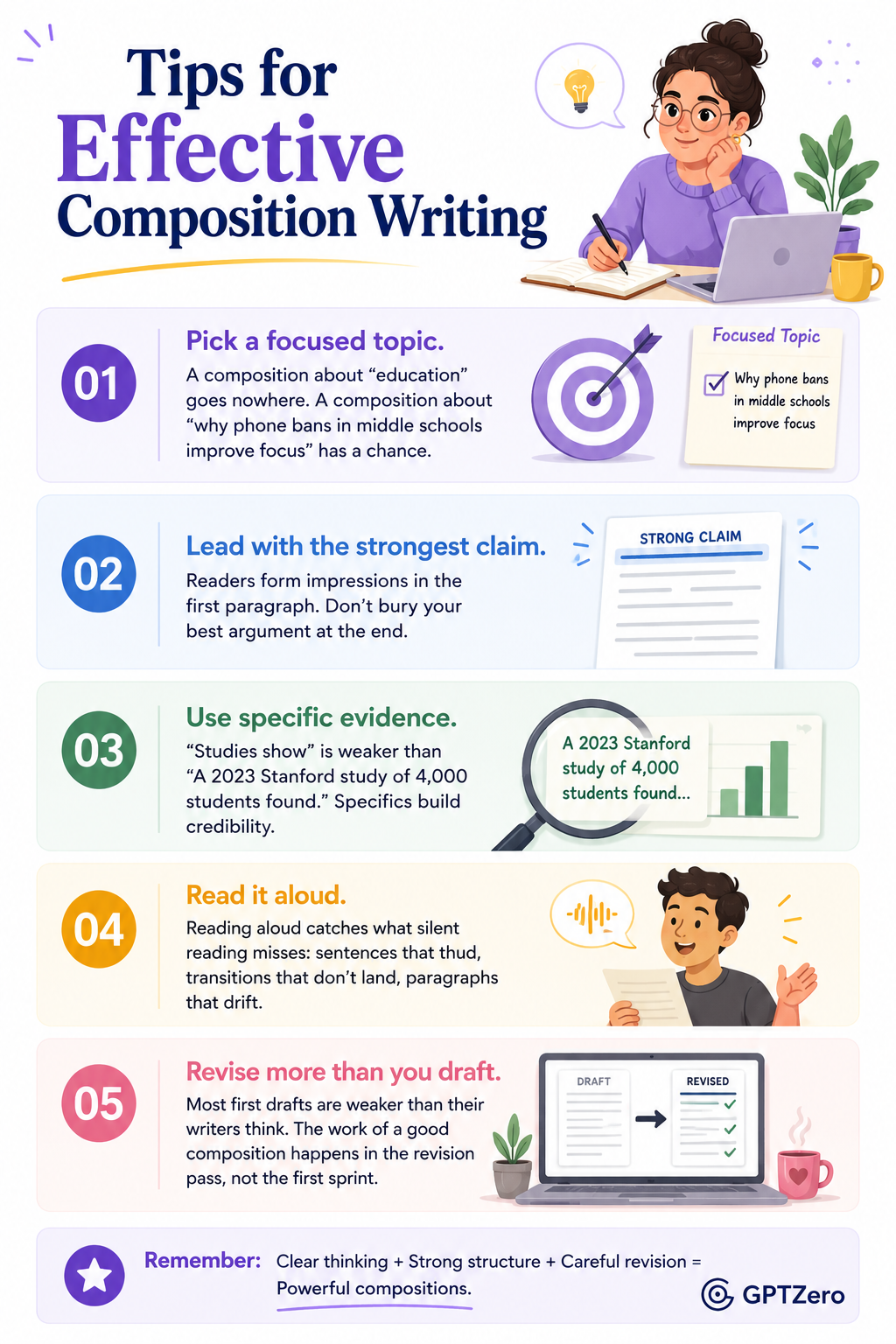
Tips for Effective Composition Writing
How to Write a Composition: Step-by-Step Guide
Step 1: Understand the Prompt
Because the term composition rating can refer to many different types of formats, always read your assignment slowly and make sure you understand what is being asked of you. A good way to gain clarity about what you're being asked to do is to underline the verbs in the assignment brief. You will notice common words like describe, explain, compare, argue, and analyze.
Step 2: Research and Gather Ideas
The best place to start a composition is by gathering your thoughts, source materials, and references. Read broadly and don't overcommit yourself to your thesis. It is normal to change course as you gain more knowledge. If you're using AI as a brainstorming partner to help you surface citations or studies, use AI Source Finder to confirm the references before you include them in your final composition or build arguments on them.
Step 3: Develop a Thesis
A clear thesis is a prerequisite to a successful composition. Your thesis should make it clear to the reader what your composition is going to be about and, if relevant, what your stance is on the topic. A great way to test whether your thesis is strong is to ask yourself whether a clear counterargument is possible. If you're not immediately able to argue the exact opposite of your thesis, then your statement is probably too vague.
Step 4: Build an Outline
Your outline is scaffolding against which your composition will stand. Make sure you list out all the main points you're going to make, all supporting evidence you're going to need, before you begin writing your draft.
Step 5: Write the Draft
Compositions vary in length, but for the most part, you should be able to complete your first draft in one to two sittings. We recommend that you don't linger too long on edits as you're writing. Draft straight through and worry about the polish later.
Step 6: Revise for Big Ideas
Your first round of revisions is for the structure of your draft. The goal is to make sure that everything flows in a logical, orderly fashion. Is the argument coherent? Do you need to rearrange the order of some of the body paragraphs? You may also find that some sections need additional information, while others may need to be cut.
Tip: It is common during the stage of the writing process to cut and paste sections from research from previous drafts and notes you might have taken on the side. The line between what you've written and what can be attributed to AI or another author can get blurry. Scan your work through a reputable AI detector to check for AI-generated text before submitting.
Step 7: Edit and Run Final Checks
Now that the structure and flow of your composition are set, it's time to clean up typos and awkward phrasing. A grammar checker scan can handle that surface polish.
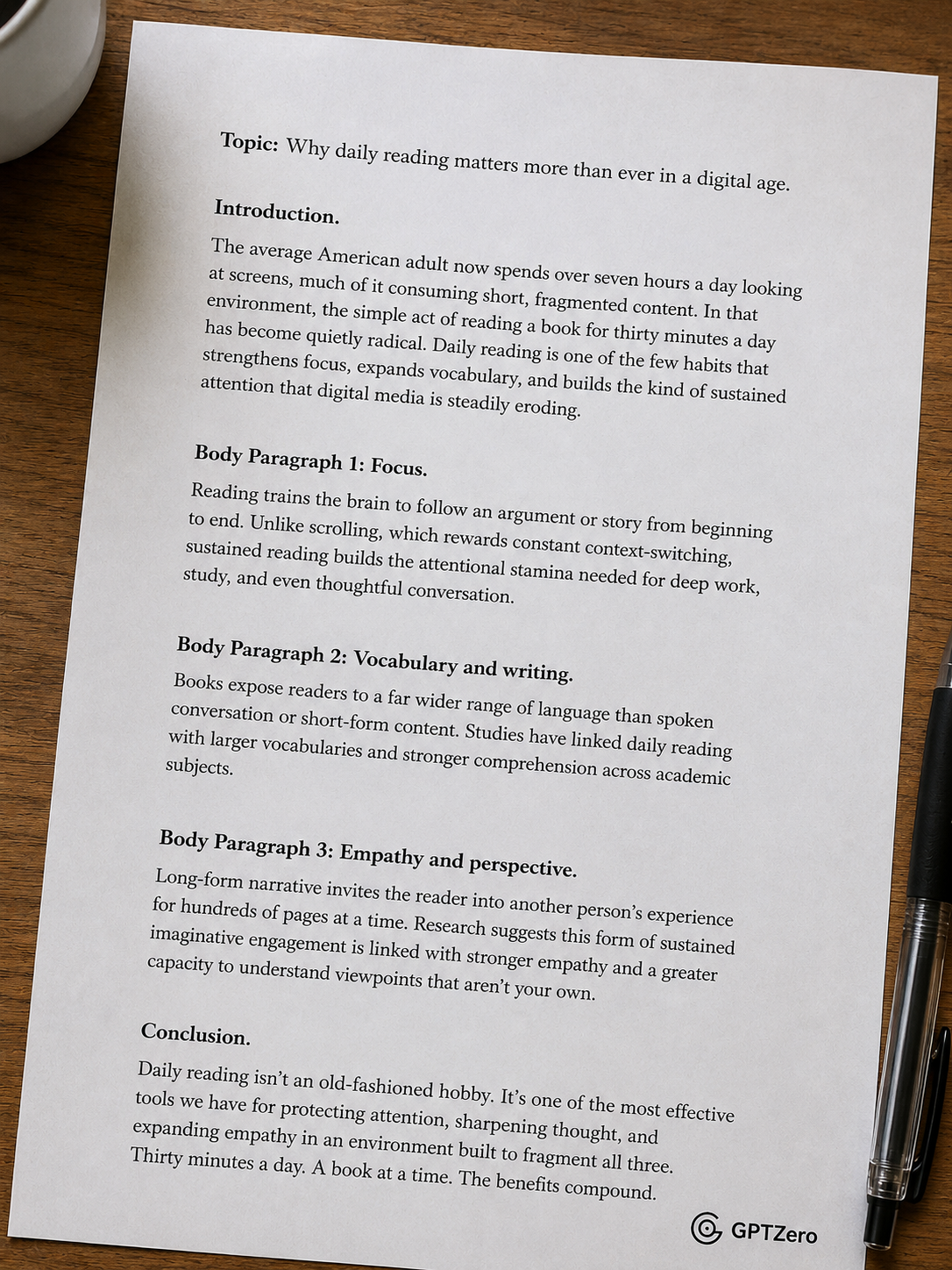
Composition Writing Example
Here's a short, complete example following the standard five-paragraph structure.
FAQs
When do you write a composition?
Think of composition writing as a skill rather than a particular format. It will show up in your academic life as part of examinations, English assignments, college applications, and more.
How do you start a composition?
Start with a statement that grabs the reader's attention immediately. Student essays often use a surprising statistic or a direct question. Briefly introduce the topic to the reader and end your introduction with your thesis statement.
What are the four main types of composition writing?
Compositions fall into four classical types. The description type paints a vivid picture of a subject. The narration type tells a story to illustrate a point. The exposition type explains a topic or a process. The argumentation type defends a position or stance. Most academic assignments will combine multiple types.
How long should a composition be?
Since composition refers to a type of writing rather than a specific format, compositions will range depending on the level you are at. Primary and middle school composition can be anywhere between 200 and 500 words. High school and college can range from 500 to 2,000 words.