AI Detection Glossary: Key Terms Explained
Knowing how to talk about AI detection is only becoming more necessary, as AI-generated content continues to grow.


According to Graphite.io, the number of primarily AI-generated (50%) articles published on the internet is now equal to the number written by humans (50%). Yet although AI writing is becoming part of daily life, the language around it can be confusing.
This glossary explains key AI detection terms in plain English, so you can make more informed decisions around AI and authorship. By the end, you’ll understand the meaning behind common AI detection terms, as well as what detector scores can and cannot tell you.
TL;DR
AI detection terms can be hard to understand, especially when tools use similar language for different parts of the process. This glossary explains some of the most common AI detection terms in plain English. Ideally, any AI detector scores need to be reviewed alongside human judgment. You can use this guide to better understand the jargon around AI so as to make more knowledgeable decisions about AI use in writing.
1. AI-assisted writing
AI-assisted writing is text that has included some help from an AI tool, but hasn’t been completely written by AI. For example, AI might have been used to create an outline or to check grammar, while the author themselves still did the bulk of the heavy intellectual lifting.
The process is becoming just as important as the final draft. GPTZero’s Writing Replay can help reveal the process of putting a document together, as it provides a recording of how the document came to be.
2. AI checker
An AI checker is a tool that analyzes whether a document was likely written by a human, AI or a mixture of both – although the results are one signal as opposed to definite proof. There are a number of AI checkers available.
3. AI checker extension
An AI checker extension lets users check writing directly in the browser, which can be helpful for teachers reviewing student submissions, as it saves copying and pasting from one window to another.
GPTZero’s Chrome Extension does this, and brings AI detection, citation checks, live essay feedback, and writing replays directly into Google Docs and your workflow.
4. AI detection
AI detection breaks down how text is written, to see whether it was created by a human or an AI. It searches for patterns like how predictable the writing is (called perplexity) and how much it varies in length and tone to look for the difference between natural human expression and AI’s more generic style.
5. AI detector
An AI detector can identify whether a piece of text is likely to have been generated by AI. There are lots of different models, using different datasets and technology, which is why results can vary. No detector is perfect as they can make mistakes, especially with short, edited, or mixed pieces of writing.
We’ve done some comparisons including GPTZero vs. Turnitin, GPTZero vs. ZeroGPT and Copyleaks vs. GPTZero, as well as a list of the best AI detectors.
6. AI-generated text
AI-generated text is writing that was created by a generative AI tool, and it has a fairly recognizable tone as it tends to be polished and a little vanilla.
Here’s a sample from ChatGPT:
“Gravity is the force that pulls objects with mass toward one another. On Earth, it is what keeps your feet on the ground, makes a dropped apple fall, and holds the Moon in orbit around our planet.”
One of the main risks of AI-generated writing is that it can contain unsupported claims or sources that do not exist – as we explore in the next item.
7. AI hallucination
An AI hallucination is when an AI system produces information that sounds plausible but is fake. These can be fake facts, fake statistics, fake summaries or fake sources.
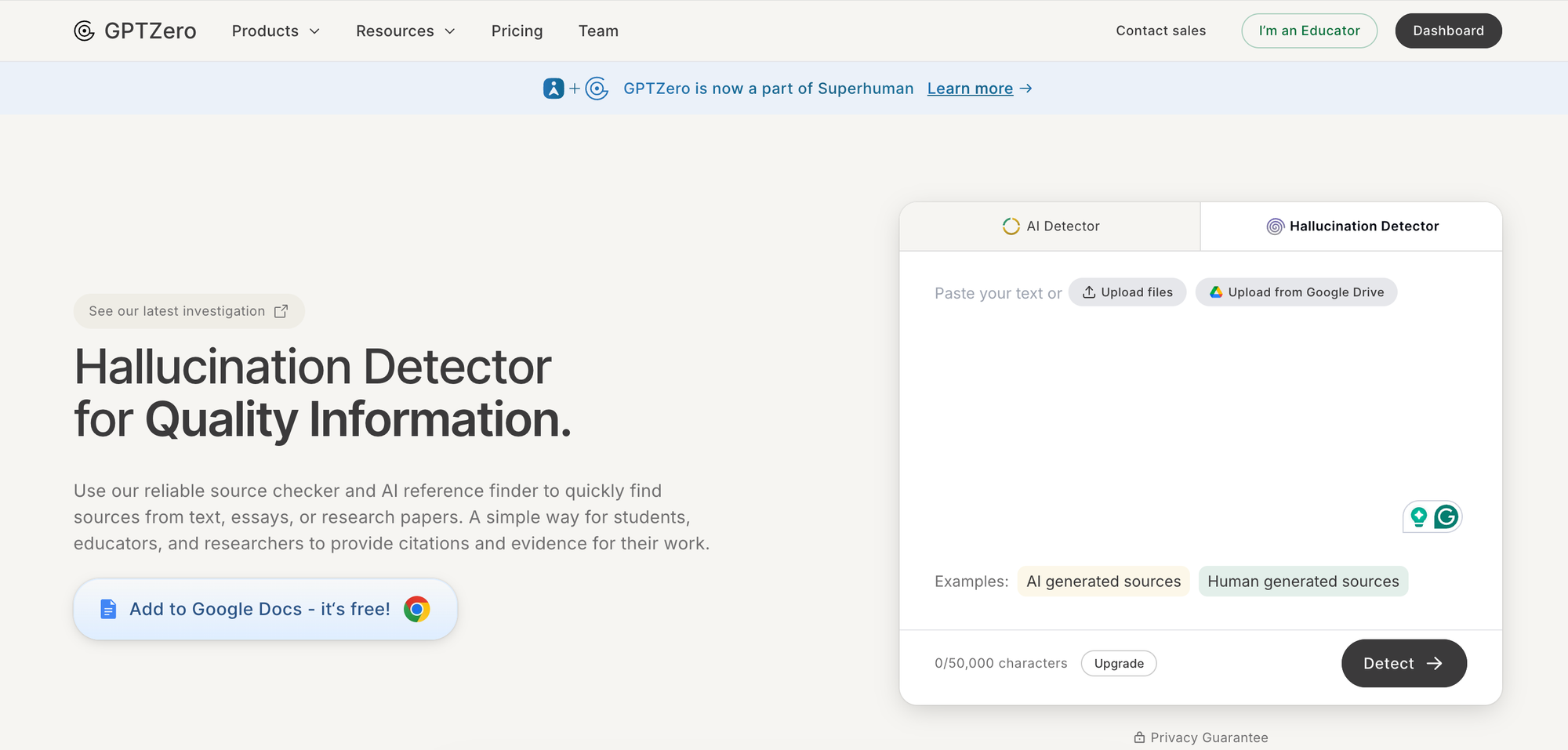
GPTZero has a hallucination detector to automatically detect hallucinated sources and poorly supported claims in essays.
8. AI humanization
AI humanization is the process of editing AI-generated text in an attempt to make it sound more natural, although many AI detectors (including GPTZero) have now updated their models to catch this paraphrased type of text.
While humanization is intended to “improve” a text by integrating supposed originality or clarity, it often falls short.
9. AI humanizer
The tool for AI humanization is an AI humanizer. Essentially, as AI detection has become more prominent, people using AI to generate work have tried to find new ways to disguise their LLM use – which is where an AI humanizer comes in.
It is a tool that is meant to scramble and paraphrase AI-generated text to make it sound more human, but they are often not successful at bypassing AI detection. For example, taking the gravity example we used earlier (in #6), after running it through a humanizer, this is what it came back:
“Gravity is a force that attracts objects with mass toward each other. On Earth it keeps your feet on the ground, makes an apple fall when dropped and keeps the Moon in orbit around our planet.”
10. AI polished
AI polished is a tag that identifies text originally written by a human and later refined or edited by an AI tool. It might have been run through an AI tool to improve grammar, rephrase sentences, or enhance clarity. In other words, the core ideas and structure are the student’s own work, but AI was used as an editing assistant.
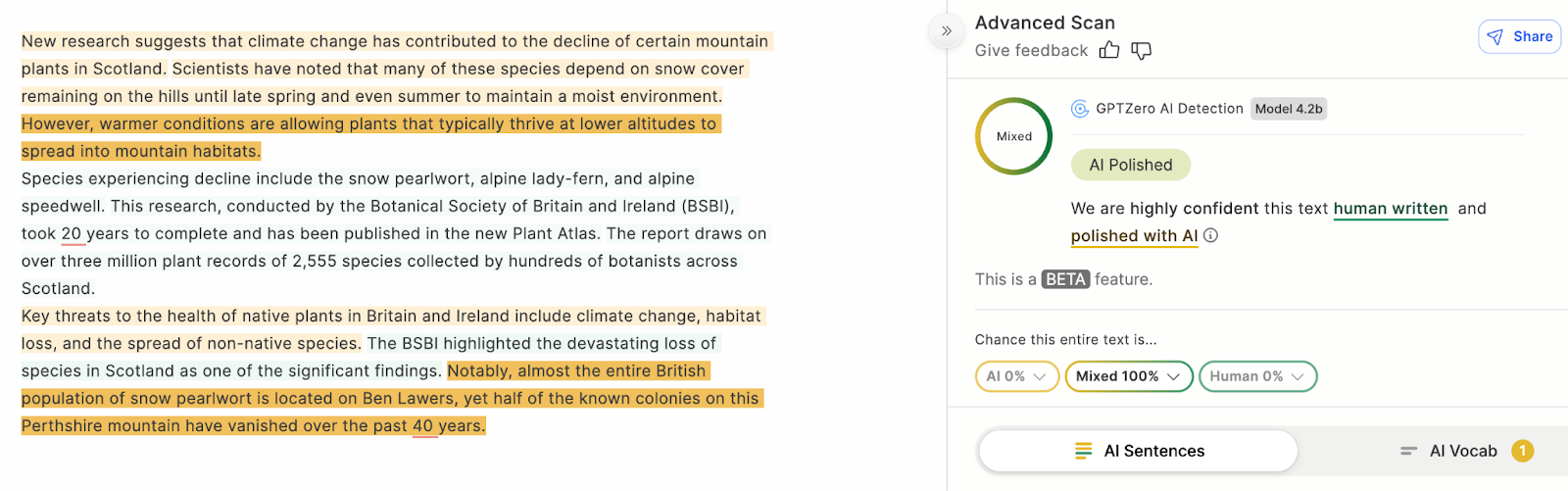
The classification was introduced by GPTZero to bring higher granularity in our AI detector, as part of our commitment to building the most transparent AI Detector and enabling responsible AI use.
11. AI probability score
When it comes to the likelihood of a piece of writing being generated by AI, this is described by an AI probability score, which is often a percentage. It’s important to remember that a high score doesn’t automatically mean AI has been used, just like a low score doesn’t mean AI wasn’t used.
For more on this topic, see: How do AI checkers work?
12. Authorship
Authorship is who is behind a piece of writing, and responsible for the ideas and the words. This is an area that has become more tricky with AI because AI can be used in the outlining or the proofreading phase, making it harder to tell how much of the final product is truly the writer’s own thinking.
At GPTZero, we’re not about “catching students.” Instead, we work to ensure responsible AI use in education and beyond. With our educational partners, we will always promote a collaborative approach over a punitive one. Our AI checker for students can help students review their work before submission.
13. Burstiness
Burstiness is the variation in sentence length and structure. While human writing often has more variation (high burstiness), AI writing can sometimes feel more bland and generic (low burstiness). Burstiness is not an automatic tell but is just one potential signal of AI-generated text.
14. Citation verification
Citation verification means checking whether references and sources and quotations are accurate. AI can often come up with citations that seem convincing but are incomplete or false.
You can use GPTZero’s source finder to quickly find sources from text, essays, or research papers. It's a simple way for students, educators, and researchers to provide citations and evidence for their work.
15. Classifier
A classifier is a system sorting text into categories, and in AI detection, this can predict if a document is human-written, AI-generated or a blend of both. Some tools also show sentence-level results, highlighting which exact parts of a document could be questionable.
16. False negative
A false negative is when AI-generated writing is wrongly classified as human-written, when in fact it should be labeled as AI-written. When AI text has been massively edited or mixed with human writing, this can happen, and it’s a key reason why no detector score should be treated as gospel.
17. False positive
A false positive happens when human-written text is incorrectly flagged as AI-generated, and it’s a huge concern in classrooms. A false accusation can ruin academic credibility.
If you’ve been flagged for AI cheating, even though you wrote everything yourself, this guide shows how to respond by gathering the right evidence, as well as using GPTZero’s Writing Report to prove your authorship.
18. Generative AI
Generative AI refers to AI systems that can come up with new content, which can include writing, such as essays, summaries, and reports. While the final output can sound polished, it can lack depth or originality.
19. Grammar checker
A grammar checker reviews writing for punctuation and spelling and is different from an AI detector, because its main concern is improving the writing itself, instead of trying to decide who wrote the text.
20. Hallucinated citation
A hallucinated citation is a fake reference produced by an AI system, which can look very real, but is in fact something that does not exist. It’s become a serious risk not only for students but also for professionals.
Over the past year, a team of GPTZero investigators has used our Hallucination Check tool to uncover hallucinated citations in government reports, academic papers submitted to prestigious conferences like ICLR and NeurIPS, and research products from two of the big four consulting firms: Deloitte and Ernst & Young.
21. Human review
Human review is the process of an actual human looking over writing before making a judgment, and ideally means taking a detector’s score but combining that with a human understanding of a student’s drafting process and history. We’ve also said that AI detection works best when it supports human judgment, and should not replace it.
22. Human-written text
Human-written text is writing created by a person based on their own thinking and in their own words. As the University of Cambridge says:
“Writing is not simply about ideas, it is about the struggle to articulate them… This process of drafting, revising, and rethinking is the very essence of writing. Outsourcing it to an LLM risks losing the discovery, nuance, and transformation that come from wrestling with words yourself.”
23. Large language model (LLM)
A large language model, often referred to as an LLM, is an AI system trained on large amounts of text to generate language. These predict likely patterns in language, yet do not have the same level of understanding that a person does, which is why they can come up with answers that sound confident but aren’t always fully accurate.
24. Mixed writing
Mixed writing is text that has been both human-written and AI-generated, and it is becoming more common. For example, a student could use AI to get feedback on an essay and rewrite a paragraph, but then add their own conclusion.
Mixed writing is tricky to detect, but GPTZero was the first detector to provide confidence categories for our classifications: “uncertain,” “moderately confident,” and “highly confident.” These categories are tuned so that the average error rate is less than 1% for the “high” confidence predictions, based on a diverse evaluation dataset used internally that was never before seen by the model.
25. Online plagiarism checker
An online plagiarism checker compares writing against existing sources to identify copied or closely matched text, which is different from AI detection as text can be AI-generated without being plagiarized, and can also be human-written but still plagiarized. The tools exist for different reasons as they address different questions.
Our free plagiarism checker scans essays, research papers, or code, highlights matches, and provides easy-to-read plagiarism percentage reports.
26. Paratext
Paratext is the text surrounding the main part of a piece of writing. Examples of paratext include headings, URLs, and front matter. Since these are often easily edited (as they can be quite formulaic), they are often best left out when assessing the authorship of a piece of writing.
Similar AI Detection Terms: What’s the Difference?
FAQs
How do AI detectors work?
AI detectors work by analyzing how text is written, its wording, rhythm, and structure, to figure out whether it was created by a human or an AI. They look for patterns like how predictable the writing is (called ‘perplexity’) and how much it varies in length and tone (called ‘burstiness’) to spot the difference between natural human expression and AI’s more uniform style. No detector is perfect as they can make mistakes.
Can AI detectors be wrong?
Yes. AI detectors can produce false positives and false negatives, and this is why a detector score should not be treated as proof on its own. At GPTZero, we share the results of a comprehensive evaluation of our AI detector openly and transparently. Evaluations are updated quarterly. We believe that greater transparency will both increase the rigor and credibility of the industry and reveal what we already know: that GPTZero’s detector is the most accurate solution available.
What should students do before submitting work?
Students should make sure the final submission reflects their own thinking, which can include making sure they've actually answered the question being asked, and checked their sources. We recommend checking out our AI checker for students, grammar checker, source finder and online plagiarism checker.