How to Write a Great Elevator Pitch in 5 Simple Steps
An elevator pitch is a short, polished introduction that highlights who you are, what you’ve accomplished, and where you’re headed. Learn how to craft a compelling pitch that makes a strong first impression and starts a conversation.


“So, tell me about yourself.”
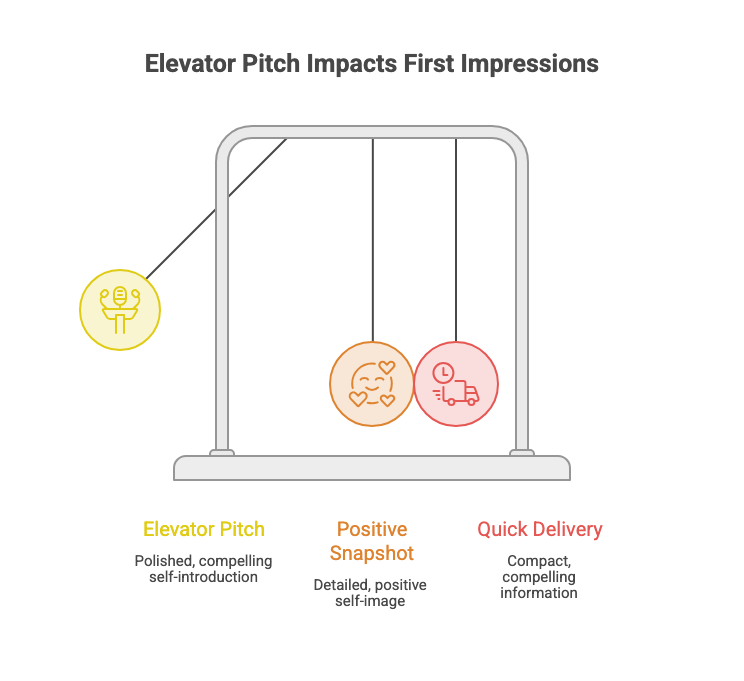
Do you have an answer ready? An elevator pitch is a small, useful speech to prepare for just such an occasion. It delivers compact and compelling information about you in the same amount of time as an elevator ride (okay, a long elevator ride). By preparing a few highly polished sentences ahead of time, you can quickly give people a detailed and positive snapshot of who you are and what you hope to accomplish.
This guide walks you through the details and features of a compelling elevator pitch so you can craft and perfect a short, punchy speech that highlights your strengths and objectives. Read on for a 4-part template and 5 simple steps to help you write an impactful elevator pitch.
What is an Elevator Pitch?
An elevator pitch is a short, professional introduction. It’s usually around 30-60 seconds long and meant to help you start a meaningful conversation. An elevator pitch helps you deliver a first impression in a number of work-related and academic contexts, including:
- Meeting with new collaborators
- Networking at a conference
- A conversation with potential funders
- At a job interview to advance your professional career
- Recruiting new talent to your team.
An elevator pitch addresses your present, your past, and your future; it tells the listener who you are, what you’ve done, and what you’re interested in doing next. An undergraduate student at a career fair or a networking event might make a pitch like this:
“Hi, I’m Jordan, a junior majoring in Political Science at UNC. I’ve interned with a local nonprofit focused on housing policy, and I’m hoping to explore careers related to public service or law after graduation.”
This gives the listener an immediate understanding of where this person is at in their career trajectory, what relevant experience they bring to the table, and how they’re hoping to move forward into the next stage of their professional journey.
4-Part Template for an Elevator Pitch
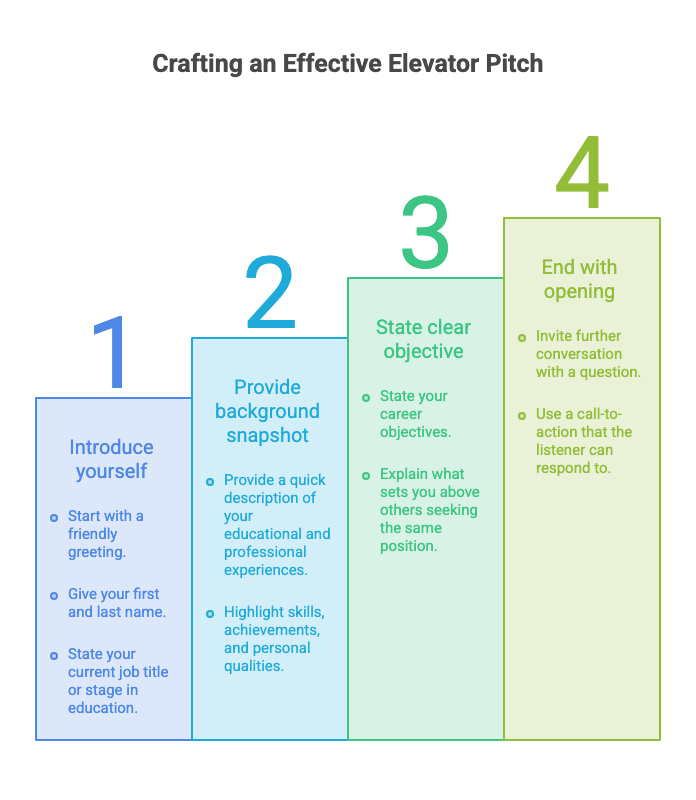
An elevator pitch should accomplish four key things. It needs to introduce you; give a snapshot of your background; state a clear objective; and end with an opening for further conversation.
Introduction
Start with a friendly greeting. Give your first and last name, and your current job title (or most recent and most relevant job title) or your stage in education (e.g. sophomore at X University, or 2nd-year PhD candidate in X department).
Background
Provide a quick description of your educational and professional experiences. Highlight the skills, achievements, and personal qualities that make you a valuable asset to future jobs, projects, etc.
Objective
Be clear about your goals. State your career objectives and what you think you can offer that sets you above others who might be seeking the same position.
End with an opening
An elevator pitch is meant to fast-track you into a meaningful conversation, not end with a “goodbye.” Invite further conversation with a question – it’s often a good idea to prepare this question in advance to show that you’re well informed and interested. Another way to end the elevator pitch is with a call-to-action that the listener can respond to, allowing them to dig further into the conversation with you.
Try out the University of North Carolina at Chapel Hill’s elevator pitch worksheet for help identifying and arranging the parts of an elevator pitch.
How to Write Your Elevator Pitch in 5 Simple Steps
Princeton University outlines five steps to creating an elevator pitch and provides a sample format to fill in.
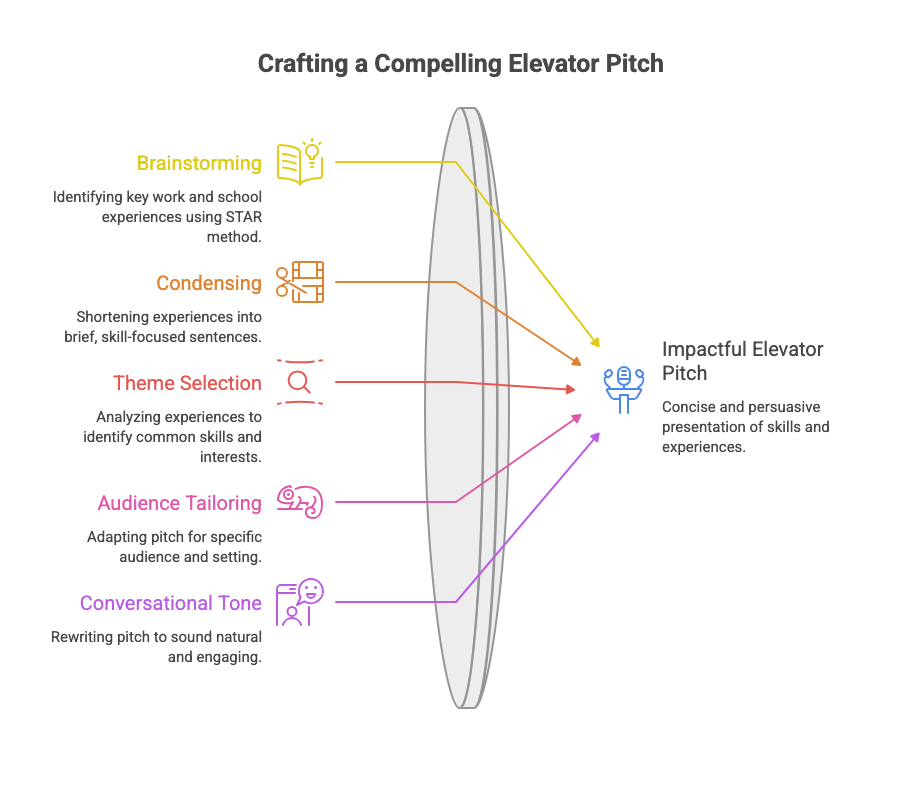
Step 1: Brainstorm
Write down your top work and school experiences. Use the “STAR” method to structure how you describe your experiences:
Situation: Give brief details about the situation so the listener understands the context.
Task: Identify the task you undertook or the goal you were striving toward.
Action: Describe the actions you took to perform the task. Highlight your skills and character traits that contributed to your performance.
Result: Explain the positive outcomes of your efforts. Highlight quantifiable results and metrics, and point out what you learned and took away from the experience.
Tip: Give Grammarly details about your history and accomplishments, and it can draft you an elevator pitch.
Step 2: Condense
Take the experiences you fleshed out in the first step and shorten them into one or two sentences each. Be as brief as possible, but do not omit the skills you applied and learned, or the measurable benefits that resulted from your work.
Tip: This is a good stage to use a grammar checker or an AI tool for writers – you can adopt their useful suggestions and corrections and then fix any “robotic” phrasing in Step 5.
Step 3: Select themes
Review the experiences you’ve illustrated through Steps 1 & 2 and analyze common themes that connect across experiences. Ask yourself:
- What are you good at?
- What do you enjoy doing?
- Are you a problem solver, analytical thinker, effective communicator, innovator, etc.?
Step 4: Tailor to the audience
Remember that you’re always pitching to someone. Tailor your elevator pitch for the audience you’re addressing and the setting in which you’re doing so. The pitch you give in a job interview should be highly formal and targeted at the job description and the interviewer. A pitch you give at a post-conference drinks event with colleagues will be less formal and probably less specific.
As you’re drafting, look to hit about 75 to 85 words and include key details about yourself.
Step 5: Make it conversational
Rewrite what you’ve drafted so that it sounds spoken, not written. Speech styles vary, and you should follow your personal preferences for how to prepare; some people find that practicing their pitch over and over makes it flow more naturally, while others prefer to leave space to ad lib and adjust as they go. Play to your own strengths and bring your personality into the mix.
Avoid clichés, jargon, and personal details. Be specific about your skills and attributes rather than rehashing overused and imprecise terms like "hardworking" or “personable.” But don’t get too specific with jargon and industry-specific terms: a general rule is to speak at an 8th-grade level.
Strike a balance between personable and professional; be approachable and friendly in your delivery, but avoid bringing up your hobbies and interests. Save that for a follow-up conversation after you’ve impressed and intrigued your audience with your perfectly polished elevator pitch.