What “Humanize” Actually Means (and Why It Won’t Help Your Writing)
While humanizer tools make a lot of big promises, the reality is that they often weaken your writing quality


As the anxiety spikes around getting flagged for AI-generated writing, so too does demand for “humanizer” tools. In HEPI’s 2026 student survey, 95% of students reported using AI in at least one way and 94% said they use generative AI to help with assessed work. As AI-assisted writing goes from the exception to more like the norm, there has come a new second wave of tools designed to make AI-generated text appear more human.
But these tools rarely improve the quality of the writing itself. While it can be tempting to use them when you’re feeling pressured by deadlines and the fear of getting caught by an AI detector, they’re not worth it. In this guide, we'll look at what “humanize” actually means, why humanized text can definitely still get detected, and what really lifts the quality of your writing. After reading this, you’ll know why humanizers fail and how to improve your writing in the long run.
TL;DR
Humanizer tools exist to redo AI-generated text so that it allegedly sounds less like AI, but in reality, they do not automatically make the writing sound more human, and more often than not, they just make the writing sound more confusing. If you want to improve your writing, it’s best to focus on editing at the idea level rather than the surface level, as well as getting specific with your examples and reasoning.
What “Humanize” Actually Means
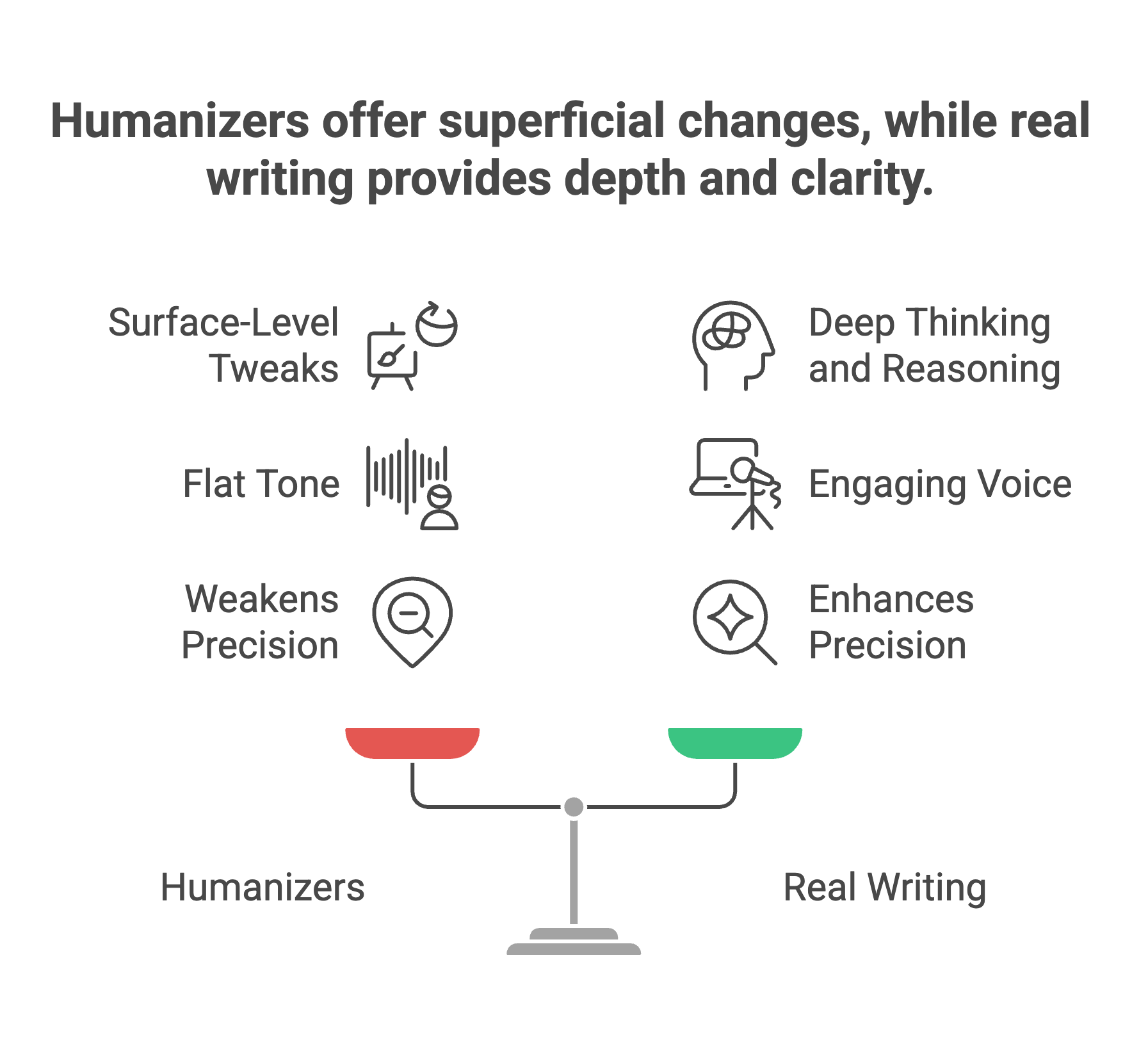
Humanizers describe themselves as “making your writing appear more natural” so that it doesn’t get flagged by AI detectors. However, all they really do is swap out words and vary the sentence length, and it’s a very surface-level set of tweaks to the text.
In other words, humanizing does not materially improve your writing, because it doesn’t deepen the insight of a piece, make its narrative more cohesive, or add the original insights or examples that only a human writer can. It changes the appearance but not the fundamental substance of a piece.
As one grad student told us, “The humanizer tools don't do a good job, as when they paraphrase or they write it in a different way, the work tends to lose meaning – they replace the specific words that are being flagged with other terms. And then when you read the work, it's totally something else and not what you wanted to get from it."
Why “Humanizing AI Content” Became Popular
Humanizers became popular because they are a form of pain relief: when you’re anxious or overwhelmed, a shortcut can seem very appealing. Instead of doing the heavier thinking, it can be tempting to just wave a magic wand to make the task go away. To understand how humanizers became so common, it’s useful to remember several developments.
After more students started leaning on AI for brainstorming and rewriting, another market cropped up to “clean” the parts that still sounded too AI-like. HEPI’s survey data shows how normalised generative AI use has become in education, and with that, comes a new series of hacks and workarounds.
Then came a more heightened collective anxiety around AI detectors, with more and more students looking for plausible deniability. While some humanizers promise to make content “undetectable” and lower AI scores, or bypass detection altogether, those claims massively oversimplify how AI checkers work and how writing is judged.
There’s also more of a shortcut mentality: if, suddenly, there’s a tool like ChatGPT that can churn out your assignment for you, why not use another one to humanize it afterwards? It’s flawed logic, but there’s more of a culture emerging around solving things through shortcuts, which is the heart of the issue.
Why “Humanizing” Doesn’t Improve Your Writing
@thehybridprofessor Stop using humanizers for writing your thesis unless you want to get caught! #studytok #chatgpt #thesishelp #collegelife #studyhacks
♬ original sound - Maria AF| AI & Tech for work
Humanizers sell themselves as a way to use AI tools without getting caught, but the truth is that they can slice up your writing to the point where it doesn’t make any sense. As one student told us, “Sometimes if you try and humanize it, sometimes they'll go completely off what you're trying to say and it'll just try and make its own sort of stuff up.”
As Elizabeth Oommen George, Associate Director of Content at Paperpal has emphasized: “AI humanizers do not enhance academic quality. While AI humanizing tools can change the phrasing, they do not improve the quality of your work.” Instead, this is what humanizers tend to do:
Make surface-level style tweaks instead of improving the actual thinking
Strong writing is about using reasoning and evidence to make an original point, and this isn’t something that humanizers do. Instead, they move words around in a sentence to change how it sounds. Tweaking the rhythm of how a paragraph is structured doesn’t help you answer the question in a better way.
You’re not getting encouraged to look at a counterargument, hunt down a stronger piece of evidence, or really question an assumption you've made. Sure, the sentence might read differently afterwards, but if the thinking behind it is photocopied, a human reader who is paying attention will notice.
Does not optimise for human readers
Humanizer logic works around common perceptions of what AI detectors are looking for (a flat tone, repetitive words, and predictable phrasing, to name a few). But to a human reader, writing made to look “less AI” doesn’t necessarily read more fluently or effectively.
The questions a human reader is asking reach way deeper than tone: Is the argument accurate? Does it land? Does it say something original, or move through the motions of acting like it’s saying something without doing so?
Creates fake “human signals” for voice
With any strong writing, there’s a perspective that makes it memorable. Humanizers try to imitate human writing by using contractions (isn’t instead of is not, for example) and attempting to make flat writing sound more conversational in that sense. But just because some apostrophes are adjusted here and there, that doesn’t give the writing a point of view.
Voice comes from that unique point of view, which arises from intentional choices about what to say and what to leave out. This is something only a human writer can provide the piece.
Weakens precision
This is especially important in academic or technical writing, where evidence often backs up the core argument. When you use a humanizer tool, those rewrites can accidentally swap around the meaning of certain points by softening claims, or inserting synonyms that are less exact.
For example, in a scientific write-up, changing the word “suggests” to “demonstrates” can seem minor but changes the meaning significantly. Or in a legal essay, a tiny change in phrasing can ruin an entire line of reasoning. Humanizers don’t understand nuance and they can damage (not enhance) the credibility of your work.
Why Humanized Content Still Gets Detected
One of the main reasons humanizers exist is because of the (false) idea that after a text has been jumbled upon through paraphrasing enough, it becomes undetectable to AI detectors. However, that isn’t true and it’s not how the strongest AI detectors work.
As Edwin Thomas, machine learning engineer at GPTZero shares, “Modern paraphrasers (both open and closed source) are designed to rewrite AI text to sound more ‘human-like’ and diminish AI writing signals by reducing statistical patterns commonly found in AI generated text.”
However, he adds, “Our detector is built with adversarial robustness in mind. We have always treated AI Detection as a continuously evolving problem — improving our models and training strategies to detect more than just standard AI outputs.”
He makes it clear GPTZero remains strong at identifying LLM texts that have undergone humanization attempts. “We have built and maintained internal systems to simulate adversarial attacks on our model… [which] is then trained to focus on deeper semantic and structural signals beyond surface form to effectively tell AI paraphrasing attempts from purely AI generated text.”
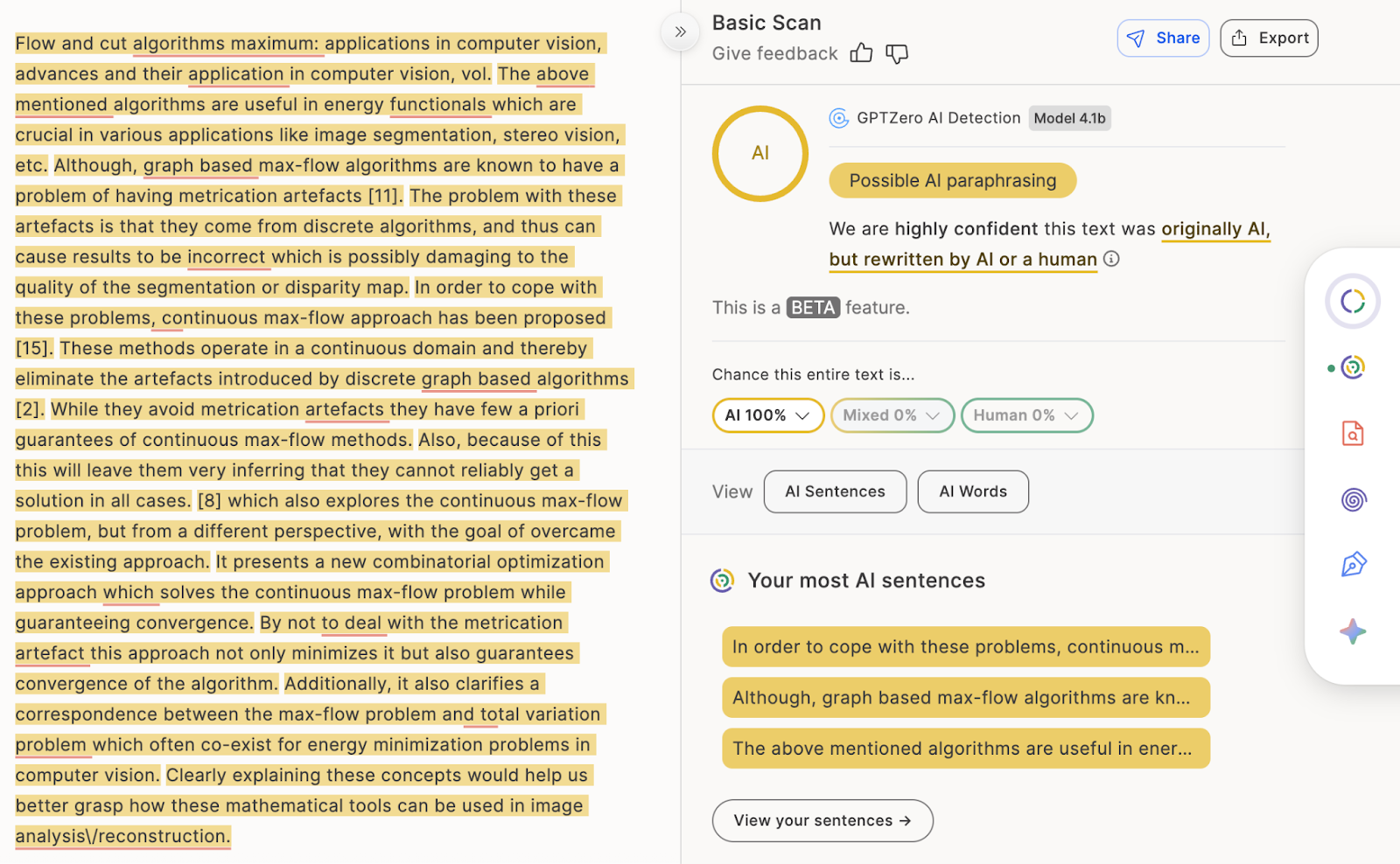
Want to check whether your work sounds like AI? Run it through GPTZero’s AI detector to review it at the sentence-level, giving you a better starting point than relying on a humanizer.
What AI Humanizers Actually Do Behind the Scenes
Most AI humanizers work by combining several of the following, which address the surface of the writing as opposed to the substance itself:
- They replace synonyms: By swapping common words for alternatives, they try to avoid repetition. It’s the most basic form of rewriting and often where true meaning gets lost.
- They restructure sentences: They split or merge sentences, and while this can sometimes improve readability, it can also just as often produce sentences that feel very strange to read.
- They vary the rhythm: They change sentence length to make the writing feel less flat – a short sentence, then a longer one, then another short one.
- They adjust the tone: They add contractions or more casual phrasing to make the writing seem more conversational.
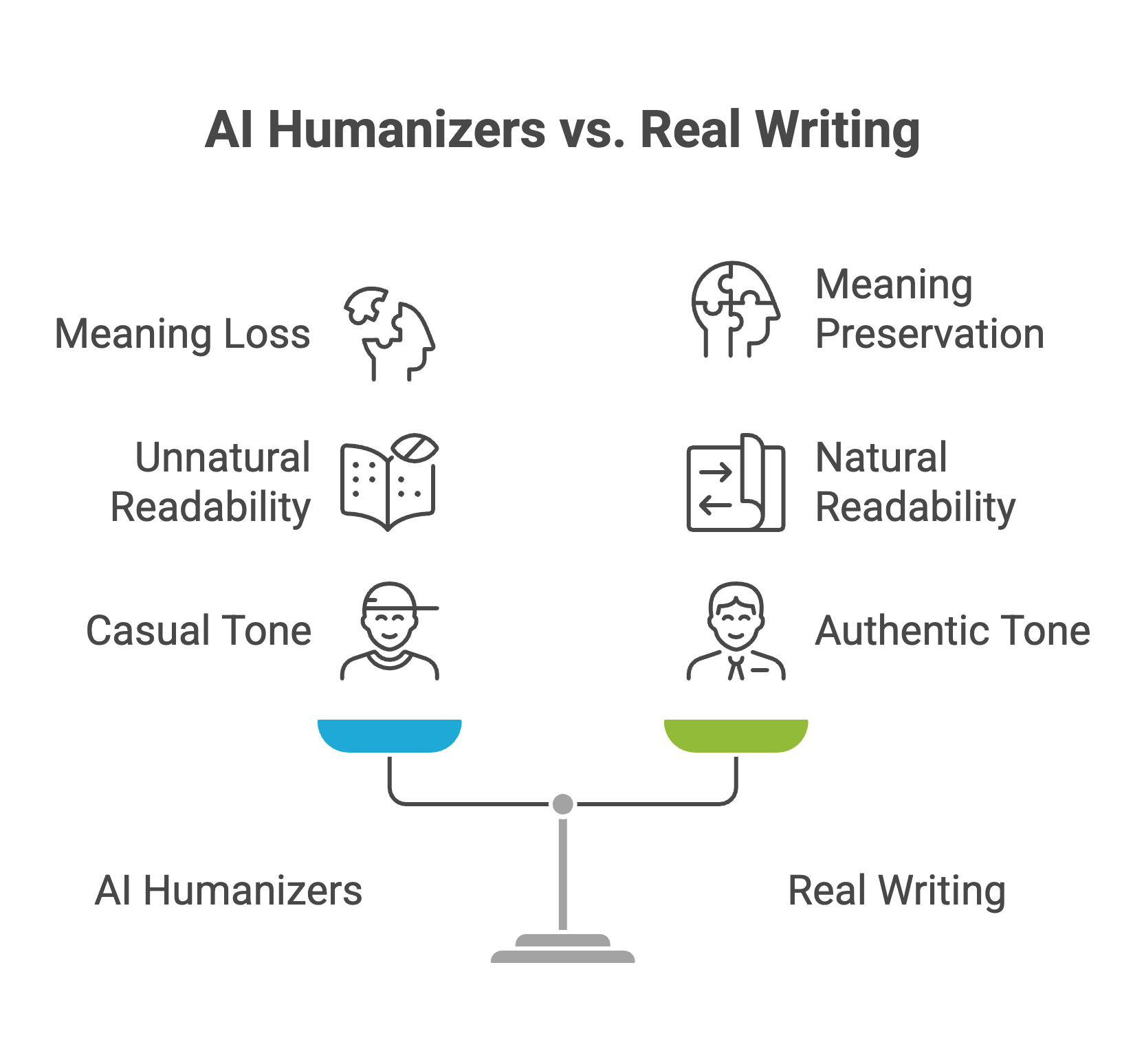
Humanizing vs Real Writing
Common Misconceptions
Myth 1: Paraphrasing is the same as human writing
Paraphrasing is switching up the words themselves (officially, the definition of paraphrase is “a restatement of a text or passage using different words while retaining the original meaning”). Human writing is original thought, while a paraphrased text can still be disconnected from any real meaning or understanding.
Myth 2: Humanized text can bypass all detectors
No tool should promise that, because that isn’t true. AI detectors like GPTZero are trained to spot when text follows the patterns that we know tend to crop up in AI-generated work, whether or not it has been through a humanizer or not.
As tech writer Yelyzaveta Hunchenko notes, “Detection algorithms are constantly being updated, and there are also ethical questions about concealing AI authorship.” A humanizer tool “cannot (and shouldn’t) ever claim to be 100% undetectable.”
Myth 3: The main issue is AI detection
In fact, the main issue is taking shortcuts when you need to engage with the intellectual exercise the assignment is asking you to do. The assignment is meant to help you develop a skill or way of thinking, and a humanized AI submission doesn't help to grow or learn much at all.
Myth 4: Humanizers enhance the voice
While humanizers can imitate some conversational features that come with voice, the actual voice of a piece comes from having a deliberate opinion.
What Really Improves AI-Sounding Writing
Authentic writing, that you have done yourself, is always a stronger choice than using a humanizer. The best way to make your writing sound more like yours is to add in things that only you could come up with – that no large language model could – because it comes from your own personal experience, your own research choices, and your own unique way of thinking through a problem.
One English Department Head told us, “Students need to realize that it's not linear. What AI has done has made them think that writing should be a linear process when it is not at all: there's a lot of jumping and going back and forth. The wrestling with the process is being compromised by AI because they're privileging efficiency.” Taking the time to sit down and read your writing with care and intention, and wrestling with the parts that aren’t working, will improve it in the long term more than anything else.
Insert personal insight or experience
As the flood of AI-generated writing grows, being able to write and think for yourself will become an even more important skill. The way to grow that skill is to include things AI could not: a specific observation, or an experience that affected how you think about the issue, or a link between two concepts that you came up with yourself. This is what makes your writing interesting, not to mention credible and memorable.
Zoom out on the ideas
Humanizers work at sentence level, but good editing works at the level of the whole piece. When you sit with your writing and ask whether it's really answering the question (does the argument build logically? Does each paragraph belong?) then you're doing something that no rewriting tool can do for you. This is where weak writing often falls apart, and also where the biggest improvements tend to happen.
Fact-check the claims
AI can sound very confident, but we’re seeing more and more how it can be factually incorrect. There are well-documented instances of hallucinations where AI cites sources that never existed, and more high-profile cases of embarrassing mishaps in this area. It’s crucial to verify every claim you make, as one false citation in an academic submission can instantly damage the credibility of what is an otherwise solid piece of work.
Conclusion
“Humanize” is sold as a way to bypass AI detectors, but instead, what it usually means is rewriting AI-generated text so the phrasing is less generic and the rhythm is less robotic. However, it doesn’t make the writing any better, plus it doesn’t guarantee the text will avoid detection. Instead of turning to a humanizer app, it makes sense to learn how you make a piece of writing genuinely better – and that includes inserting personal insights and experiences, zooming out on the broader ideas, and fact-checking all claims.
FAQs
Can AI content checkers detect text that has been run through a humanizer?
Yes – paraphrased text can still have the telltale signs of AI generation, and any claims about a text becoming completely and totally undetectable is often exaggerated.
Can AI humanizers handle academic or technical content?
They can rewrite it, but don’t necessarily preserve the intention behind the words well – in specialised writing, small tweaks can end up weakening precision or the intended meaning.
Does humanizing AI text make it better for readers?
No: while it can mix the words sentences around, the overall piece is not guaranteed to be any stronger.
Is humanizing the same as editing?
No, because editing is about taking raw writing and making it more sophisticated: restructuring ideas, making the logic flow, and tightening the argument. Humanizing is a more quick-fix hack.