How to Lower Your AI Score
Getting your work flagged as AI can lead to a lot of wasted time and stress, so here, we lay out how to make sure your writing voice stands out.


If your content has a high AI score, it can be very stressful and can make you feel helpless. To have your work flagged as AI can put your academic credibility at risk and have long-term implications, and can also lead to a lot of wasted time having to cycle through revisions.
The thing to remember is that no AI detector in the world can be 100% accurate, 100% of the time: the truth is that an AI score is just one signal in a broader context. And while having to do an AI check can feel like just one extra thing on top of a full course load and everything else going on, doing one can save a lot of time and stress in the long run.
In this article, we’ll cover how to lower your AI score in both a practical and ethical way. After reading this, you’ll know how to revise your writing so it sounds more like you, while understanding what AI scores can and cannot tell you.
TL;DR
If you want a lower AI score, the key is to make your writing more obviously yours, instead of trying to “beat” the detector. Writing like yourself means using your own ideas, including specific examples, and keeping your writing sounding as human and as natural as possible. The best long-term strategy to lowering your AI score is to make sure you write your work yourself, then revise your work with awareness of how AI detectors rank content.
What Is an AI Score & How Is It Calculated
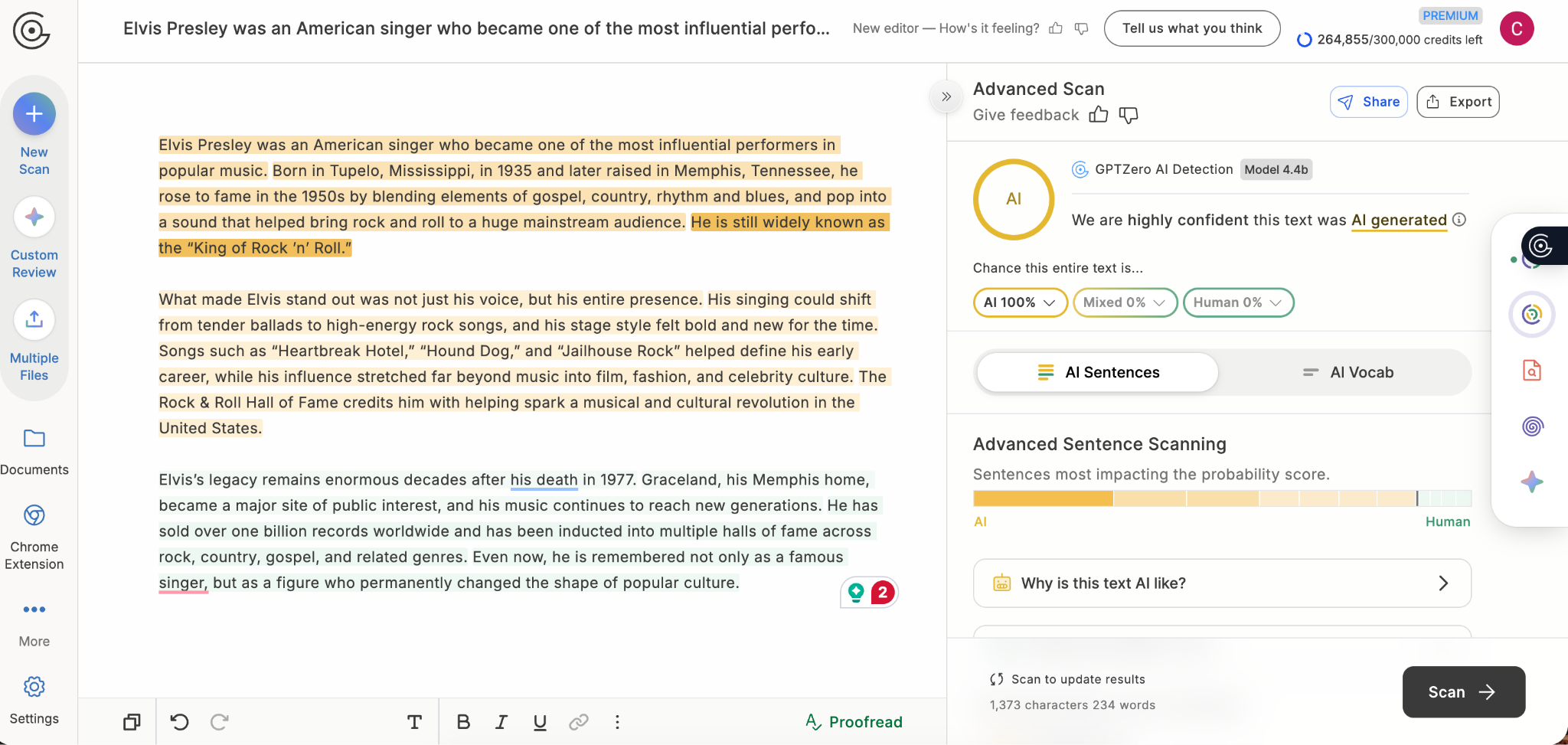
An AI score is an estimate of how likely a piece of writing is to have been written by AI. It is usually a percentage, with lower scores indicating likely to be human-written, and higher scores pointing towards more likely to be AI-generated.
The percentage is calculated through analyzing patterns in text, sentence structure, and tone, gauging whether the language looks more like human authorship or more like typical AI output.
AI scores are used by AI detector tools, including GPTZero. What we have always emphasized is that a score is simply a signal and should always be paired with human judgment, as work that has been human-written can sometimes get flagged as AI-written and vice versa.
What is a High AI Score?
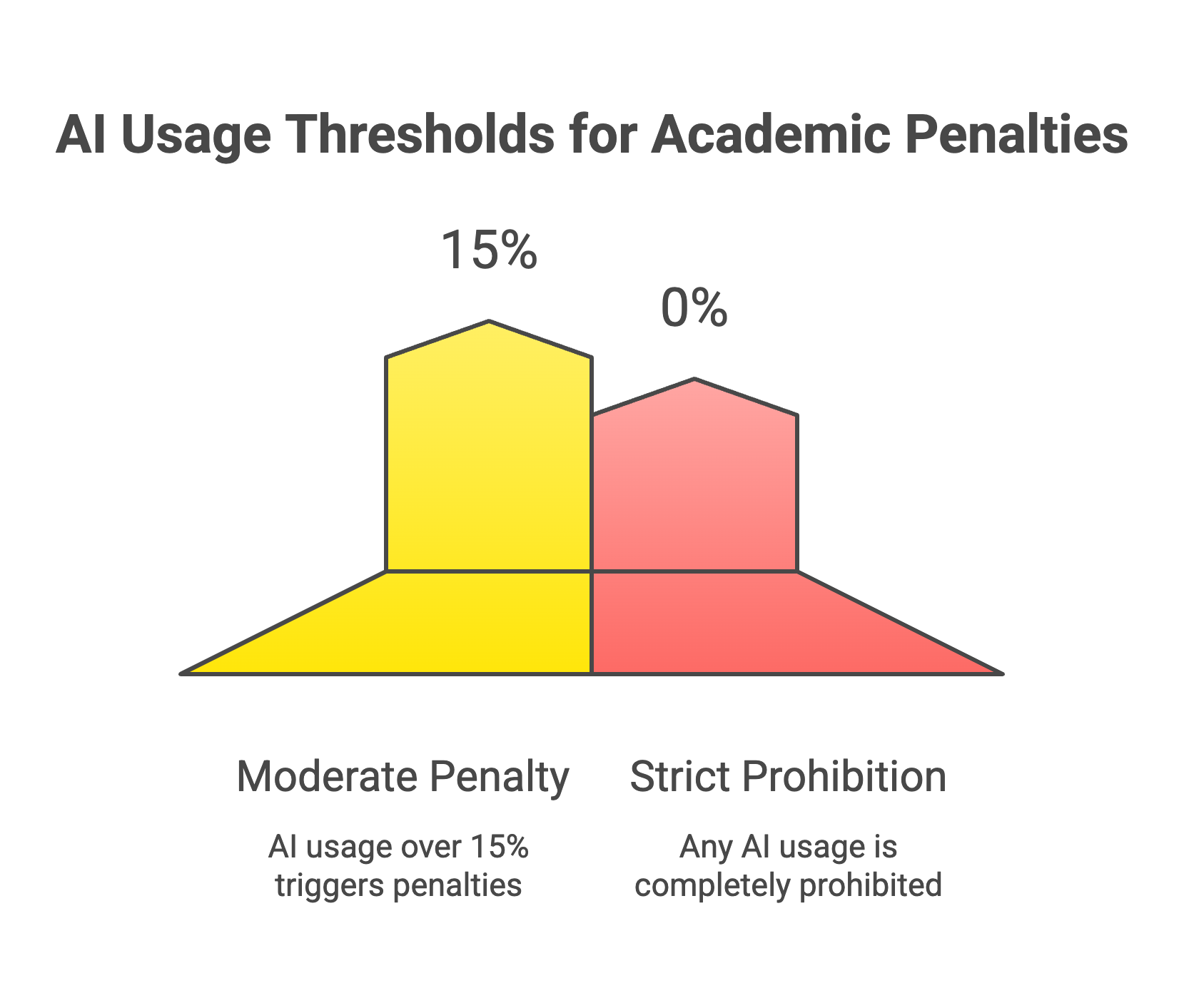
When it comes to what counts as a “high” or actionable score, this varies widely depending on the user and the institution. Some university policies treat anything over 15% AI as serious enough to trigger academic penalties or even an automatic fail. Some institutions are even stricter, with any form of AI at all being completely prohibited.
According to the teachers we’ve spoken to, though, many educators see 50% or higher as the main red flag. Reaching that level often prompts a closer review of the document’s version history, an oral exam, or a direct conversation with the student to check their understanding of the material.
As one grad student and grader put it, “If it's 53% AI-generated, then I would ask the student to rewrite it because it's more than 50% AI generated.” A college writing professor described a similar approach: “Well, the last question in the workshop that students have to do on two other students drafts is they have to take three paragraphs from the student, they have to click on a link which leads them to GPTZero and they have to paste it in and they have to give me the results. For the last answer to the workshop, they give the student the results and if it comes back higher than 50%, they have to send me an email to indicate that the student got a higher than 50% usage and they let the student know.”
However, when a paper returns a score of 100% AI, users and evaluators often read that as a sign that the text may have been copied directly from an AI output with little or no human editing. Most still treat that result with caution, especially when the subject matter naturally includes technical language.
As one evaluator explained: “I would guess that it means that like someone literally just copy pasted ChatGPT output – but because it's saying 100%, I don't really trust it because there's no way someone submits like a paper completely just copy-pasted from ChatGPT.”
How to Lower Your AI Score?
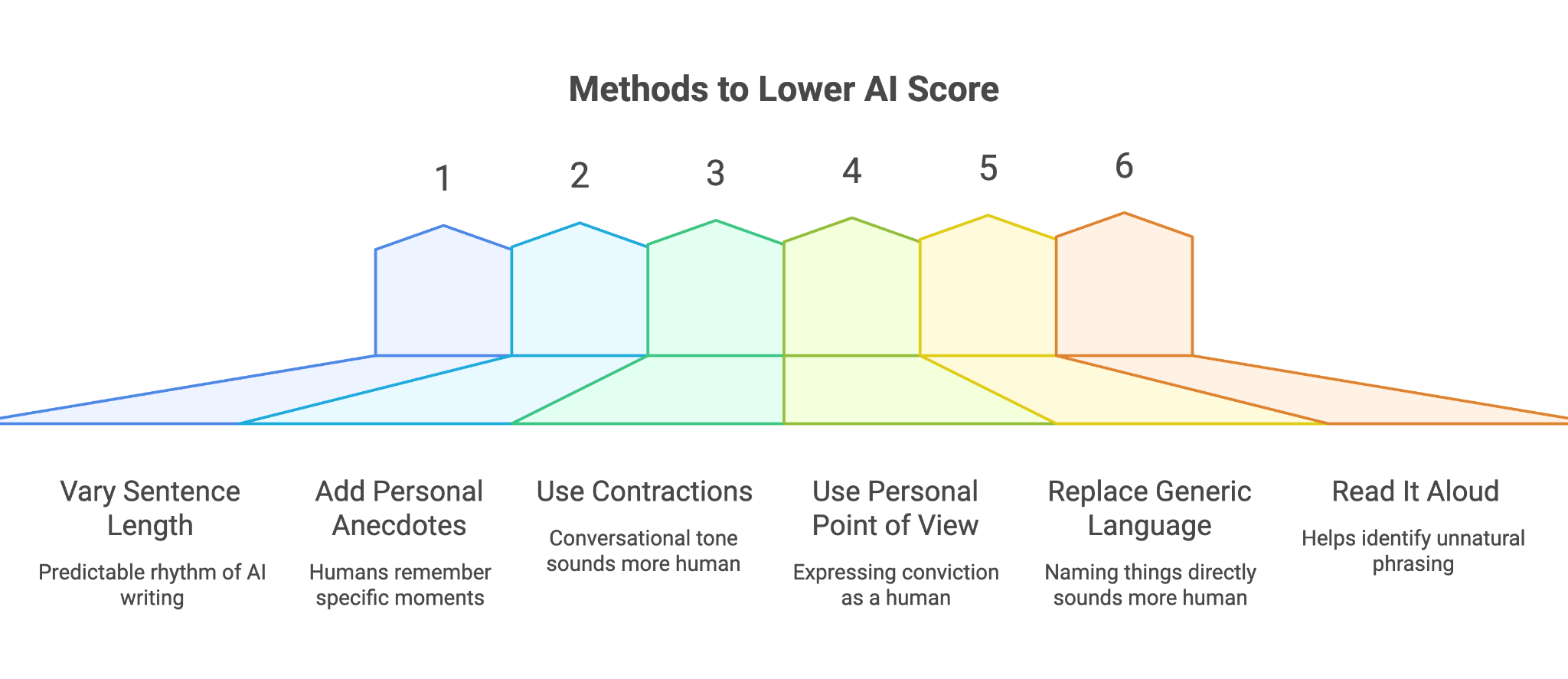
Writing that feels generic, overly even, or detached from lived experience is more likely to trigger AI signals. The best approach is often to make your work more reflective of how you think, so that originality prevails. Here are six methods to do just that, as well as examples of AI-sounding and human-sounding writing:
1. Vary your sentence length and structure
AI writing can have an extremely predictable rhythm, where the sentences all make sense, but feel too evenly paced. Human writing, on the other hand, usually has more variation. There can be short sentences. Very short. And then there can be longer sentences that are much more descriptive and cover a broader territory.
Example:
More AI-sounding: Online education has many benefits. It is flexible for students. It is also cost-effective. It can help improve access to learning.
More human: Online education is known for opening doors for students who need flexibility. However, it can also have its limits, especially when motivation or access to a quiet place to work becomes an issue.
2. Add personal anecdotes or lived detail
Only humans remember specific anecdotes or moments, whereas AI tends to make sweeping and general statements and doesn’t have the ability to link work back to that. One of the easiest ways to sound human is to include something very specific that comes from your lived experience.
Example:
More AI-sounding: Time management is important for student success.
More human: I only really understood time management when I missed an English Lit deadline in my sophomore year, as I tricked myself into thinking I could push out an essay in one evening. It didn’t work. After that, I started breaking everything into smaller tasks.
3. Use contractions and natural phrasing
Overly formal writing can sound artificial, which is why keeping a more conversational or natural tone helps. This can include using contractions (“it’s” instead of “it is”) and essentially writing similarly to how you’d speak out loud.
Example:
More AI-sounding: It is critical to understand that students do not always receive enough support for their mental health.
More human: It’s critical to understand that students don’t always get enough support for their mental health.
4. Use a personal point of view
While AI often tries to keep balanced, it can mean that it ends up sounding devoid of an actual perspective. Human writing usually has more of an opinion, which doesn’t have to be extreme! It just means expressing a conviction as someone who has actually reflected on the subject.
Example:
More AI-sounding: There are many perspectives on remote work, and each one offers useful insights.
More human: While remote work has some benefits, I think people underestimate how lonely it can become over time.
5. Replace generic language with concrete details
AI-generated text often defaults to vanilla phrases such as important issue, in today’s society, or many benefits and challenges. Human writing, on the other hand, tends to name the thing more directly.
Example:
More AI-sounding: Many people face challenges in the modern workplace.
More human: Many people are dealing with back-to-back Zoom calls, hazy boundaries after work, too many notifications to keep track of, on top of all the pressure to always look available online.
6. Read it aloud
This is one of the best and also simplest editing methods that doesn’t involve AI: read your work out loud. If a sentence sounds a bit weird when you speak it out loud, it probably feels that way to whoever is reading it on the page. Reading aloud helps you remove the parts that don’t flow as well.
Ask yourself: does this sound like me? Or would I never actually say this?
Essentially, lowering your AI score without using AI is really about making your writing stand out as something that has been written by an actual human being.
Limitations of AI Score Checkers
Even if you do all the above, and don’t use an AI detector, there is the potential that you could run your work through an AI score tool and get a false positive. This is because AI score checkers don’t actually know who wrote the text – instead, what they’re doing is looking for patterns and guessing whether they’re the types of patterns typically seen in AI-generated work.
Like Geoffrey Fowler shared in The Washington Post, “Just remember: This is new to everyone…. With AI, a detector doesn’t have any ‘evidence’ – just a hunch based on some statistical patterns.”
When it comes to academic work, that is a really important distinction, so that a high score is treated as a conversation starter as opposed to automatic and guaranteed evidence of misconduct.
Why AI score tools are not always right
Some human writing naturally looks more AI-like than other human writing, especially in school assignments, where students could be using overly formal structure, academic phrasing, repeated sentence structures, or generic transitions because they are trying to sound intellectual or academic.
Also, AI-generated writing is getting more sophisticated and therefore harder to detect (although we are constantly updating our model at GPTZero). Still, it’s true that LLMs models can produce text that sounds more natural than earlier tools, and if a student edits the text heavily, the final result may no longer look obviously AI-generated, even if AI played a major role in producing it.
What is a false positive?
A false positive is when human-written text is incorrectly flagged as AI-generated.
It can happen when the writing is formulaic or overly polished, which are easy traps to fall into for students who are writing in a second language. In some cases, the writing may flag as AI-like even when the ideas belong to the student.
What is a false negative?
A false negative is when AI-assisted or AI-generated text is not flagged, or is flagged at a lower level than expected.
This can happen when a student substantially rewrites AI output, mixes it with their own writing, or uses prompting strategies that produce more natural-sounding text. It can also happen because detection models are constantly trying to keep up with newer language models that are improving quickly.
Tools To Calculate AI Score
GPTZero is designed to help students and educators interpret AI-writing signals responsibly, helping learners strengthen their writing skills by balancing AI-generated text with their authentic voice.
Our mission begins with demystifying AI in the classroom. At GPTZero, we’re not about “catching students.” Instead, we work to ensure responsible AI use in education and beyond. With our educational partners, we will always promote a collaborative approach over a punitive one.
When it comes to explaining the likelihood of AI being used in your work, GPTZero goes beyond a single overall score. We use sentence-level deep learning classification and confidence categories to show where AI may be present and how strong that signal is. This makes the results more interpretable, especially for reviewers who need more than a simple yes-or-no answer.
We also take mixed documents very seriously, which means that models are designed to better identify blended authorship. This includes writing that has been drafted, rewritten, or polished with AI.
Besides all of that, we want to make sure you’re never falsely accused of cheating by any plagiarism checker. With our Origin Chrome Extension, you can replay assignments on Google Docs and earn badges that demonstrate originality in an essay.
The Importance of Using AI Responsibly
AI isn’t going anywhere, but knowing how to use it responsibly is an ongoing balancing act that both students and teachers are working through. One department head shared with us, "I want students to be able to think for themselves and to use AI as a tool and not as a crutch. And my worry is that it is currently being used as a crutch and not as a tool... we need to prep our kids to trust their own ideas before what they read from a machine.”
As one Masters student said, "With how helpful AI is now, it can be very tempting to use it for a simple assignment. But at the end of the day, we do need to remember our ethics and morals. AI is an amazing tool for suggestions and feedback. I use it almost every single day to give me ideas about certain things. But I think we should always have a limit on how much we use it and make sure we also think for ourselves.”
Use GPTZero’s AI Detector before your next assignment to make sure your writing sounds like you.
Conclusion
The best way to lower your AI score is make your writing so obviously your own that your human voice cannot be doubted. This means using your own ideas, personal examples, and your own judgement. While AI score checkers can be useful, they are not flawless, and they should never be treated as automatic proof on their own. In the long run, the strongest protection against a high AI score is also the thing that matters most academically: writing work that is genuinely yours, because it stems from your own intellectual reasoning.
FAQ
What does the AI score percentage actually indicate?
An AI score percentage shows how likely a detector thinks a piece of writing matches patterns often found in AI-generated text but this is an estimate as opposed to rock-solid proof.
Are AI score checkers accurate?
They can be useful, but they are not always 100% correct – ideally, they are just one signal alongside the broader context of the student’s work.
What do AI detectors look for?
AI detectors often score according to predictability, repeated structure, generic phrasing, shallow explanation, and writing that feels polished but potentially impersonal.
Can I lower my AI score without using AI?
Yes. In fact, the best way is to write the piece yourself, while using specific examples, keeping your sentence structure and wording as natural as possible so that your own voice stands out on the page.