GPTZero Investigation: One in Five Words at the UN General Assembly are AI-Generated


From September 8 to September 28, world leaders descended upon New York City for the 81st session of the United Nations General Assembly. This marked a major milestone in history as world leaders convened to discuss partnerships and debate major geopolitical challenges, including ongoing conflicts in Iran and Ukraine, and the role of humanity in the development of artificial intelligence.
This year, the use of AI by world leaders and the debate over the use of AI have grown increasingly intertwined — two contrasting examples this summer include an AI speech praised for its language condemning foreign exploitation, which was wrongly attributed to the President of Namibia; and a Canadian parliamentarian, Bill Oliver, accidentally reading an AI chatbot prompt during an assembly speech. Even US President Donald Trump has publicly admitted to using an AI-generated speech, after being impressed by its 'beautiful' content.
This begs the question: How much AI-generated writing appeared at one of the most consequential events in modern history this week?
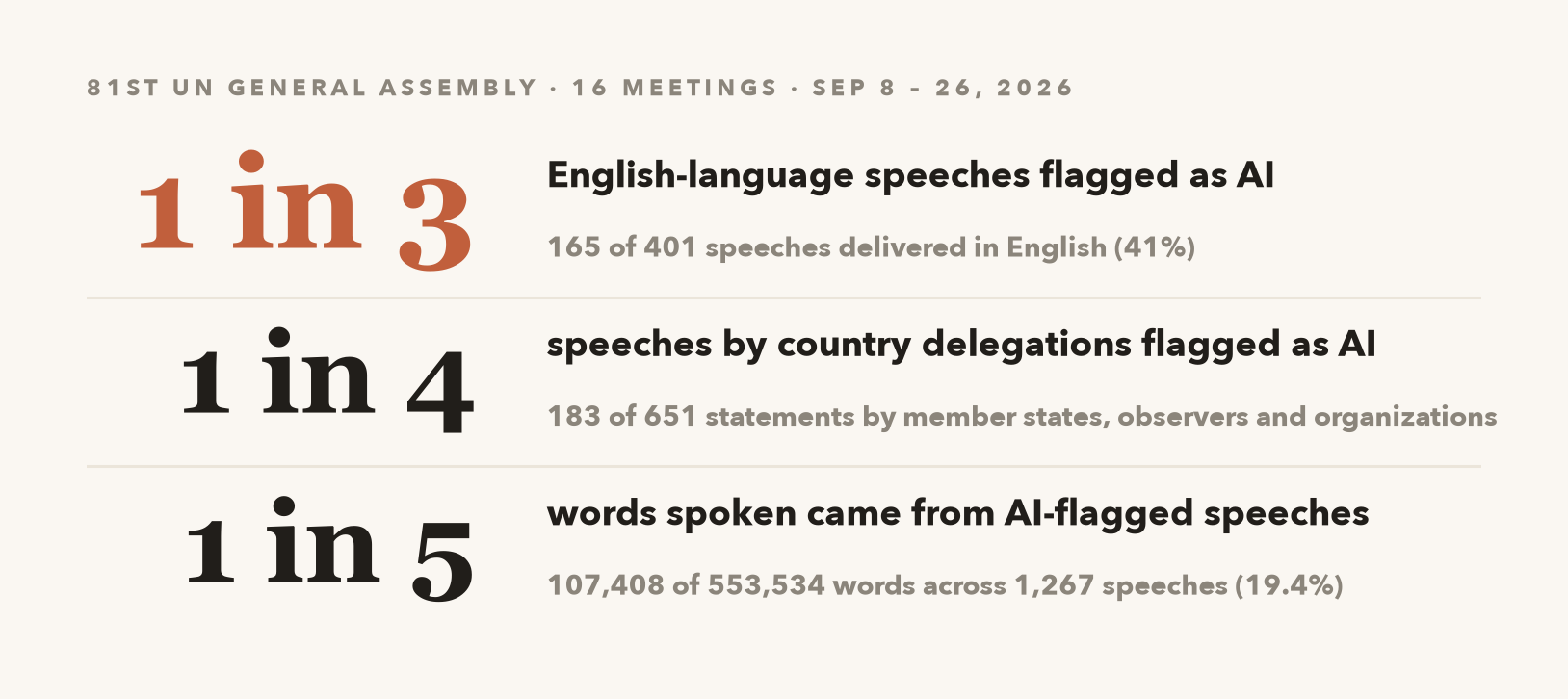
Our analysis, using GPTZero, found that about one in five of the words spoken at the United Nations General Assembly came from speeches drafted by AI. Even more egregiously, more than one in three English-language speeches at the General Assembly were flagged as AI-generated.
Methodology:
To determine the answer, the GPTZero investigations team analyzed every General Assembly meeting from the 81st session available from September 8th to Saturday, September 26. This excludes sessions not in the General Assembly and the closing session for the General Assembly on Monday, September 28.
The GPTZero investigations team gathered every General Assembly meeting of the 81st session that is publicly available on UN Transcripts as of September 28, 2026. This came to 16 sessions over nine days, starting on September 8. They included the opening plenary meetings, the first five days of the General Debate, and the themed high-level meetings. We did not include sessions held outside the General Assembly, or the closing session on September 28, which had no transcript at the time of our investigation.
Measuring AI Use:
GPTZero uses a proprietary detection model carefully trained by a team of machine learning engineers to identify AI-generated text. The detector determines the probability that the text is entirely human-written, AI-generated, or a mix of both types. Sometimes probabilities are split across multiple classes, or further subclasses (like "AI Paraphrased" or "AI Polished"). In general, GPTZero’s detector has an extremely low false positive rate: run on all 191 national statements from the 2022 General Debate, before ChatGPT was released, it flagged none.
We ran each full speech transcript through the GPTZero AI detection API. For the purpose of this analysis, each speech is labeled “AI”, “Mixed”, or “Human” according to the class GPTZero rates most likely. Only speeches labeled “AI” are counted as flagged. For our word counts, we took a conservative approach. Every word in a speech labeled AI counted as AI-generated. Every word in a speech labeled human or mixed did not
Overall for 2026, we analyzed 553,534 words from 1,267 speeches across 16 General Assembly meetings (September 8–26, 2026). GPTZero classified 203 speeches as AI-generated; together they contain 107,408 words (19.4%) of the total words spoken as AI-generated. The share was higher among country delegations: 183 of 651 speeches by member states, observers, and international organizations were flagged. Among English-language speeches, the figure rose to more than one in three (165 of 401).
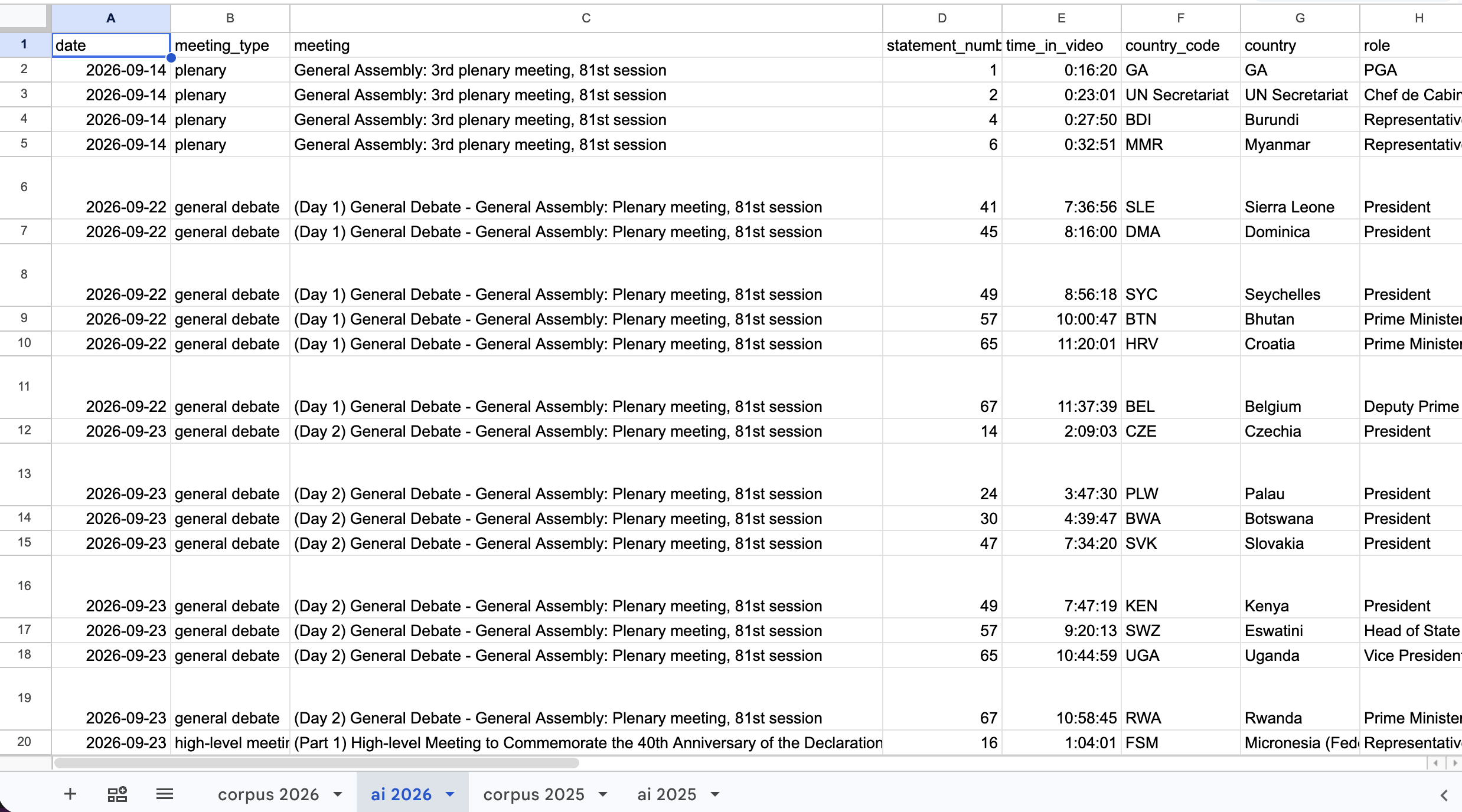
We are publishing our full dataset of the UNGA transcripts alongside our findings for transparency and reproducibility. The dataset includes four sheets, containing speeches in 2026, AI speeches in 2026, speeches in 2025, and AI speeches in 2025, accessible below:
On the Podium:
The 81st session opened on September 8 under its president, Dr. Khalilur Rahman, Bangladesh's foreign minister, and the General Debate began on September 22 with UN Secretary-General António Guterres presenting his annual report.
Over the following weeks, several world leaders delivered speeches that were 100 percent AI-generated. This included the presidents of Kenya, Liberia, Hungary, and the Czech Republic, the prime minister of Bhutan, and the vice president of Nigeria.
For some leaders, the pattern held from one year to the next. Speeches by Kenyan President William Ruto and Sierra Leonean President Julius Maada Bio at the UNGA were flagged as AI-generated in both 2026 and 2025.
US President Donald Trump, to his credit, had entirely human-generated scores in all his UNGA speeches, often owing to his organic conversation and ad-libs during speeches.
The General Debate:
At the General Debate, an annual meeting of Heads of State and Government is a key section of the UNGA where world leaders make statements outlining their positions and priorities. His Excellency Khalilur Rahman of Bangladesh presides over the UN General Assembly’s 81st session, under the theme of "Restoring trust, managing transformation: A United Nations that delivers for all.”
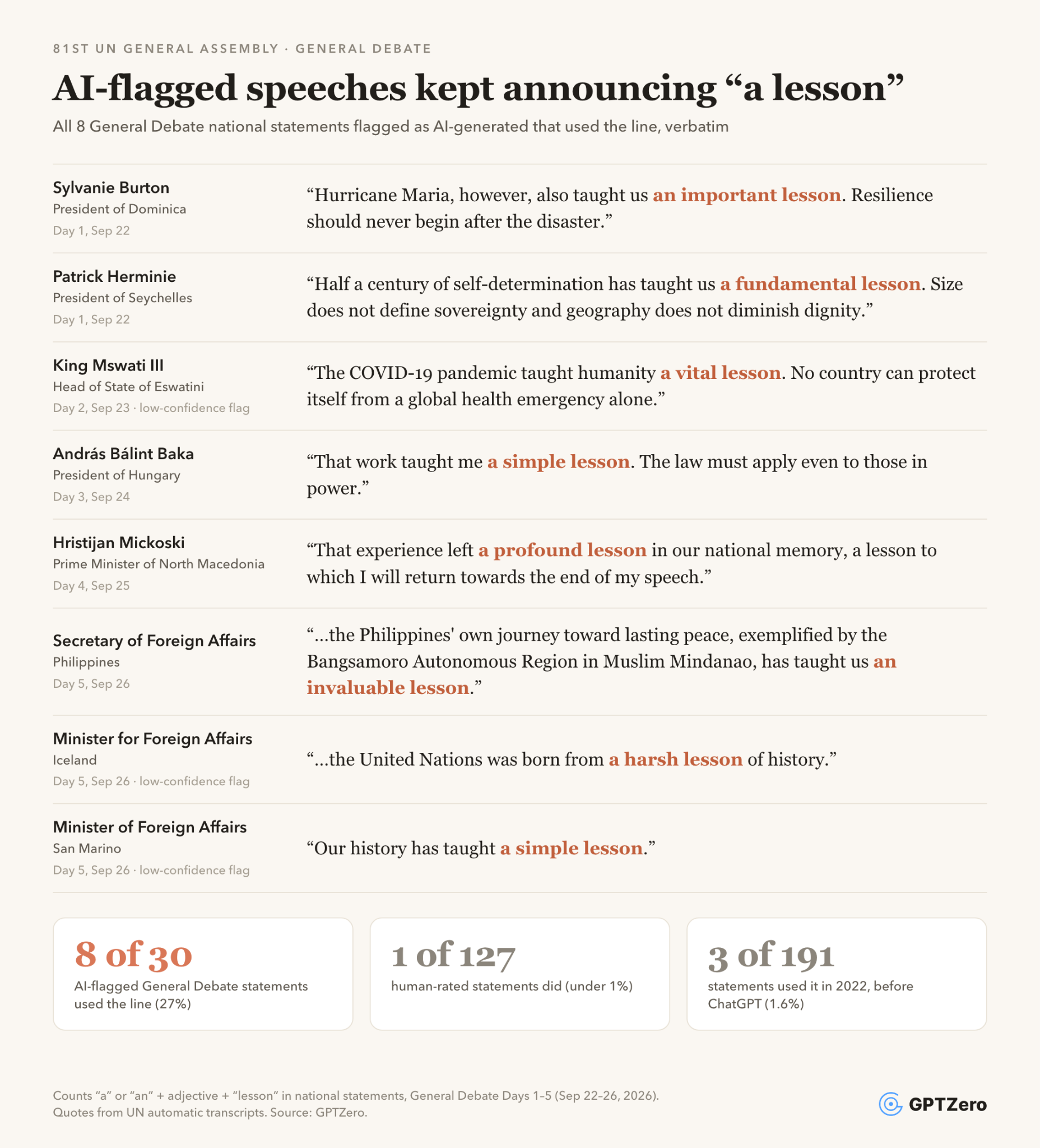
Multiple incidents occur with AI speeches running the same tropes. For example, the leaders of Seychelles, Dominica, Hungary and North Macedonia took the podium at the United Nations General Assembly and, in separate speeches, made the same move in nearly the same words: announcing a lesson. Patrick Herminie, President of Seychelles, said on day 1 of the General Debate, 'Half a century of self-determination has taught us a fundamental lesson.' Earlier that day, Sylvanie Burton, President of Dominica, had said 'Hurricane Maria, however, also taught us an important lesson.'
András Bálint Baka, President of Hungary, said 'That work taught me a simple lesson.' The next day, Hristijan Mickoski, Prime Minister of North Macedonia, said 'That experience left a profound lesson in our national memory.'
All of these verbatim quotes were part of speeches flagged as AI. In total, 8 of the 30 General Debate national statements flagged as AI announced a lesson this way (27%), compared with just 1 of the 127 statements rated human (under 1%). The line was rare among world leaders in earlier years too: 3 of 191 national statements used it in 2022, before ChatGPT was released, and 2 of 174 in 2025.
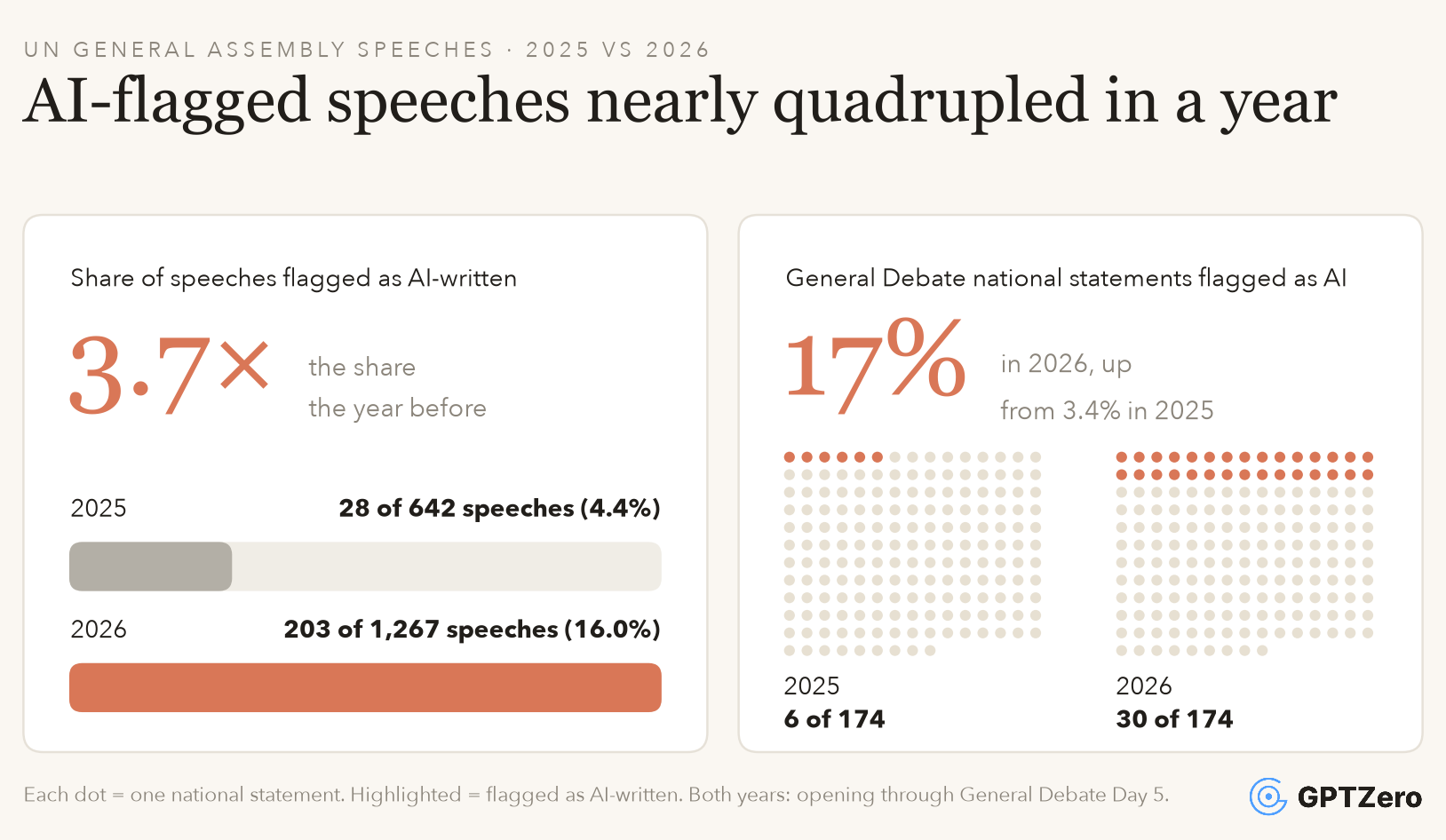
To compare with the results and analysis from a prior year, we scraped and processed the transcripts for 2025. Notably, last year's General Assembly had significantly less use of AI in speeches: 6 of 174 speeches (3.4%) of national statements during last year's general debate were flagged as AI, compared to 30 out of 174 national statements (17%) in 2026.
Closing Remarks:
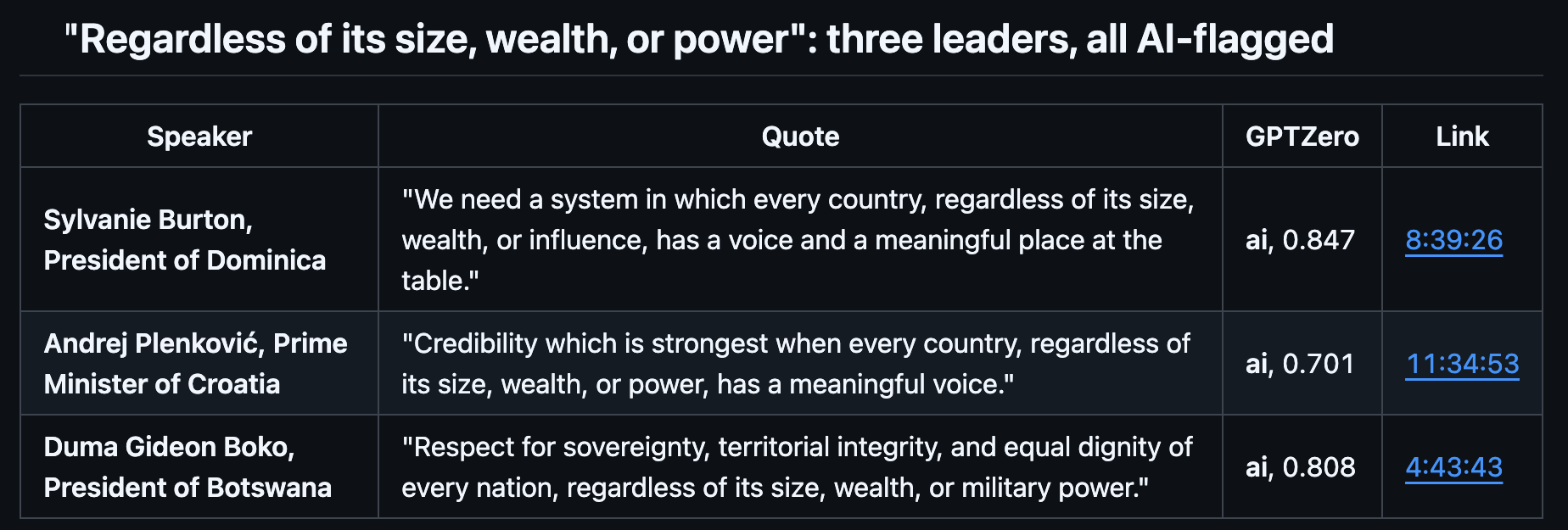
The clearest sign of what's changing may be in a single phrase. Dominica's president, Croatia's prime minister, and Botswana's president each called for a voice for every nation "regardless of its size, wealth, or power," or, in Botswana's case, "military power." Of the 111 General Debate speeches we analyzed, only these three used that formation, and GPTZero flagged all three as AI-generated. The phrase does not appear anywhere in the 2025 corpus. Shorter versions of the idea are common in diplomacy: Kyrgyzstan, Timor-Leste, Andorra, and Nauru all spoke of nations "regardless of size." What stands out is the specific three-part list, a rhetorical habit common to large language models.
The pattern raises a question that goes beyond detection. The General Assembly is one of the few places where each country, large or small, gets to speak to the world in its own voice. If more speeches are drafted by the same few AI systems, the Assembly risks hearing fewer individual voices and more of the same one: polished, balanced, and interchangeable. Three leaders from three continents asked every nation to be heard. They may, however, share a chatbot.