
How to Write an Essay
Writing an essay can feel intimidating, but when you break the process down into the following steps, you give yourself the best chance of producing great work.


Most students feel overwhelmed by essays at some point, but the good news is that it doesn’t have to be difficult. At GPTZero, we have helped thousands of students and educators write and assess essays using our tools, and what we’ve learned about how to write a good essay is this: take time to genuinely understand the question, research thoroughly, organize your ideas, and edit your work ruthlessly.
Here, we go through how to write an essay step by step: how to start an essay, how to structure an academic essay, and how to make an essay easy to follow. We’ll also cover the best essay writing format and well-known writing strategies so you can produce your best essay writing with less stress.
What is an essay?
An essay is a structured piece of writing that presents an argument or point of view, supported by evidence. It’s not a list or a summary of facts. Instead, a strong essay is something that has been well thought-out and carefully articulated.
Even though nearly nine in ten (88% in a 2025 poll) said they use tools like ChatGPT for assessments, an essay is still one of the best ways to show your critical thinking. The research shows that if we don't use those skills, we lose them.
An essay asks you to do analysis and independent thinking that leads you to make a claim, then showing the reader why it’s reasonable. As Professor Tim Wilson puts it in the video below, an essay “is not only your ideas, but also the ideas that you've acquired, which prove that you understand the subject.” This is why institutions rely on essays: they show how well a student has grasped a topic as well as how effectively they can communicate an idea.
Types of essays
While most essays follow a similar structure, each subject may ask you to approach a question differently. Knowing which type you’re writing helps you choose the right strategy.
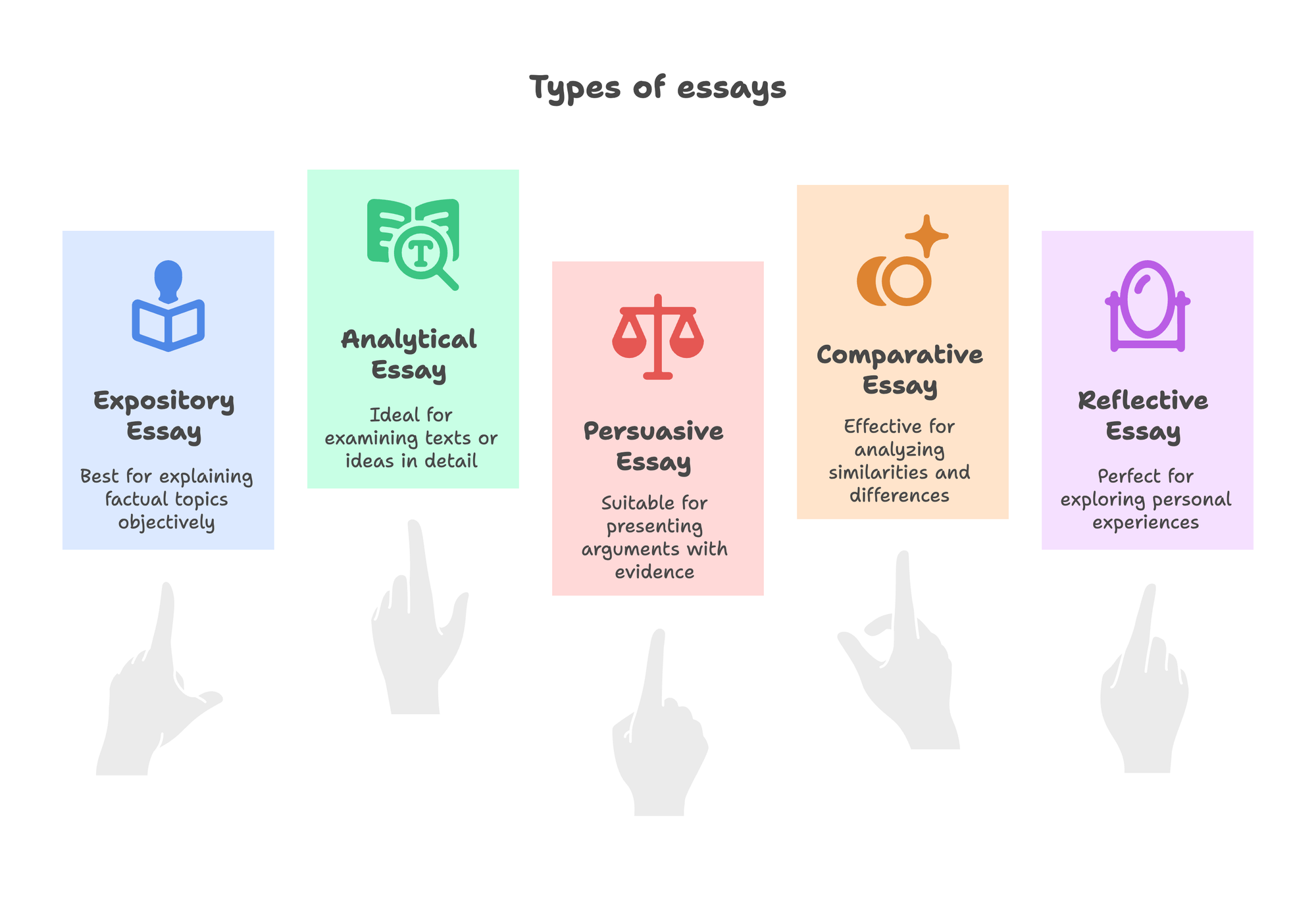
The most common types include:
1. Expository essays
Explain a topic in a factual and objective way. These often appear in history and science subjects. (Sample here from The City University of New York.)
2. Analytical essays
Examine a text, idea, or issue, breaking it down into parts to understand how it works. This is common in English literature and humanities. (Sample here from Suffolk University.)
3. Persuasive/argumentative essays
Present an argument and use evidence to convince the reader. This format requires strong reasoning and critical thinking skills. (Sample here from Virginia Woolf.)
4. Comparative essays
Analyze similarities and differences between two or more items, such as texts, theories, historical events, or scientific approaches. (Sample outline here from The University of Waterloo.)
5. Reflective essays
This is about exploring personal experience or learning, and is common in vocational courses and professional programmes. (Sample here from Monash University.)
Preparation for writing an essay
It’s tempting to think you should start by diving into answering the question itself, but there are a few steps that can set you up for success.
Create a time schedule
Researchers at Warwick Business School found that students who submit their essays at the last minute score five percentage points lower on average, which can in some cases be an entire degree classification lower.
This is why it’s useful, before you even start putting any ideas on the page, to decide how you’ll pace yourself. The intellectual heavy lifting is about what goes behind your words, such as selecting the examples you’ll use to sharpen your argument.
Steady progress is the ideal as it gives you more time to edit and refine. You might find producing a focused section each day (such as 500 words) keeps the workload manageable. After you’ve hit that amount, take a break, let your brain chew over the topic in the background, and by the time you revisit what you’ve written, you’ll often come up with connections or points that you just didn’t see before.
Structuring your essay
After you’ve got a rough plan for how you’ll use your time, it’s time to tackle how your argument is going to go. What’s the main idea you’re trying to illustrate? What’s the logical path you can take the reader down, through the evidence that supports that idea?
You don’t have to land on a perfectly formed version of this idea right now. At the start, it’s about the shape of your argument. Treat each section as a step in your reasoning. What does the reader need to know first? What evidence backs that up?
Once you’ve got this sketched out version of your structure, keep it nearby as you write, to make sure you’re generally staying on track instead of getting tempted to wander into unrelated ideas, which ultimately can dilute your argument. When you get to the editing stage, coming back to this original skeleton can pinpoint where the argument feels weak, repetitive, hard to understand, or logically out of order.
Researching
It’s tempting to gather as many different sources as possible, but before you start your research, define what it is you are trying to understand. This can stop you from going down time-wasting rabbit holes and keeping lots of tabs open.
You might start with broad overviews from textbooks and academic summaries and then narrow down to more specific studies or articles. As you read, keep notes on anything that backs up your points, challenges your assumptions, or offers a useful statistic or example.
Later on, it will save you time if you track your sources as you go (key details: author, title, publication, and date) so you’re not scrambling to rebuild your bibliography at the end.
Creating an Outline
While the skeleton is a rough road map, an outline is a more detailed list of how your essay is going to develop, and writing this now saves you a lot of time later down the track. It’s the methodology of your argument: how it develops and how it gets to the conclusion.
List the big points you want to make, in an order that feels logical, with each point connecting to your main argument and building on the one that came before it. Under each heading, jot down the examples or points you know you’ll use.
This main point of the outline is to show you which direction you’re heading in, pre-draft. It means that whenever you have a new point or idea, you’ll know where to slot it in. Most importantly, having a plan like this means you’ll write more purposefully instead of figuring out the structure as you go.
Writing the introduction
Here’s something counterintuitive: you might find it helpful to write the introduction last. This is because it is often a type of overview that will immediately signal to the reader what the context is as well as the main argument you’re going to be exploring, and the angle you’re taking to do so. All of this is much easier to write after you’ve done the main body.
The main point of the introduction is to show the reader a preview of what’s ahead. You need to make it very obvious what question you are answering and how you are going to answer it. A few crisp sentences that address that means that you’re on the right track.
Keep the tone assertive and avoid the temptation to go into unnecessary detail: remember, the introduction is just a peek at what’s to come. Your central argument has to be very easy to understand. You’re not trying to tell the reader everything in these first few paragraphs; you’re getting them warmed up.
For more on how to write a compelling introduction, we love the tips here:
Writing the main body
The main body is the meat of your essay. This is where you walk through each of your ideas, with every paragraph focusing on a point that links back to your central argument. If a sentence doesn’t help you make that argument, it can be a signal that the paragraph needs tightening.
Start each paragraph with a sentence that explains the idea you’re looking at, then beef it up with evidence or analysis that strengthens it. Instead of falling into the trap of describing your sources, show why they matter and how they move your argument forward.
Don’t forget to link each paragraph to the next one with good transitions. This guidance of the reader gives the essay extra weight and makes the essay feel coherent instead of a laundry list of random points.
Writing the conclusion
Many people think of the conclusion as a summary, but in many ways, it’s more like a finale. It brings the essay full circle by revisiting your central argument and showing the insight your analysis has led to. It’s important to remember that you are definitely not introducing new evidence here; you’re showing the significance of what you’ve already covered.
Ask yourself: What do I want the reader to take away? Use your final sentences to emphasise that exact idea. Maybe you’ll present your argument in a slightly refined way, bringing attention to the most compelling piece of your reasoning, or signalling to a broader implication (without drifting into speculation). It should provide a sense of closure, like your reader can leave the essay now being very aware of your argument and why it matters.
Proofread and edit
Editing is a different skill from writing as you become a reader, as opposed to a writer. You’re now going to check if each paragraph supports the main argument, and if what you’ve written actually makes sense. Look at the overall flow. Can any sections be expanded or cut?
If you’re happy with the higher-level view, zoom in on the details: does each sentence make sense? Could you use any more suitable words? Could you use simpler words?
After all, as the famous writer Stephen King says, “One of the really bad things you can do to your writing is to dress up the vocabulary, looking for long words because you may be a little bit ashamed of your short ones. This is like dressing up a household pet in evening clothes. The pet is embarrassed and the person who committed this act of premeditated cuteness should even be more embarrassed.”
Reference and create a bibliography
Your references and bibliography make sure every idea that isn’t your own is properly credited. Beyond an academic formality, this traces back where your evidence comes from and boosts the credibility of your argument.
Check which referencing style your course requires (Harvard, APA, MLA, Chicago, or another system) and follow that format consistently. Each one has slightly different rules for how to present authors, dates, page numbers, and publication details, so stick closely to the guidelines your lecturer has provided.
As you finalise your bibliography, double-check that every source you mention in the essay appears in the list and that every item in the list is actually used in your essay.
Submit your essay
Before you upload your work, take a moment to review the submission instructions: the deadline, file format, naming conventions, and whether your course requires a cover sheet or declaration of originality. These seem like very minor details ,but they can cost marks if you miss them.
Since many universities now use plagiarism- and AI detection tool when reviewing assignments, keep a copy of your draft history just in case. Before you submit, you can run your work through GPTZero to make sure your writing appears authentically as your own. Our detector highlights sentences that may resemble AI patterns, helping you revise with confidence, especially important as AI use becomes more common in academic settings.
4 Essay Writing Tips
Often, the same pieces of advice crop up again and again, and that’s mainly because they’re effective! Here are some practical habits that consistently improve the quality of an essay:
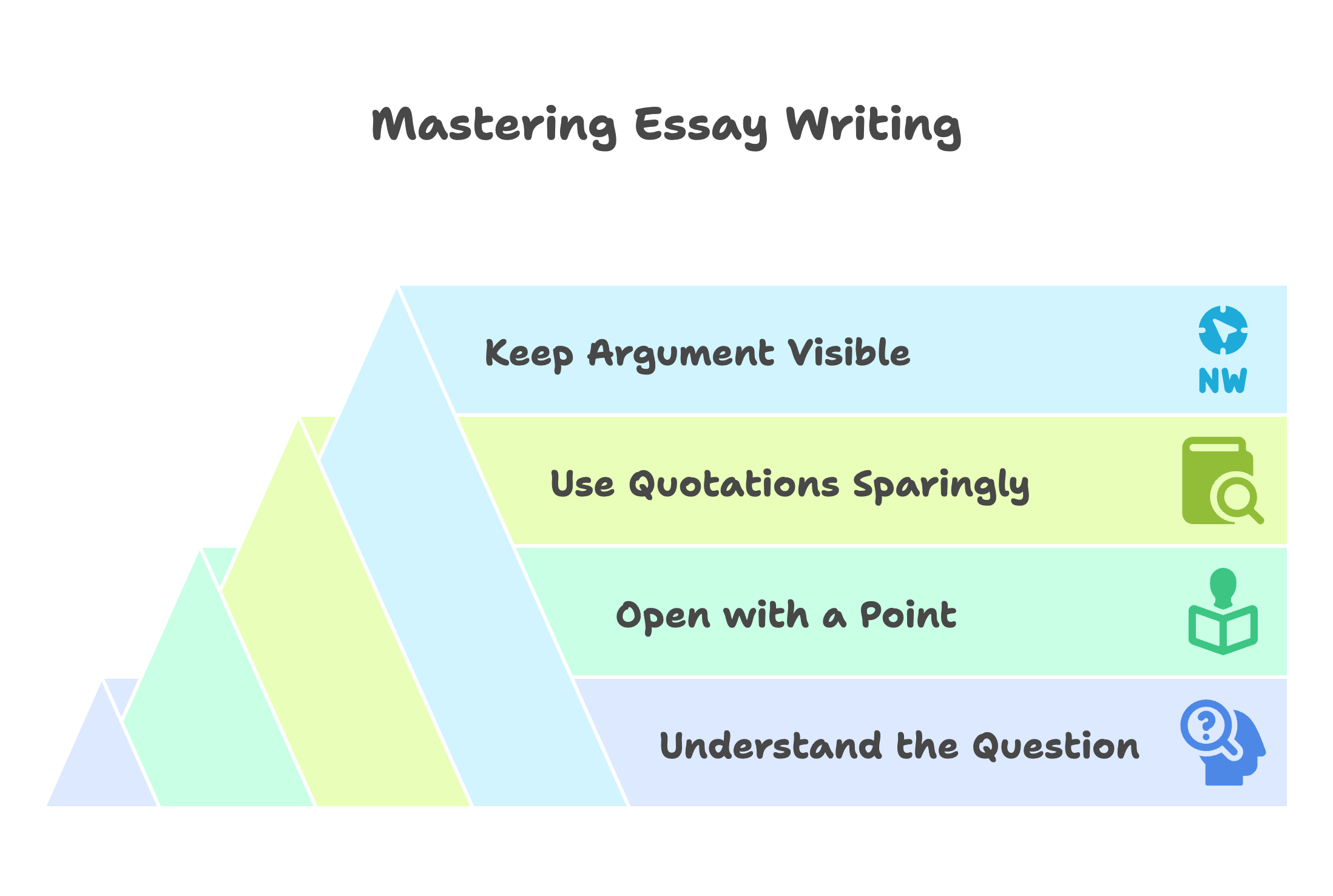
- Focus on what the question actually is, not what you wish it could be. As Joe Bunting advises: “Yes, you need to follow the guidelines in your assignment. If your teacher tells you to write a five-paragraph essay, then write a five-paragraph essay! If your teacher asks for a specific type of essay, like an analysis, argument, or research essay, then make sure you write that type of essay!”
- Open each paragraph with a focused point. A powerful first sentence helps keep your reasoning on track. Scribbr says, “Each paragraph should be centered around one main point or idea. That idea is introduced in a topic sentence. The topic sentence should generally lead on from the previous paragraph and introduce the point to be made in this paragraph.”
- Use quotations sparingly. What matters most is your interpretation and analysis. The Portland State University Writing Center emphasizes, “The paragraphs that follow your thesis should be full of support, e.g. examples, anecdotes, or evidence. Additionally, each paragraph should link back up to your thesis statement in a logical way.”
- Keep your central argument visible. You could even place it at the top of your notes to stay oriented as you write. Or as advice from the University of Liverpool goes: “Some students prefer to write a summary before they begin, setting out the central thesis of their essay within one or two sentences, to ensure they have a strong, overarching direction.”
Conclusion
Even though essay writing might feel intimidating, hopefully with the above steps, the process will become easier – especially when you build the habits of taking time to understand the question, zoning in on a firm argument, and making sure each paragraph links back to it. You don’t have to write the perfect essay on your first attempt. Instead, it’s about taking the tips above and using them to build a strong working pattern for the future.
Further resources
- Tips for Reading an Assignment Prompt from Harvard College Writing Center.
- How to Write An Essay from the University of Toronto Scarborough
- Essay and dissertation writing skills from The University of Oxford students’ website