
How to Write a Resume Summary, With Examples and Formula
Learn how to write a concise, tailored resume summary that highlights your strongest qualifications, uses relevant keywords, and makes a compelling first impression. Includes a simple formula and examples for different careers.


If your resume is sitting in a stack of dozens (or hundreds!) of other resumes, a summary statement can give you the edge in creating a specific, lasting impression in the mind of a busy recruiter. A resume summary is a chance to strike a first impression that stands out. It offers an opening statement that points the reader to the most important parts of the resume—the parts that reveal an applicant’s greatest strengths and compatibility for the job.
This guide reviews what a resume summary is and teaches you best practices for writing one. With a template formula to get you started and top-quality examples to emulate for various industries and experience levels, you will be able to craft and perfect an engaging resume summary for your next job application.
What is a Resume Summary?
Coming after your name and contact information at the beginning of a resume, a resume summary is a short paragraph that emphasizes highly relevant skills and experiences from the resume. It is your “first opportunity to communicate who you are and why the hiring committee should choose you over other job applicants.”
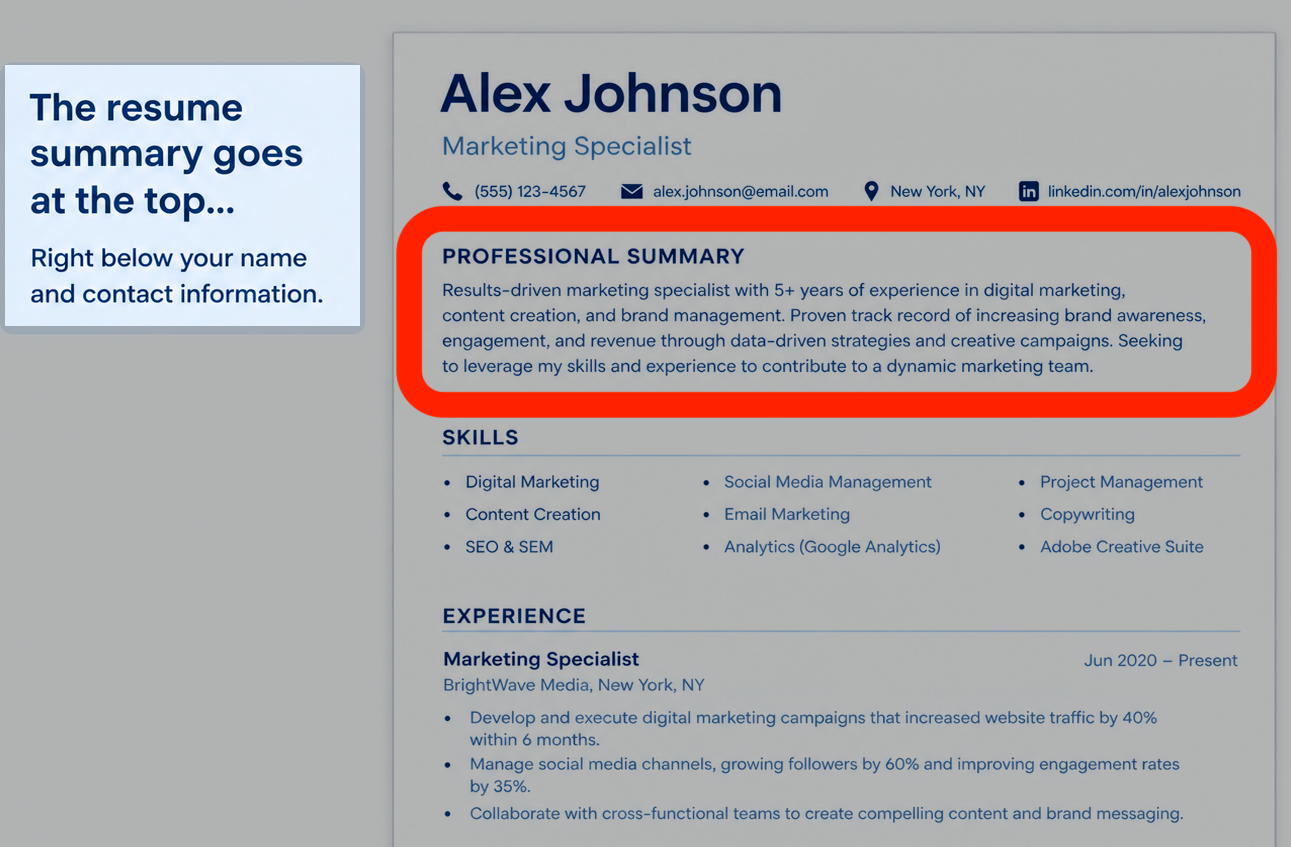
This section of the resume is always at the top, but may be titled differently based on its contents and the best fit for the job being applied to.
- Professional Summary
- Summary of Qualifications
- Key Skills
- Key Qualifiers
Resume summaries help provide easy recognition, highlight core accomplishments, and hit keywords. They offer busy managers and recruiters an at-a-glance snapshot of your profile that makes your relevant skills and experiences more visible, while also permitting your resume to use keywords that automated systems will pick up on.
How to Write a Resume Summary in 5 Steps
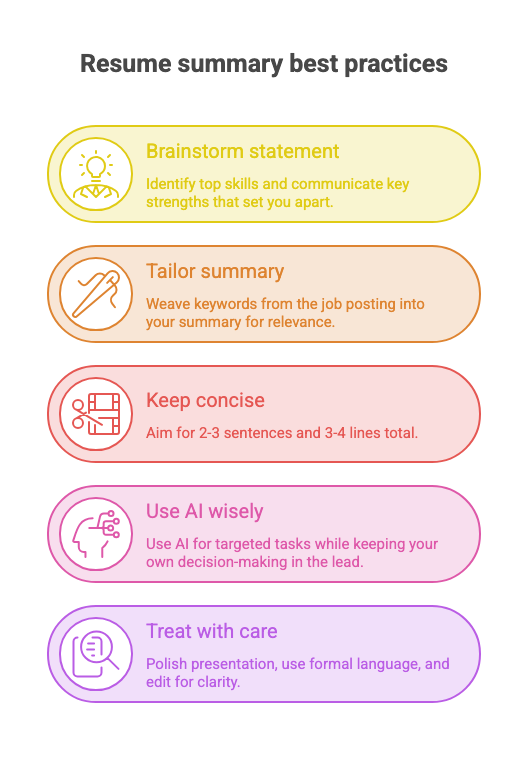
Brainstorm your summary statement
Set the priorities of your summary and signal where the strongest connections lie between your resume and the job. Identify top skills and experiences that are reflected in your resume in order to direct the reader toward the core strengths and competencies that make you the best choice to hire.
List out the things you want to communicate that will set you apart as a key candidate.
Focus on:
- Past accomplishments that show what you can offer in the future if hired
- Transferable skills you’ve demonstrated across seemingly unrelated experiences
- Keywords and skills from your target job posting that you can tie to your resume
Tailor your summary
Two different job applications should have two different resume summaries. The best resume summary is not the one that sums up the most about your resume; it’s the one that sums up the parts of your resume that are the most relevant to the job you’re applying for.
Identify keywords from the job posting and weave them into your summary, but be sure not to go overboard. Your writing still needs to sound natural, so aim for a balance between highlighting your fit for the position and maintaining smooth readability.
Keep it concise
A resume summary aims to be brief and snappy. The goal is not to land the job through the summary alone; the goal is to strongly signal your fit for the job. You’re looking to make the recruiter think, “Hmmm, this person could be a great hire. Let's find out more…”
The ideal resume summary is 2-3 sentences, around 3-4 lines total. If your summary is longer than that, make strategic cuts—critically consider each point of information you provide and ask yourself if it’s absolutely essential or not.
Be smart about using AI
Avoid simply plugging your resume into an AI platform and asking for a summary; a generically written text is unlikely to impress, and there are ways for employers to check if applicants used AI. Consider how to summarize your points without using AI-like phrases.
AI can be helpful when used in targeted ways where your own decision-making is still taking the lead. Try asking AI to suggest ways of incorporating keywords or prompt it to mimic the language found in a job posting, but beware of misusing AI in ways that will damage your chances at landing the job.
Treat with care
This is a professional document that makes an important first impression for you, so polish its presentation and put your best foot forward. Use formal language. Use a grammar checker and edit for clarity. If you know someone who works in HR or does hiring, bring them a baked good and ask them to please review your resume summary. Do everything you can to refine and perfect this text to create a strong, positive impression.
Resume Summary Formula
Each resume summary is based on a specific resume and tailored to a specific job application, so it can be tricky to generalize this into a template, but myperfectresume offers this formula:
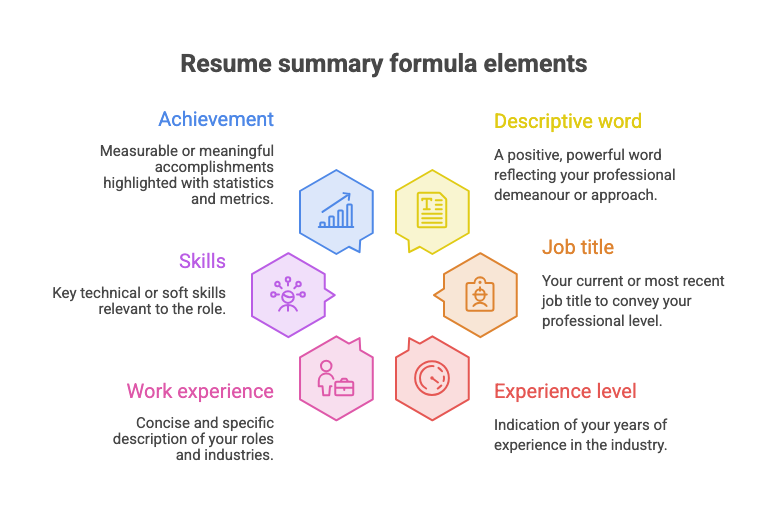
[Descriptive word] [Your job title] [Experience level] [Work experience] [Skills] [Achievement].
Each element involves its own criteria and choices:
- The descriptive word should be positive, powerful, and speak to your professional demeanour or approach.
- Give your current or most recent job title to quickly convey your professional level.
- Indicate your level of experience, especially if you’ve been in the industry for more than a few years.
- Describe your work experience in concise and specific terms, indicating roles and industries.
- Pick out key skills; these may be technical skills or soft skills or a mixture of both.
- Finally, the achievement(s) you choose to highlight should be measurable or meaningful-–statistics and other metrics shine here.
The formula helps create a summary that hits key points very clearly and conveys a strong snapshot of who you are as an applicant:
Innovative marketing manager with 7+ years of experience in digital advertising. Skilled in strategic planning, campaign execution, and social media analytics. Led initiatives that drove a 40% increase in online engagement over 2 years. Strong track record of using data to improve performance and build brand visibility across digital channels.
Resume Summary Examples
Here’s an example from the professional recruiting firm Robert Half for the position of administrative assistant:
Detail-oriented and highly organized administrative assistant with experience managing calendars, coordinating meetings and supporting office operations through internships and part-time roles. Strong communication and multitasking skills with a knack for improving efficiency in daily tasks. Ready to bring strong organizational skills to a growing team.
The University of Arizona’s Center for Career Readiness offers this example that would suit an undergraduate student or recent graduate:
Adaptable student leader with experience facilitating discussions to empower students and youth in personal development. Skilled in supporting social media marketing initiatives and coordinating events to drive engagement. Social Justice-focused public speaker and influencer.
Duke University provides a number of resume summary examples, including this one that would likely be used by a graduate student or early career professional:
Accomplished researcher and economic analyst with seven years of experience focusing on commercial and retail banking. Adept at combining in-depth knowledge of industry practices and legal requirements with analytical expertise, strategic negotiation, and skillful relationship building to secure new and repeat funding sources. Earned top graduate researcher award from pool of 750 students.
For a wide range of resume summary examples from diverse industries and career stages, read this guide from Indeed.com.