Which Autotyper Detection Software Is Best?
Inside GPTZero Autotyper Detection in Writing Replay, which shows the writing process behind the final draft.


When evaluating the authenticity of written work, the writing process can be as significant as the final draft. Alongside AI detection scores, GPTZero’s Writing Replay gives insights into this process, as a document recording can be reviewed along with typing pattern scores, showing how likely a human is to have produced a document.
However, as AI writing tools have evolved, so have attempts to bypass authorship checks. The rise of autotyping tools introduces a new challenge in this space. These tools are designed to mimic the human typing process and make it indistinguishable to a human reviewer or a typing pattern detector.
To address this challenge and preserve the authenticity of writing, GPTZero has made significant advancements in the field of autotyper detection. Our latest Writing Replay typing detection model offers state-of-the-art autotyper detection capabilities with 98.5% accuracy (precision of 99.9% and autotyper recall of 97%).
What is GPTZero’s autotyper detection?
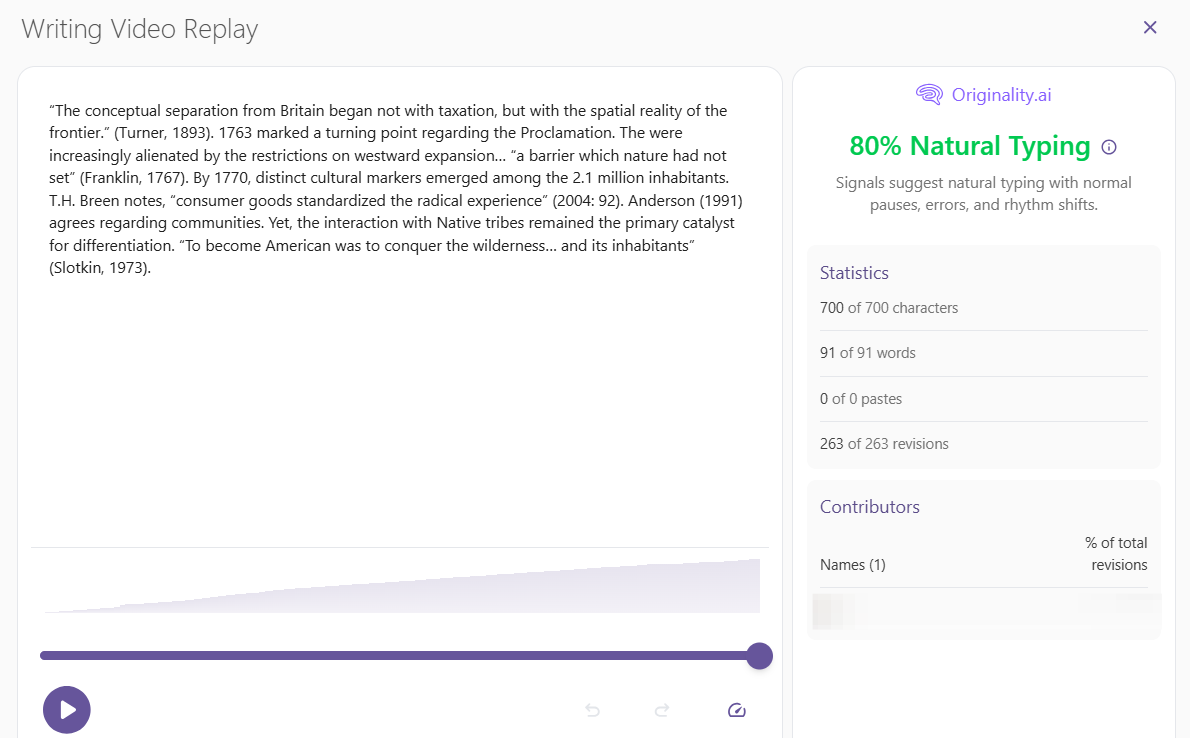
Autotyper detection is part of GPTZero’s writing replay feature. Our Writing Replay lets reviewers easily analyze patterns, including pauses, revisions, bursts of writing and other signs of natural composition.
Given a document, an Autotyper software generally tries to replicate natural human typing patterns and makes the typing process configurable to fit various typing profiles (e.g. slow writer, fast writer, student, professional) and typing behavior presets (e.g. speeds, pauses, corrections, rhythm). However, these tools still leave subtle non-human typing signatures.
By analyzing a large corpus of the human typing process, we have mined a distinct signature of natural typing patterns and trained our Autotyper detection model to identify and flag any sign of inorganic composition or anomalies in the typing process.
Our model analyzes several typing patterns such as overall pace, rhythm and burstiness, burst structure, correction behavior, and more, to precisely flag the typing process. A document that has involvement of autotypers is flagged as “Unnatural” with an explicit “Autotyper Detected” flag. A document that exhibits human typing behavior without unnatural copy-and-paste activity or autotyping behavior is classified as “Natural” by our system.
How accurate is GPTZero at detecting auto-typed documents?
To assess the accuracy of our typing pattern detector model, we prepared a comprehensive benchmark of seven popular autotypers available in the market. For each autotyper, we collected typing samples using a wide variety of configurations and presets, such as but not limited to typing speed, accuracy and mistakes, pauses and breaks (e.g. break frequency, break frequency duration etc.) and content transformation (e.g. replacing em-dash with a comma).
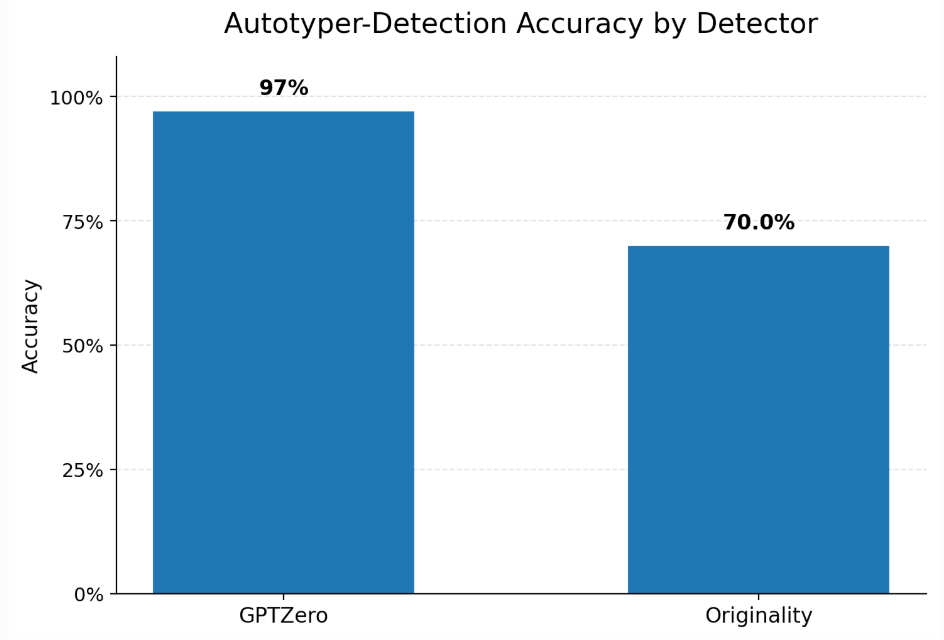
We benchmarked ourselves and another commercial AI detector (Originality.ai) that also offers autotyper detection as a service. We used a threshold of 50% for both models to classify a sample as autotyped. Across all the 7 tools tested, our detector achieves an overall autotyper accuracy (recall) of 97%, while Originality achieves an accuracy of only 70%.
Our benchmarks indicate that we are the only commercial AI detector that also provides reliable Autotyping detection. Some AI bypasser tools include autotyping as an added evasion feature, in which case, detecting both AI-bypassed content and Autotyping activity can provide a stronger combined signal. We also achieve state-of-the-art performance in detecting AI-paraphrased content, which you can read more about in our live benchmarking page (AI Bypasser Detection).
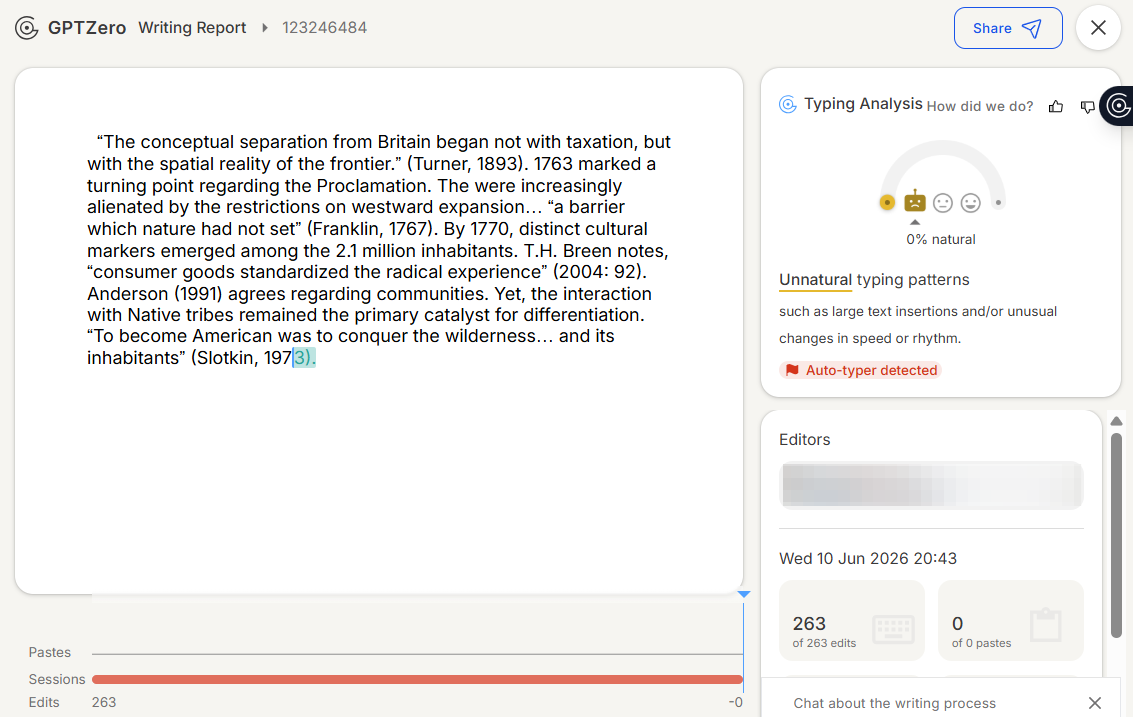
Try our latest Writing Replay
Our Writing Replay feature not only helps reviewers see how the final text looks but also lets reviewers examine the writing process.
With autotyper detection, we can now better identify the presence of adversaries in the writing process and flag them with confidence.
As writing tools evolve, we will keep expanding the signals that help verify authentic writing. We’re building models that understand not just the final draft, but the process behind it.