10 AI Patterns, and A New Way to Understand AI-Like Writing
Our new AI Patterns feature helps explain why a piece of writing might appear to be AI-generated.


What makes writing look as if it were written by AI? While an overall detection score can reveal what GPTZero found, users often want to know how that result came to be.
GPTZero has always treated interpretability (helping users understand how a result was reached) as an essential part of AI detection. Our document-level scores give an overall picture, while sentence-level highlighting helps pinpoint where the strongest signals appear.
Today, we’re introducing AI patterns, a new feature available in our Advanced Scan view. It identifies, extracts and explains recurring stylistic and rhetorical AI writing patterns in your document, helping you understand what makes a document look AI-like and why.
What is an AI Pattern?
Large Language Models (LLMs) seem to have a recognizable writing style. They do not always use the same vocabulary or sentence structure, but often return to familiar ways of organizing and presenting ideas.
An AI Pattern is a content, language or grammatical structure characteristic of AI chatbot writing. Examples include arranging ideas in neat sets of threes, framing claims using a “Not X, but Y” structure and attributing unusually high importance to ordinary ideas with little to no grounding.
Our initial taxonomy of AI writing patterns is derived from Wikipedia’s Signs of writing: A field guide that helps detect undisclosed AI-generated content on Wikipedia. We refrain from using patterns based on formatting as AI tropes, as we believe that it reflects only a presentation choice separate from the underlying language and ideas. Our AI detector is also designed to avoid attributing AI scores to formatting choices.
Our initial release includes 10 AI writing patterns, which we discuss in more detail below.
None of these constructions is exclusive to AI writing, but they do appear disproportionately higher in AI-written documents compared to human-written ones. This also means you may see these patterns in documents classified as human-written. As such, an AI writing pattern is not proof of AI authorship but helps readers identify and discuss AI-like writing habits instead of vague impressions of what “sounds” like AI writing.
10 AI writing patterns in practice
Here are the AI writing patterns we currently detect in text documents.
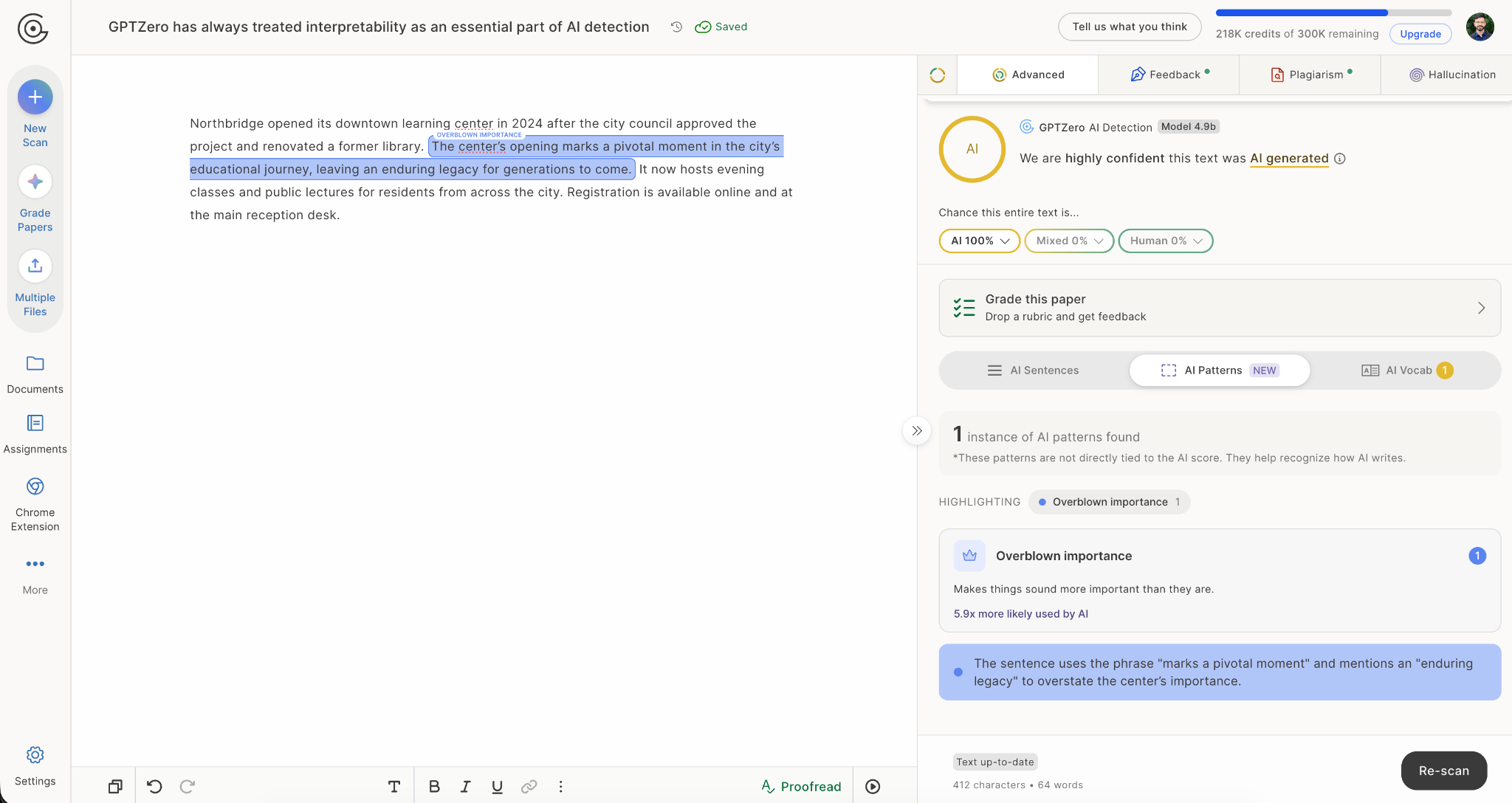
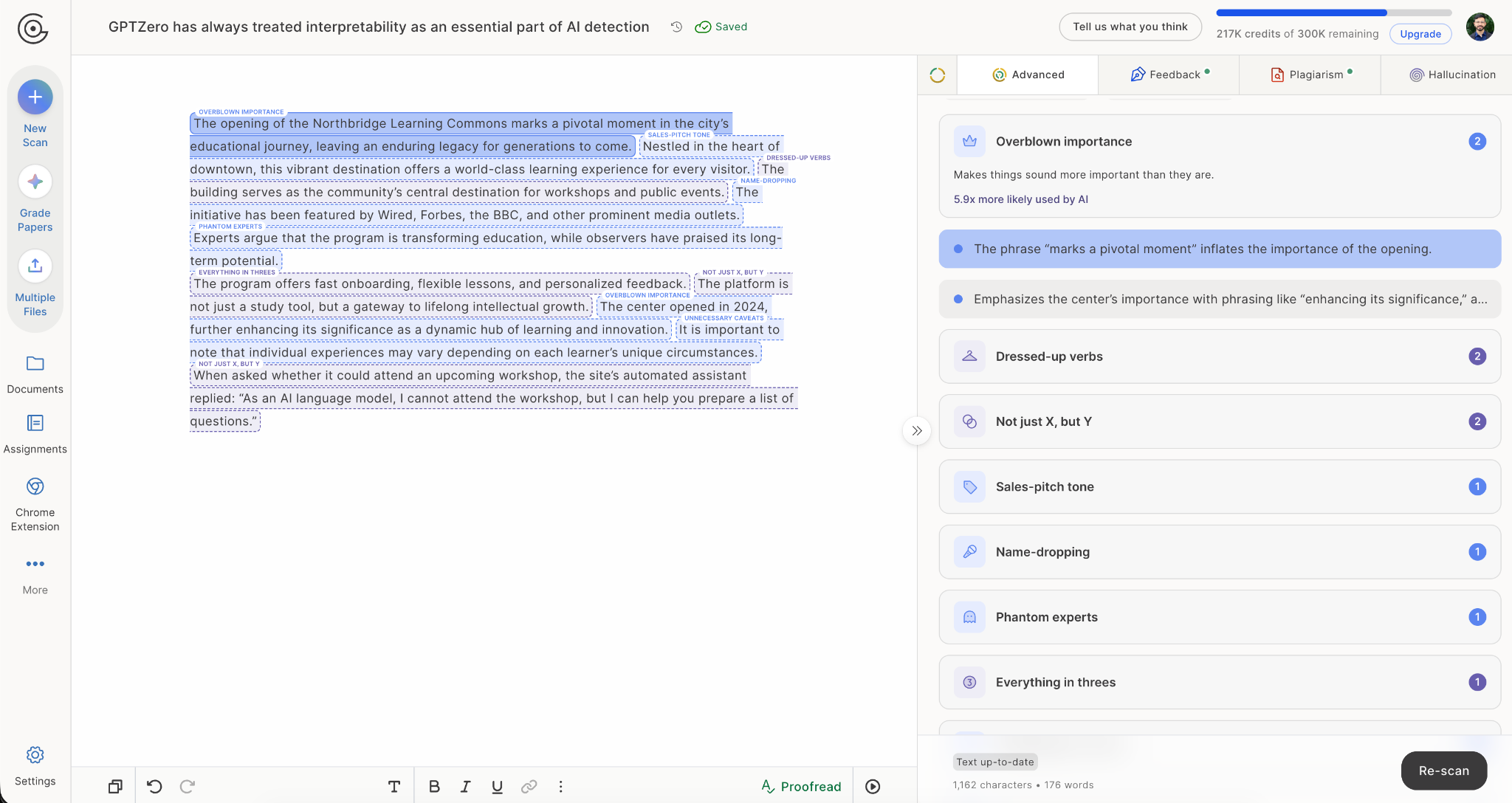
Overblown Importance
This pattern recognizes sentences in a document that make ordinary events sound much more important than they are.
In this example, the sentence uses phrases such as “marks a pivotal moment” and “enduring legacy” to overstate the center’s importance.
Name Dropping
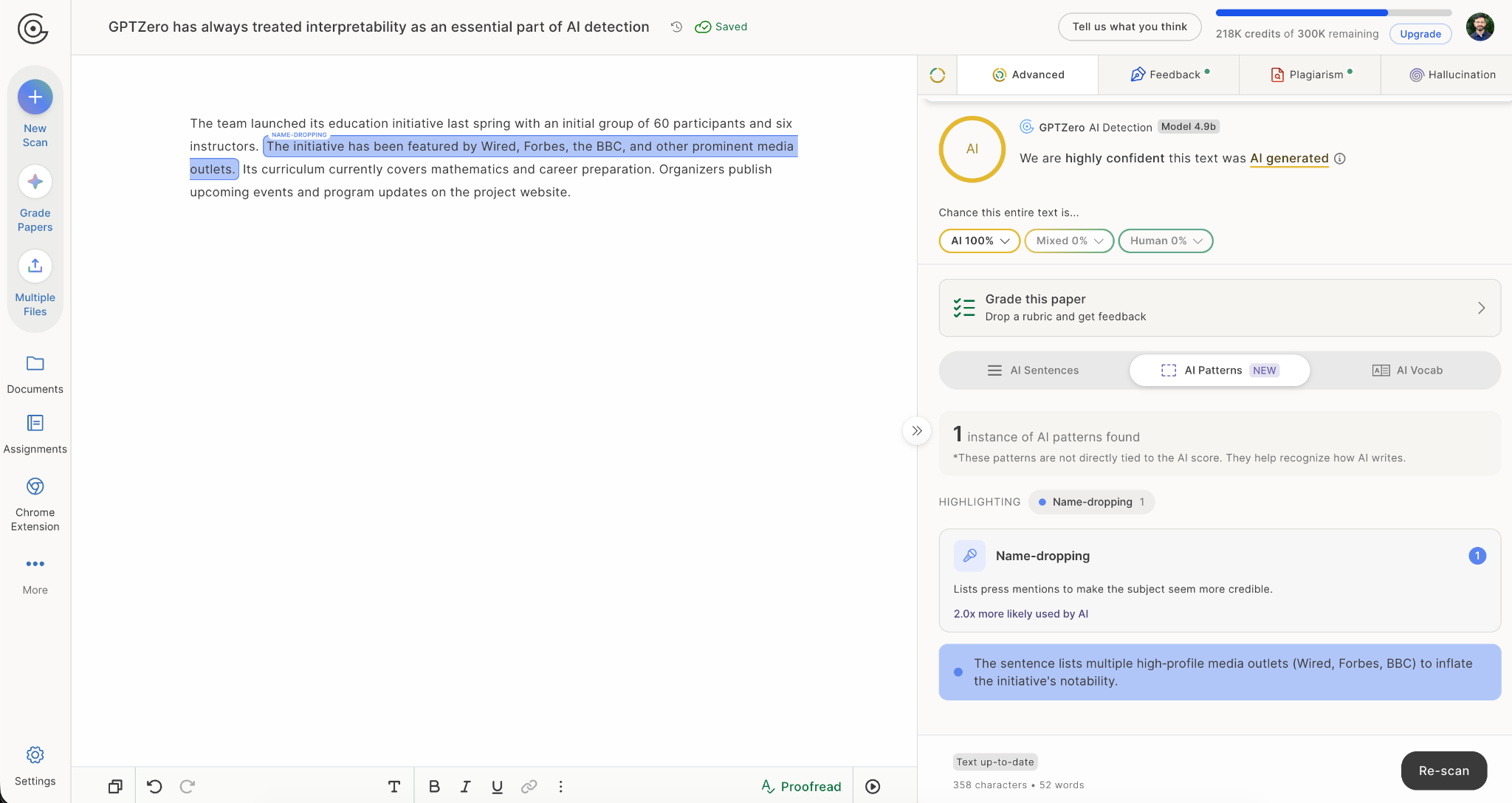
This pattern piles up press coverage references to make the subject seem more credible.
In this example, the sentence lists high-profile media outlets such as Wired, Forbes and BBC to inflate the initiative’s notability.
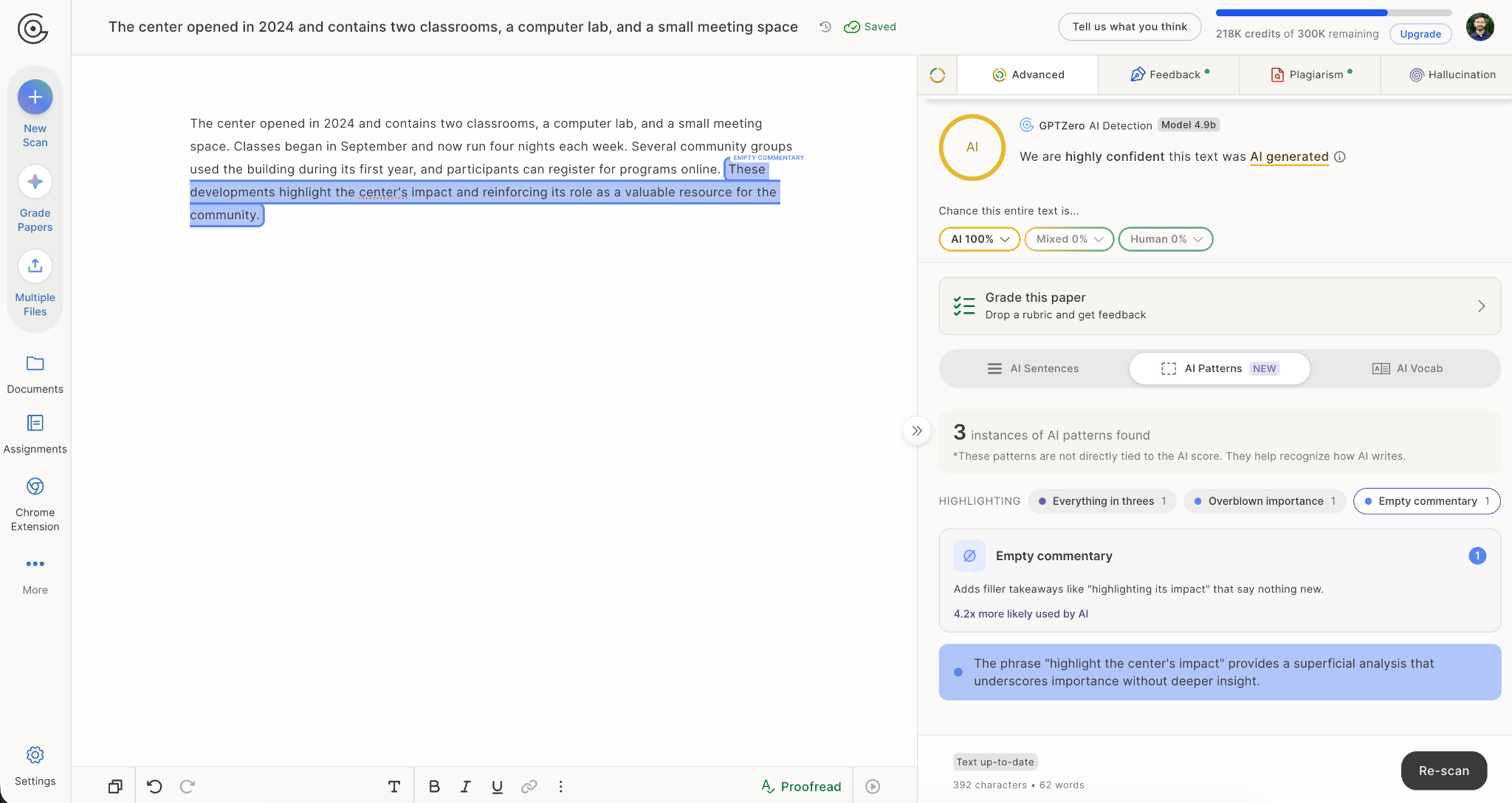
Empty Commentary
LLMs also tend to insert superficial analysis to make sentences sound more analytical without giving suitable evidence.
Sales-pitch Tone
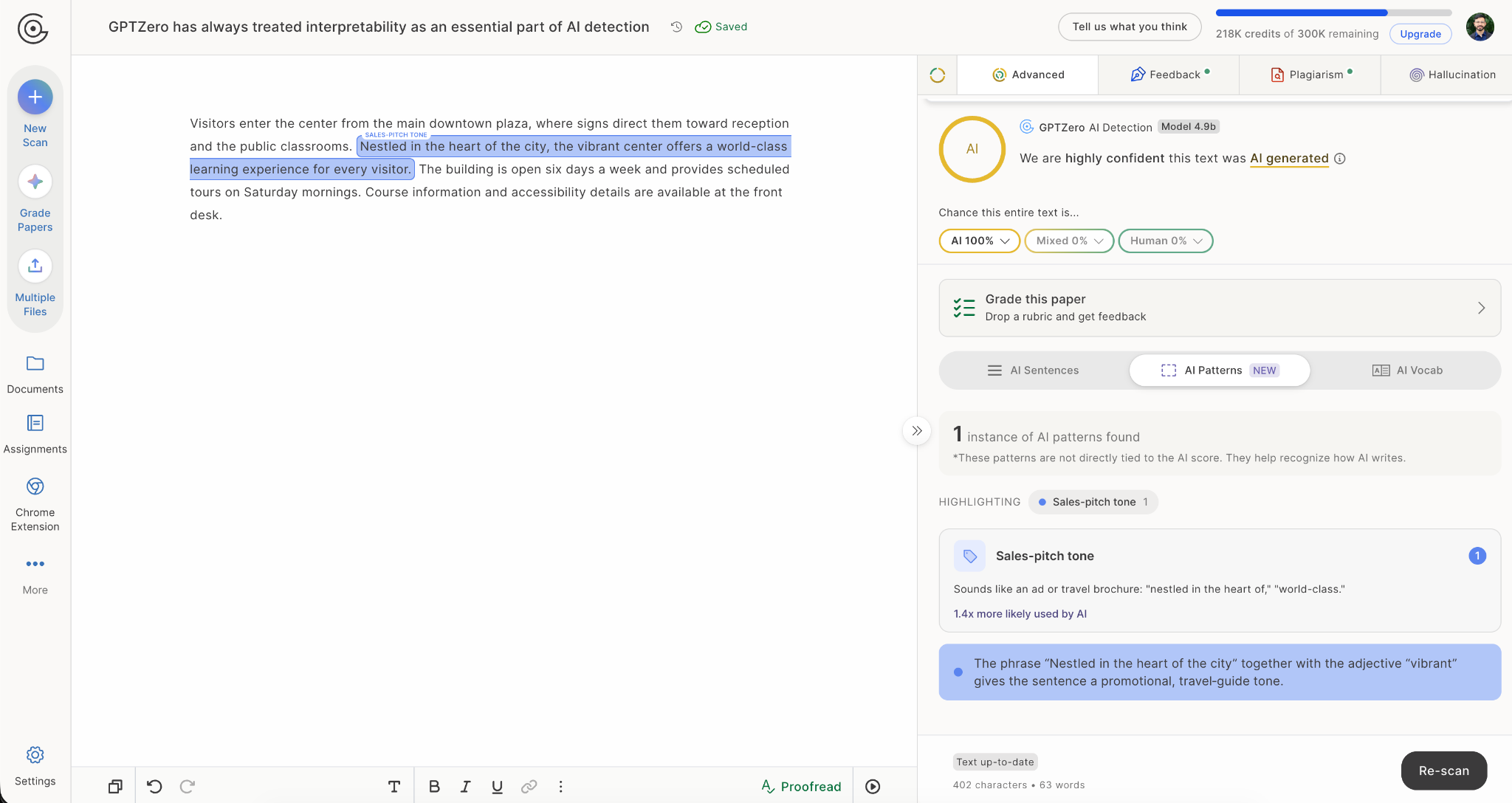
LLMs also have a tendency to use an advertising-like writing style rather than a neutral tone.
In this example, the LLM uses phrases such as “Nestled in the heart of the city” and “vibrant” which makes the document sound like it came from a travel guide.
Phantom Experts
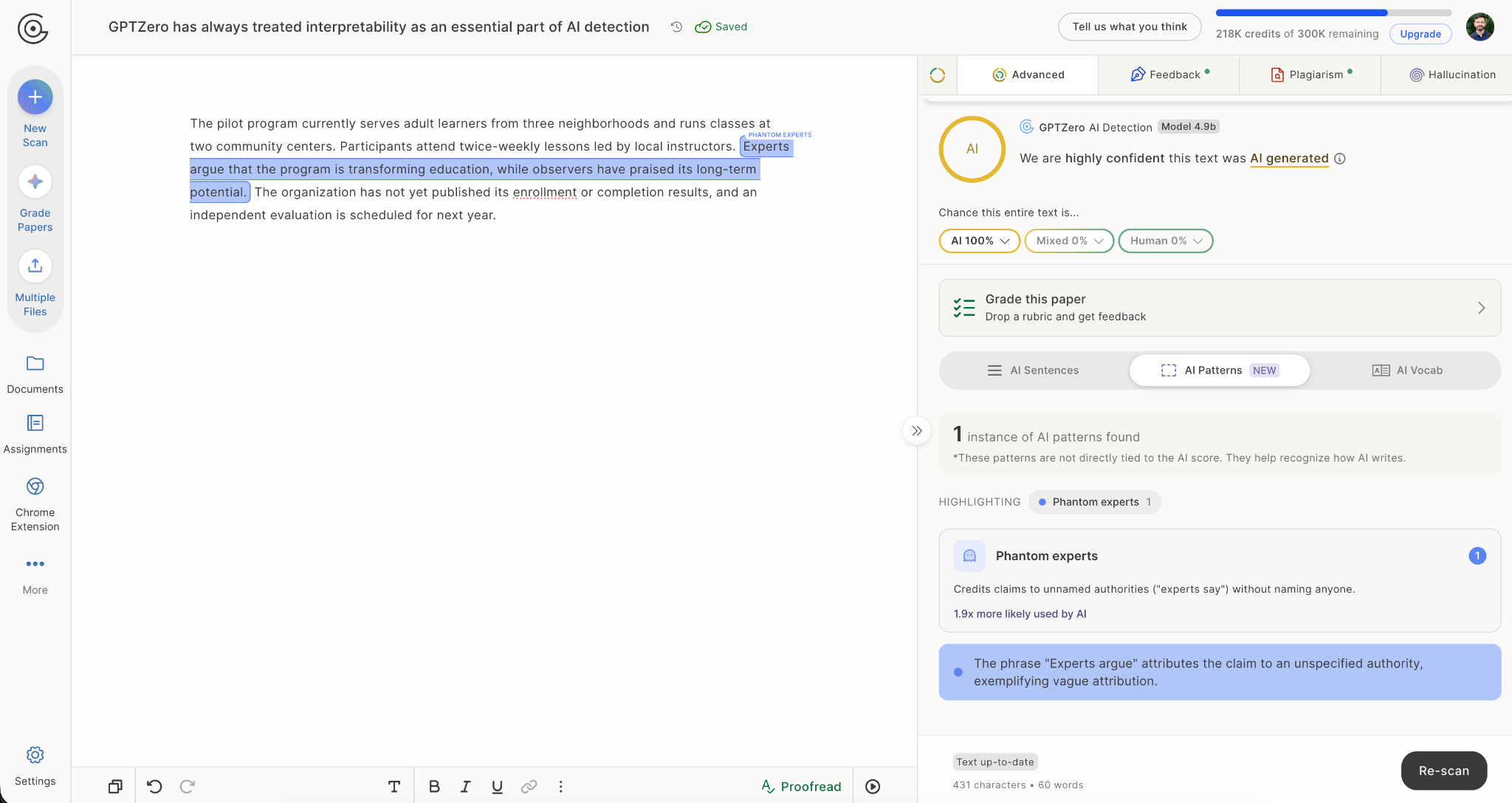
This pattern assigns a claim to unnamed authorities instead of identifying a source.
In the following example, the LLM attributes a claim to an unknown authority using the phrase “Experts Argue”.
Dressed-up Verbs
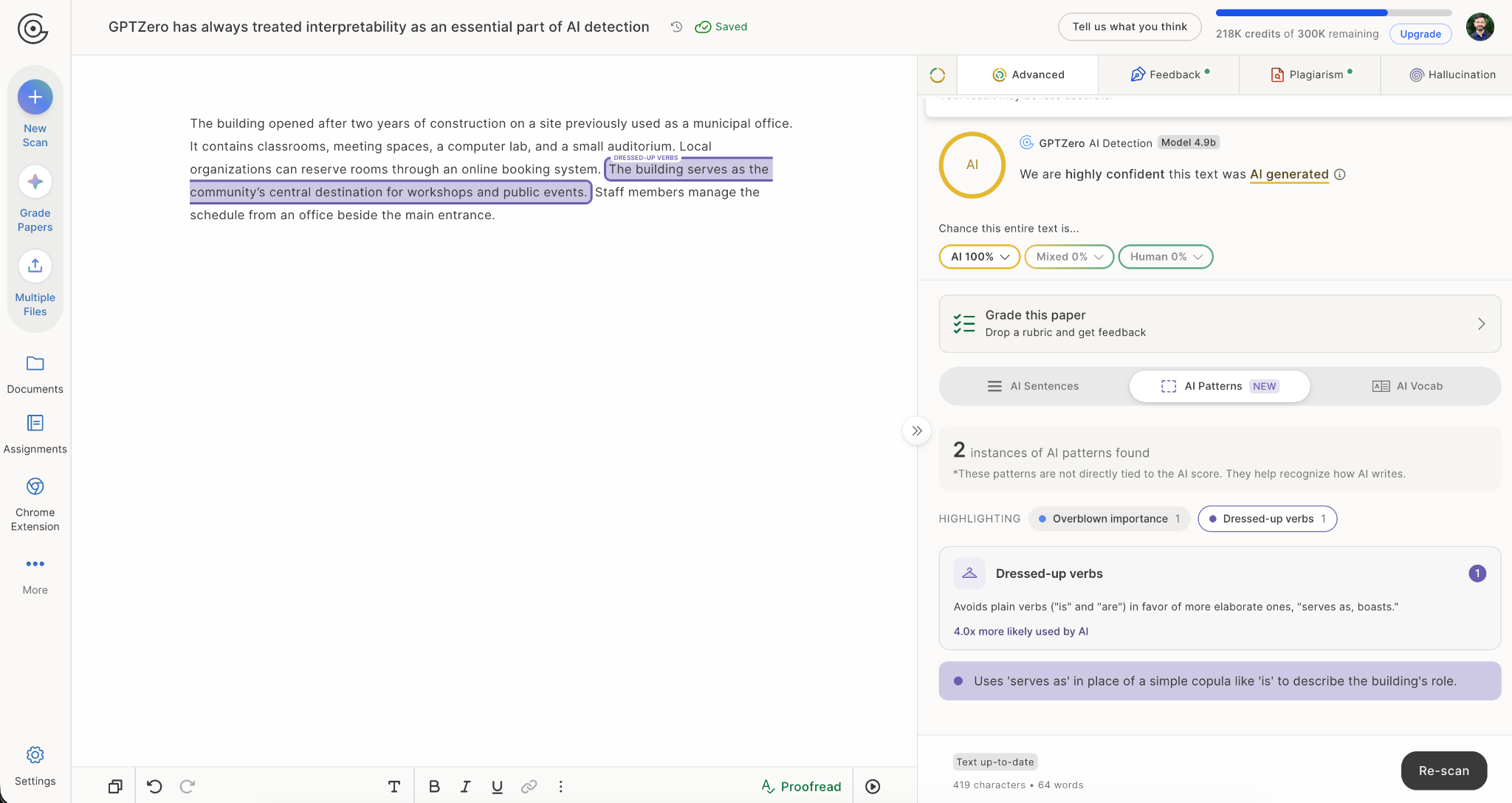
Instead of using simple verbs such as “is” or “are,” LLMs have a tendency to replace them using elaborate-sounding constructions, including “such as” and “serves as”.
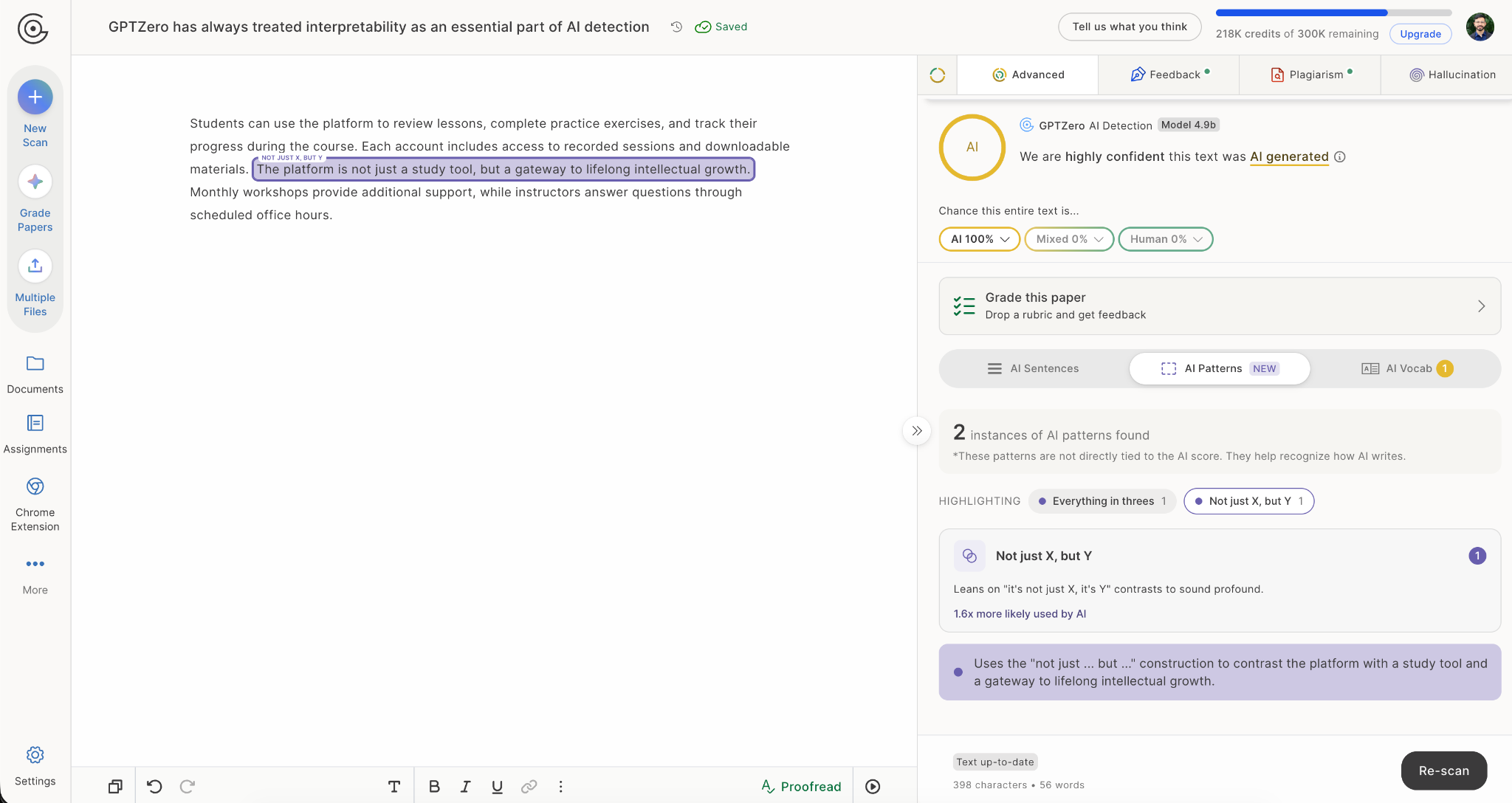
Not just X, but Y
To give a claim more importance, LLMs can directly reject a statement and then follow that up with a more expansive one.
In the following example, the LLM uses a “not just X but Y” structure to present a claim.
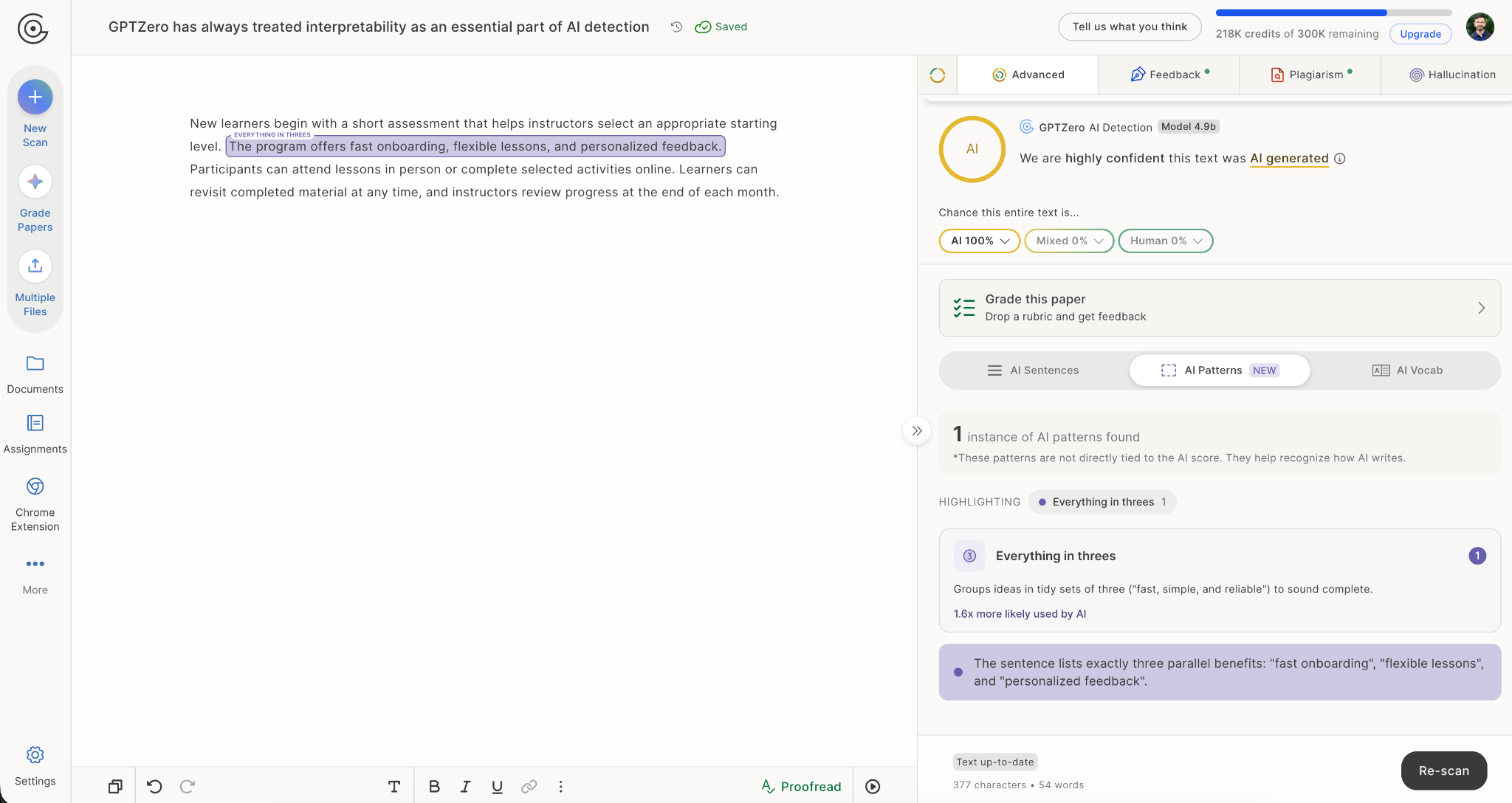
Everything in Threes
This is another classic AI trope, where an LLM tends to present ideas using three parallel items to make the writing sound tidy. This can make the clause sound mechanically polished.
In the following example, the sentence lists three parallel benefits: “fast onboarding”, “flexible lessons” and “personalized feedback”.
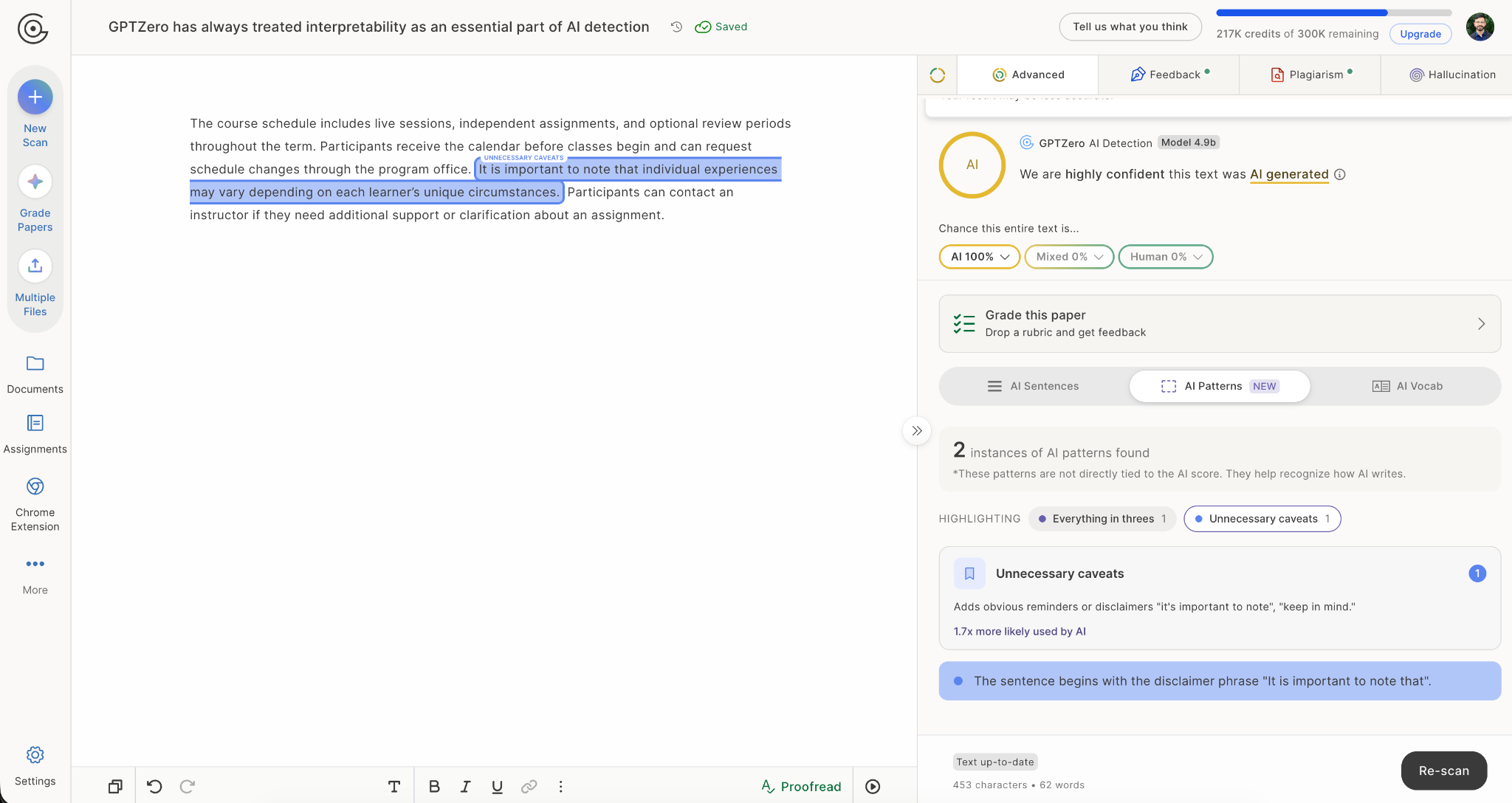
Unnecessary Caveats
LLMs also tend to provide disclaimers or reminders that readers are likely to already understand.
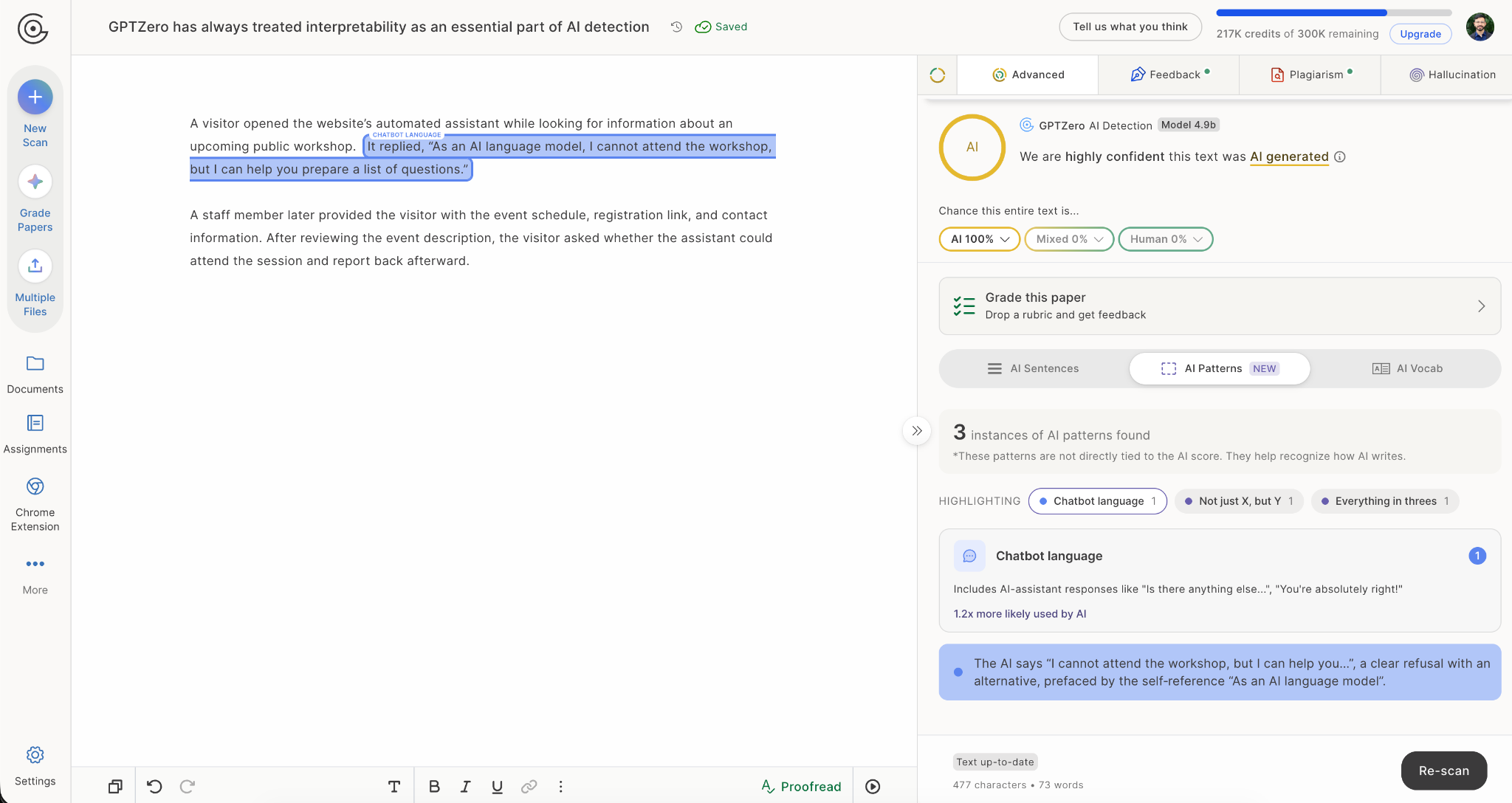
Chatbot Language
This pattern contains explicit AI-assistance or refusal messages. In the following example, the LLM uses the phrase “As an AI language model” to refuse a user’s request.
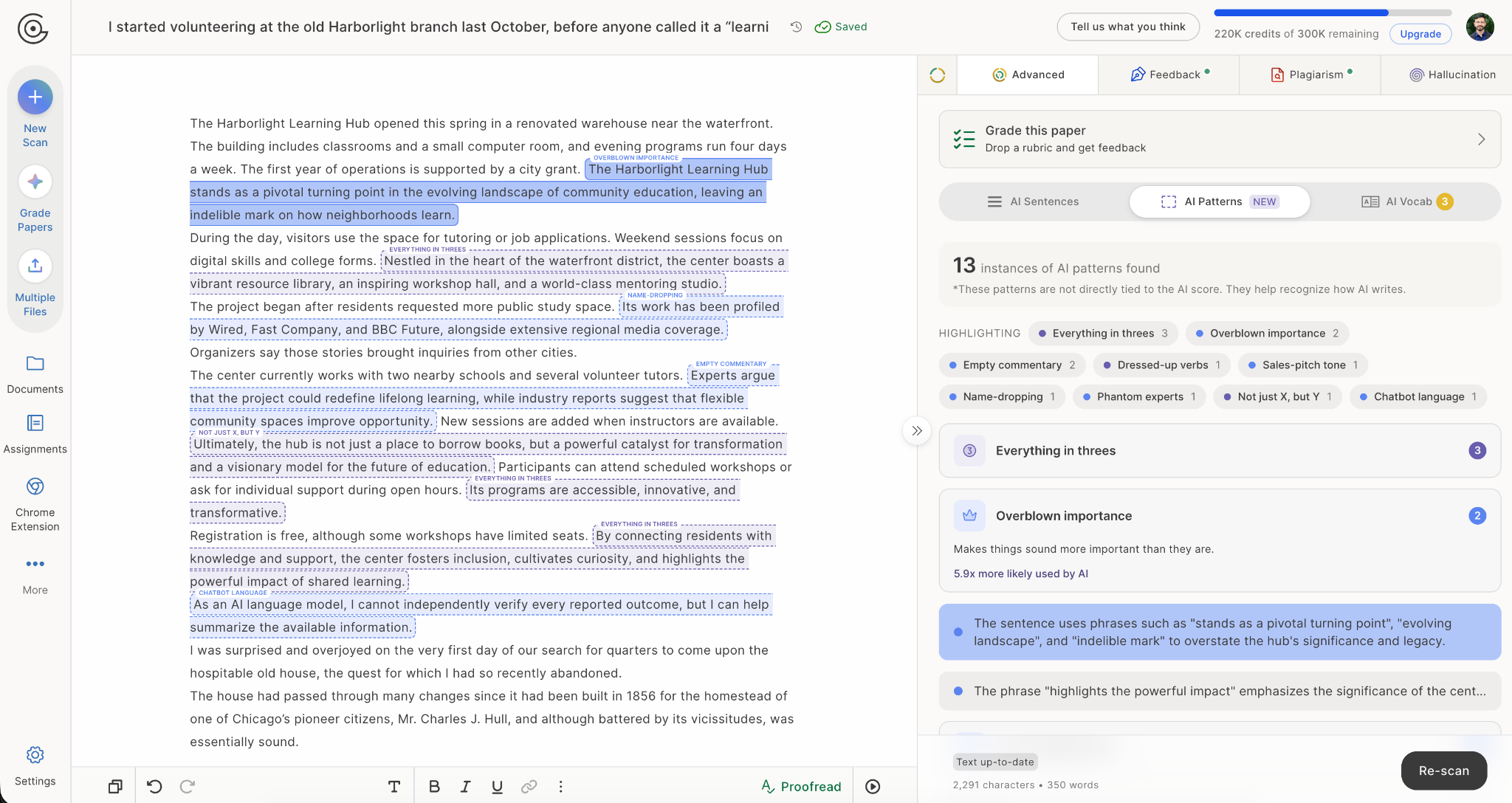
The following example combines several AI patterns into a single document and triggers multiple AI detections at once.
How Do AI Patterns Work?
We found that these patterns occurred more frequently in AI writing compared to its human-written counterparts. We mined our database of human-written and LLM-generated documents to measure how much more frequently each pattern occurs in AI-generated text than in human-written text, expressed as a multiplicative factor (×).
To compile these statistics, we paired human-written source documents from several domains including essays, academic writing, social media, wikipedia, and creative writing, with corresponding AI document pairs sourced from a variety of LLM families such as GPT-5.x, GPT-4.x, Gemini 2.5/3.1, Claude 4.x, and Grok 4.3. We then measured how often each AI trope came up across the human-written and AI-generated texts.
When an AI pattern scan is triggered, our system scans the submitted document to identify sentences that match the supported AI tropes and generates a plain-language explanation for each match.
The recognized patterns are grouped into categories in the panel on the right. To focus on specific trope categories, the chips on the right can be selected, which then filters the highlighted sentences to the specific trope of interest.
Click an occurrence of the trope in the editor view or the drop-down view to bring the corresponding section of the document into focus. This makes it easier to move between the pattern’s definition and its use in context.
Looking Ahead
Our goal is to build industry-leading tools that help humans examine signs of AI writing.
We have made significant advancements in AI detection interpretability by expanding our scan types from AI detection scans to AI Vocabulary Scan, Advanced Scan with Explanations and AI Patterns Scan. These scans offer different ways of understanding AI-generated writing and the signals and patterns that contribute to an assessment.
We also note that AI writing style is a moving target that changes as models, prompts and editing habits evolve. To this end, we will continue to expand our AI trope taxonomy by analyzing new data and identifying emerging AI-like writing patterns.
Try AI Patterns in Advanced Scan and let us know which writing patterns you would like to see next.