How to Create a School Budget
A school budget is a formal plan for protecting what matters most to an institution. Here’s how to create one step by step.


If you’re a teacher hoping to someday be part of your school’s senior leadership team, you’ll need to know how school finances work. In RAND’s spring 2026 survey, budget shortages were flagged as the most common concern, voted by 54 percent of district leaders (a big increase from the 33 percent who named this as one of their three most pressing concerns in 2025).
The cost of running a school only keeps getting higher, with the latest US Census Bureau data showing public-school spending per pupil rose 6.6% in fiscal year 2023, reaching $17,619. This has made knowing the nuts and bolts of a school budget more crucial than ever. In this guide, we show you what a school budget is and how it comes to be.
TL;DR
A school budget is based on numbers, but is also a formal plan for protecting what matters most to an institution. It starts with understanding which costs are fixed, where there is room to adjust, and what could happen under several different scenarios. If you’re putting one together, start with consulting stakeholders early enough for their input to count, then keep comparing planned spending and revenue with what is actually being received and spent on a regular basis.
Understanding School Budgeting
A school budget is a financial plan that looks at the anticipated amount of revenue coming in and going out, setting out how those funds are going to be spent across everything needed to keep a school running.
For public schools in the US, that revenue usually comes from a variety of places. According to the Census Bureau, state governments gave 45.2% of public-school funding in fiscal year 2024; local sources gave 43.2%; and the federal government provided 11.6%. This combination can fluctuate from district to district, and it’s important to clarify if the source is linked to enrollment.
While the final budget may plan for a single year, the work starts months before approval and projects several years ahead. As the following video shows: “A budget isn't just a spreadsheet or an expense ledger. It's a public promise…. If it's not in the budget, it probably won't happen.”
What Should a School Budget Include?
While each category will differ according to each school system, most take into account the following:
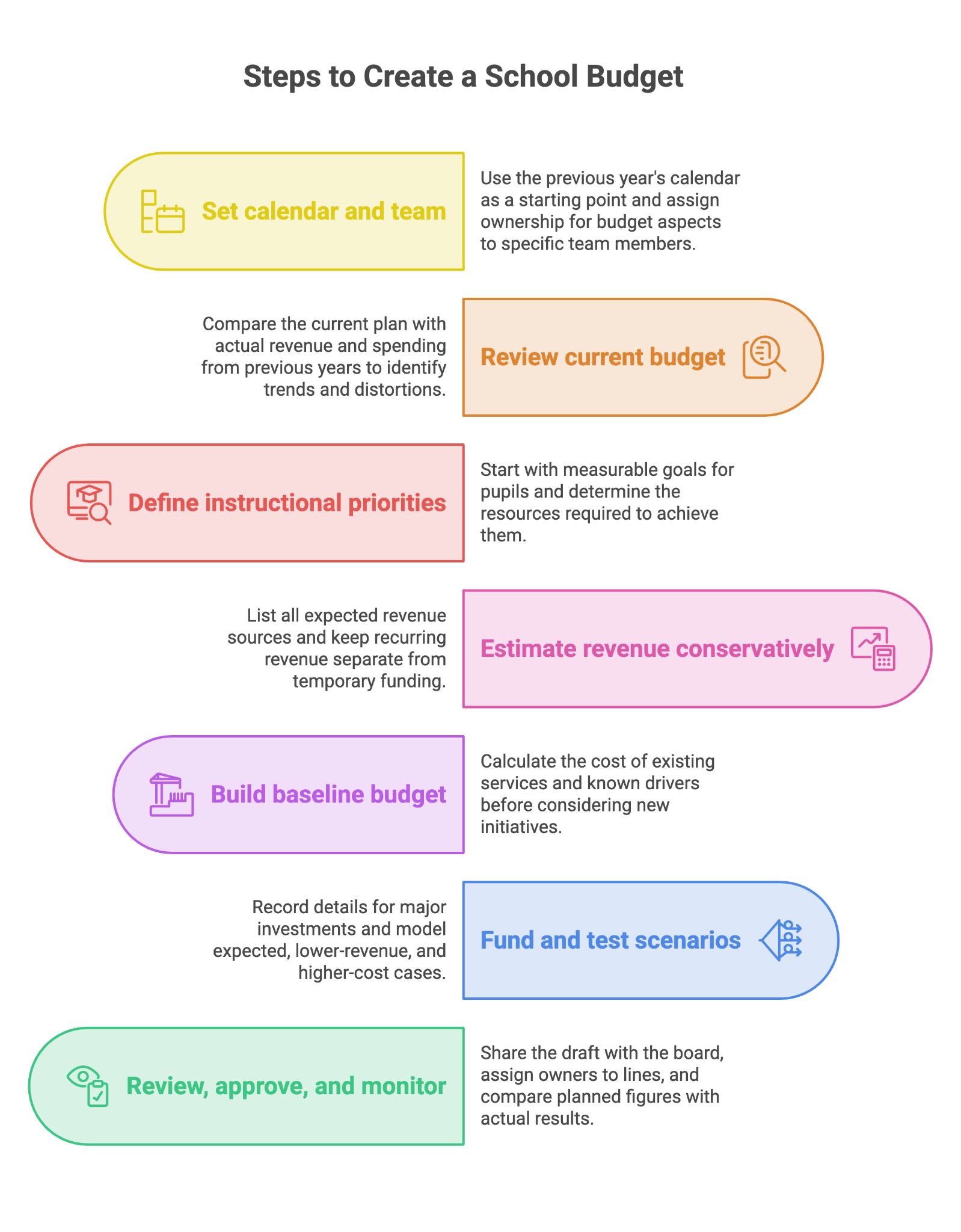
How to Create a School Budget Step by Step
1. Set the calendar and assemble the team
School budgets are rarely put together by a single person and are not thrown together quickly. The first step is to know how long you have to put together the budget, often based on the previous year’s calendar.
Then know who is going to help. While the finance team might be in charge of testing affordability, facilities leaders might be the ones to keep an eye on contracts and replacement cycles. As the group is put together, assign ownership for each aspect.
2. Review the current budget and recent actuals
Before starting next year’s budget, it’s worth holding the current plan with actual revenue and spending from last year’s results. The National Center for Education Statistics explains that “problems that occurred in the prior year's budget cycle should be identified for changes to the current year's calendar.”
Where was there over- or underspending? Which “one-time” costs keep returning? If you can, take a look at multiple previous years where possible, as emergency funding or capital projects can distort the true reality of a typical single year.
3. Define instructional priorities
A budget will ideally start with what the district is trying to ultimately achieve. Our own survey of the GPTZero education community shows how wide-ranging those priorities can be: six in ten respondents (61%) said schools underfund teacher training and professional development, while 58% selected technology and digital tools. Classroom resources and staffing support were each selected by 45%.
“It can be tempting to take an incremental approach to school budgets - but sometimes we need to step back and start from first principles,” says Warren Porter, Head of Education Strategy at IMP Software.
He explains that an incremental budget might start with, ‘How much more or less do we spend this year compared to last?’ But ideally, he says, “A needs-led budget, on the other hand, begins with: ‘What do we want to achieve for pupils, and what resources will it take to get there?’”
4. Estimate revenue conservatively
List each expected revenue source but also track what could affect it, such as changes to enrollment or attendance. Also, make sure to keep recurring revenue separate from temporary funding.
For example, if a two-year grant pays for permanent staff, the district has to know how those salaries will be covered after the grant ends. Usually it’s more sensible to use one-time money for one-time costs, such as equipment, instead of a commitment that the general fund cannot keep up with.
5. Build the baseline budget
Before adding new initiatives, know the cost of keeping up the existing services, which can include salary increases that have already been negotiated, transportation contracts, debt payments, and other known cost drivers.
Once you do this, you might find a structural gap, which will have to be acknowledged before any new requests are considered. If you can spot a gap early then it gives you more time to try and seek new funding.
6. Fund priorities and test different scenarios
It can be hard to rank new spending requests against the agreed priorities and evidence of need, but it’s easier when there’s more data attached to each priority. For each potential major investment, model at least several versions: an expected case, a lower-revenue case, and a higher-cost case.
For example, see what happens if enrollment falls by 3% and a grant is not renewed, and then come up with a plan with which spending would be protected, delayed, reduced, or removed.
7. Review, approve, and monitor
After you’ve got a draft, share it with the board and community so that any major concerns or questions can be dealt with. Instead of just writing down variances, know where they came from.
For example, if your substitute spending is higher than anticipated, look at whether it’s linked to a broader retention issue, and the forecast should be updated accordingly.
Once the budget is approved, each line should be assigned to an owner and planned figures should be compared with actual results regularly.
School Budgeting Best Practices
Link spending directly to student outcomes
“The budget ought to tell the financial story of what matters to us,” says superintendent of Wilton Public Schools, Dr Kevin Smith. In other words, each request should spell out exactly what will change for students and how the district will know whether it worked.
Use multi-year projections
A balanced budget for next year can hide a future problem, while a three- to five-year forecast will include enrollment, revenue, staffing, contracts, capital needs, and reserves. It will also show potential funding cliffs and areas where costs might rise.
Show your assumptions
Track the evidence behind enrollment forecasts, inflation assumptions, grant expectations, vendor quotes, and cost estimates. If your team uses AI to summarize grant guidance, make sure to check the original sources yourself: GPTZero’s source finder can help locate evidence for claims.
Involve the people affected before any final decisions
In our own survey of the GPTZero education community, “asking teachers for input” was the most selected way school leaders could make better budgeting decisions, chosen by 53%. Using data to identify the greatest needs and prioritizing spending that directly affects students followed closely, both at 52%, while 48% called for more transparent communication.
Consultation is not meaningful if families and staff only see the budget after every choice has been made. The GFOA’s public-engagement guidance advises starting early enough for public input to influence decisions and showing the information with a narrative and format that makes it easy for anyone to immediately understand.
How to Present the Budget to Your Board and Community
As school business administrator Jim Rollo puts it, a budget is “where the rubber meets the road of what the district’s goals are.” The numbers make more sense when each major increase or reduction is connected to its goal. He also says that a great district budget presentation can happen in three key steps:
Bring to mind what’s happened
Start with the current year: what did the board approve, what was achieved, and what changed? This creates continuity between previous decisions and the new request.
Make it really simple
Show the full budget, but lead with the numbers that explain the story in a way that’s easy for people to understand. It’s helpful to use plain language, charts, and per-pupil figures.
Be ready to explain why things happened
While you might have been working on this for months, and be very familiar with each number, the people you’re presenting to might be only just hearing this all for the first time. Have explanations for why anything might have changed.
Free School Budget Template
A budget worksheet can start with this structure:
There’s also this helpful school budget planning worksheet or published DC Public Schools budget worksheets, which you can adapt to take into account your own institution’s rules, accounting system, and approval process.
Conclusion
A school budget is a statement about what a school values. It begins with realistic revenue and spending data as well as an understanding of existing commitments. Not every priority can be funded at once, and the strongest budgets make those trade-offs easy to see rather than trying to hide them.
Keep checking the budget against what is actually happening, and update forecasts when circumstances change. A school budget is a living plan that helps leaders respond to uncertainty without losing sight of students. While it may evolve, the stronger it is to begin with, the more inspiring it is likely to be.
FAQs
How do you create a school budget plan?
It starts with setting a budget calendar, reviewing recent actuals, getting clear on instructional priorities, estimating revenue, and also calculating the cost of maintaining current services (which can then help to set the priorities for new investments). It helps to test several scenarios before you get approval, and also to keep track of actual vs. planned results.
How often should a school review its budget?
While each school typically takes a year-long approach with an annual budget, the actual vs. planned revenue and spending should be tracked on a monthly or quarterly basis. You should also adjust forecasts if there are changes in enrollment, funding, or staffing, or if other major assumptions evolve.
What happens when a school budget falls short?
If this happens, it needs to be confirmed whether the shortfall is temporary or structural, and exactly what the causes were. Then, there are options to freeze vacancies, reallocate funds, or use reserves under an approved policy. There’s also the option to look for additional revenue.