
GPTZero Research Motivates Major arXiv Ban on AI and Hallucinated Citations
arXiv’s new one-year ban for unchecked AI-generated content marks a turning point in the fight against hallucinated citations.


arXiv is one of the world’s largest open-access archives for nearly 2.4 million scholarly articles.
On May 14th 2026, Thomas Dietterich – the chair of arXiv’s computer science section – announced a new rule: if an author submits a paper that has unchecked AI-generated content, including hallucinated citations, they will face a one-year ban from the platform.
Attention @arxiv authors: Our Code of Conduct states that by signing your name as an author of a paper, each author takes full responsibility for all its contents, irrespective of how the contents were generated. 1/
— Thomas G. Dietterich (@tdietterich) May 14, 2026
Over the past year, GPTZero has played a major role in motivating this decision and a broader shift in how academia addresses AI-generated and assisted research.
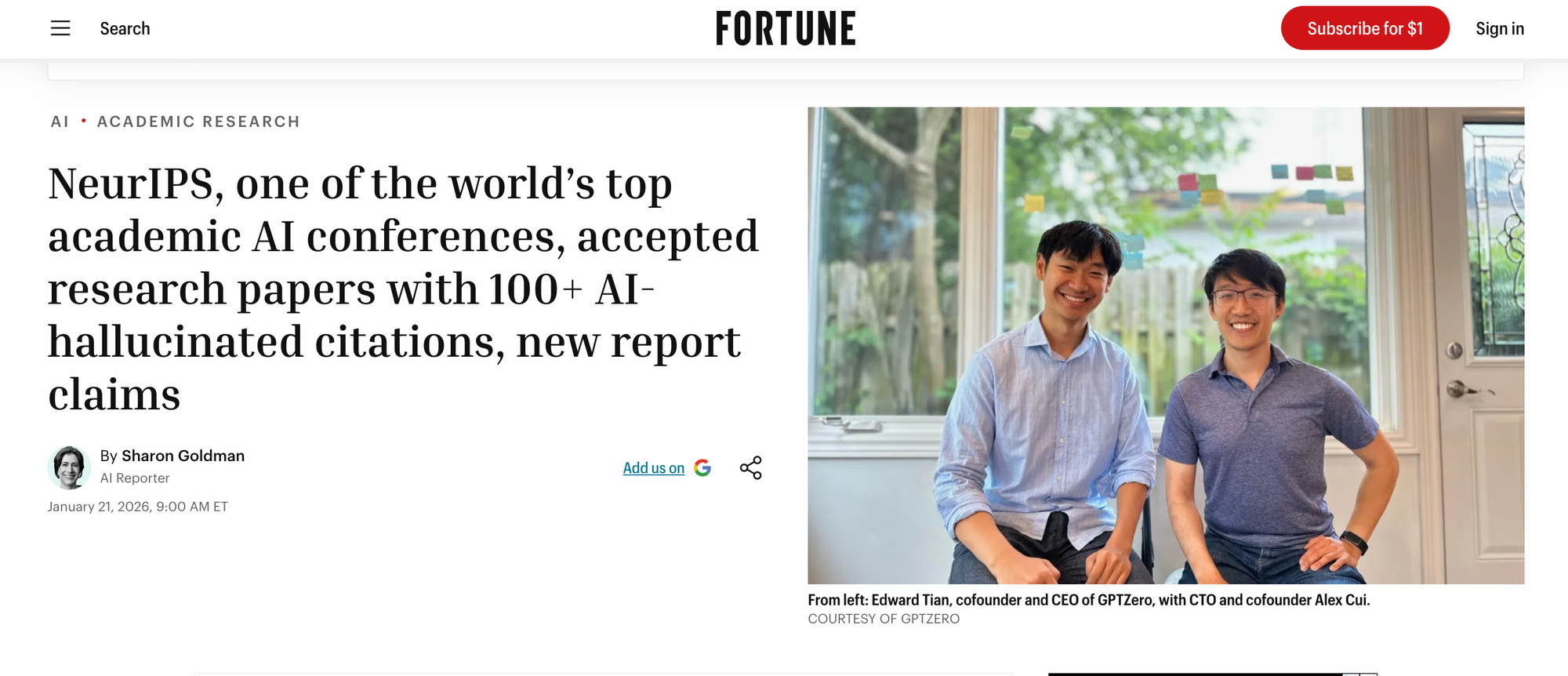
In January this year, we found over 100 hallucinations in accepted NeurIPS 2025 papers, one of the world’s most prestigious machine learning conferences. Fortune broke the news on GPTZero’s investigation.
TechCrunch also covered the investigation, questioning, “If the world’s leading AI experts, with their reputations at stake, can’t ensure their LLM usage is accurate in the details, what does that mean for the rest of us?”
As our founder Edward Tian told Fortune, “It’s definitely a bigger escalation in the sense that these were the first documented cases of hallucinated citations entering the official record of the top machine learning conference.”
It led to widespread discussions of AI use in academia and even cases of notable professors like Kyunghyun Cho (the Glen de Vries Professor of Health Statistics and a professor of computer science and data science at New York University) publicly admitting their mistake and correcting it:
i was made aware of miscitations thanks to the GPTZero team (cc @alexcdot). ji won and i quickly checked them ourselves and have posted what happened on openreview: https://t.co/FPCY5ZsQEk. we have already notified NeurIPS'25 PC's about this issue.
— Kyunghyun Cho (@kchonyc) January 22, 2026
i truly thank the GPTZero… pic.twitter.com/D8Hh1Y97B7
This is what leads us to today, and to arXiv’s decision to draw a much firmer boundary around author responsibility – making unchecked AI-generated content and hallucinated citations into a much more serious research integrity issue.
According to the full statement on X by Dietterich, authors are fully responsible for the contents of their work – and if a submission contains “incontrovertible evidence that the authors did not check the results of LLM generation, this means we can't trust anything in the paper.”
arXiV is a central part of the academic publishing ecosystem, particularly in physics, mathematics, computer science, quantitative biology, quantitative finance, statistics, electrical engineering and systems science, and economics.
For many researchers, it plays a crucial role in sharing new work and making research accessible before formal publication.
The danger of hallucinated citations is finally becoming more recognized. Beyond building a broken and false trail of evidence, they also waste people’s time and can undermine credibility of both the authors and the institutions they represent.
At GPTZero, we’ve seen how serious the problem is. Since GPTZero launched our Hallucination Check tool to catch hallucitations in January 2025, we’ve tested it on RFK Jr.’s “MAHA” report, a scandal-ridden Deloitte Australia report, and hundreds of other documents.
We also used it to scan a sample set of 300 ICLR papers submitted to OpenReview. Our tool flagged 90 papers as containing at least one citation that appeared to not exist online. Following human verification, we determined that 50 papers included at least one actual hallucitation.
Notably, in December 2025, we used our Hallucination Check tool to find over 50 hallucinated citations in ICLR 2026 submissions, each of which had been missed by multiple peer reviewers.
Recently, we chased down every citation in an Ernst & Young (EY) Canada cybersecurity report on loyalty program safeguards. We found most were hallucinated, and the FT covered the story of how EY subsequently retracted the study.
Our AI detection model contains seven components that process text to determine if it was written by AI. We use a multi-step approach that aims to produce predictions that reach maximum accuracy, with the least false positives. Our model specializes in detecting content from ChatGPT, GPT 4, Gemini, Claude and Llama models.
We are proud of our mission to preserve what’s human and to be building an authenticity layer for the internet.