A New Dawn of More Meaningful AI Text Detection
We’re focusing on the content that matters most, to make our AI detector even stronger.


GPTZero pioneered interpretability in AI detection, first with precise sentence-level highlighting, then with the importance-based highlighting from Advanced Scan, our proprietary algorithm for visually communicating the most AI-like parts of a document. Users can expect this highlighting to be faithful: remove a section that’s highlighted as human, and the AI score increases, and vice versa.
Still, users wonder why paratext – the material around the main writing, such as headings – is sometimes highlighted as AI and other times as human. Labelling this material as either human- or AI-written can be misleading, as arguably, such content is neither. It brings up whether there are some parts of a document that should be excluded from AI detection altogether.
In a bold step to make AI detection results more intuitive, GPTZero is taking an opinionated stance on paratext. Paratext such as headers, URLs, frontmatter, and bibliographies all share something in common: they are easy to edit/replace, making their origin harder to gauge. Also, if used as a feature by an AI detector, paratext is unreliable and can affect predictions, which is undesirable since what should be evaluated is actual content.
This is why we’re introducing ‘Meaningful AI Detection’: GPTZero’s AI Detector now masks headers as of our August 1, 2026 model release 4.8b. This means that our detector does not consider headers as a feature, removing this as an attack vector for bypassers.
We’ve also changed how we communicate these results to users by introducing a third highlighting color: gray. Gray spans in our dashboard or chrome extension indicate pieces of text which are ignored by our detector. As always, these benefits are available to all users, and are meant to improve user education about what should and should not be considered to be AI-generated.

Why This Matters
These changes mean that you can expect even more consistent results, and a score based on the main writing itself (and not the bits around it that can be changed quickly and easily). It also means AI detection results will be harder to manipulate by just changing the headers of a document.
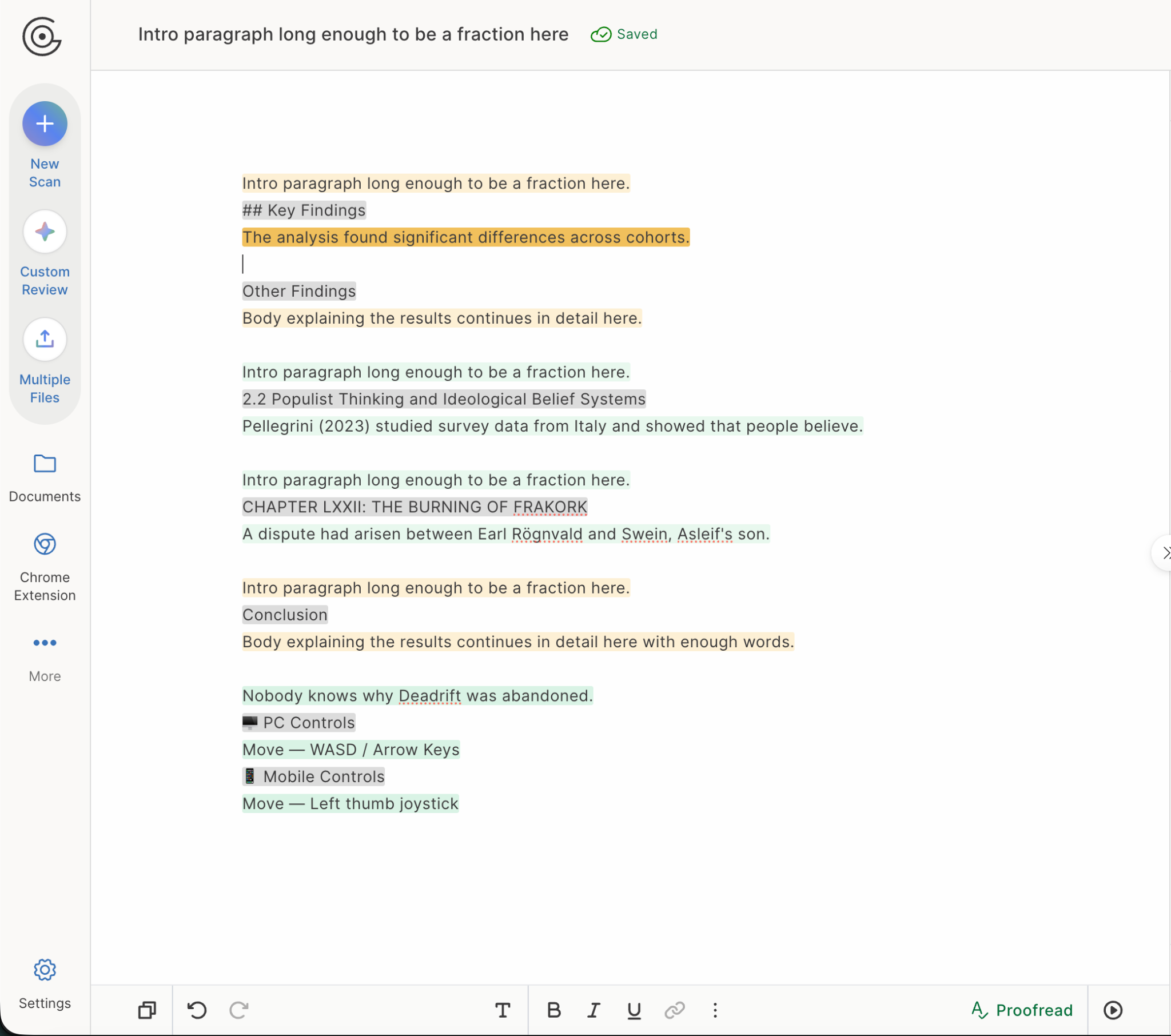
After all, detecting headers is far from trivial. They come in all kinds of shapes and sizes, can be stacked one on top of another, and when following simple heuristics, non-headers can sometimes appear to be a header. Figure 2 shows some of the common header types we have prioritized as part of our initial release of Meaningful AI Detection. Markdown indicators, common header phrases such as “Conclusion”, and even short lines starting with an emoji are now considered to be headers, and are excluded from AI detection as indicated by the gray highlighting.
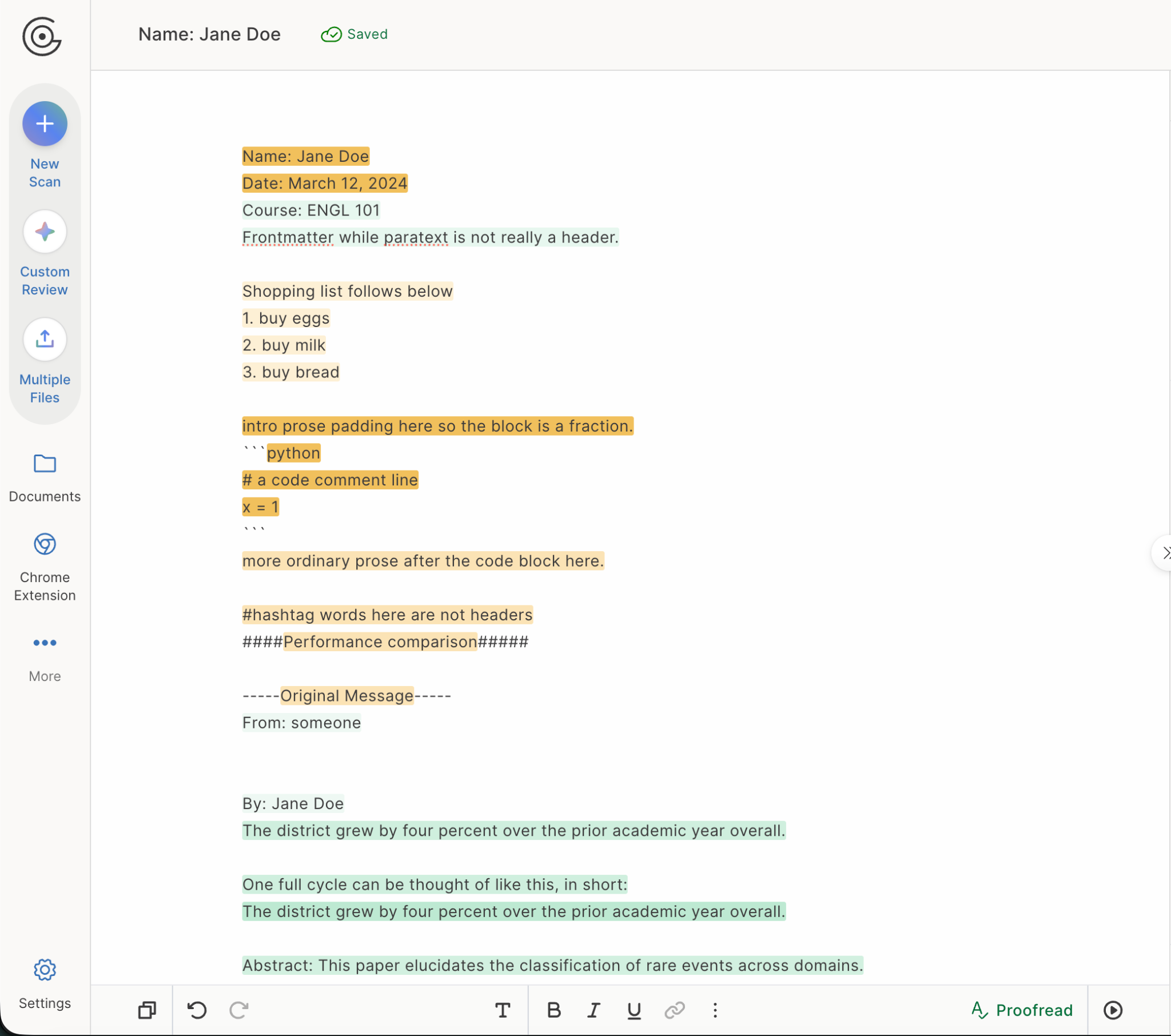
In developing these header detection rules, we came across scenarios where content should not be detected as a header. Figure 3 shows examples where a prefix to a list, a code block description, a hashtag, and an introduction to an email. These are explicitly encoded in our rules as content that should not be counted as a header, though the “By: Jane Doe” is paratext that will be excluded as part of a future release, but it is not technically a header.
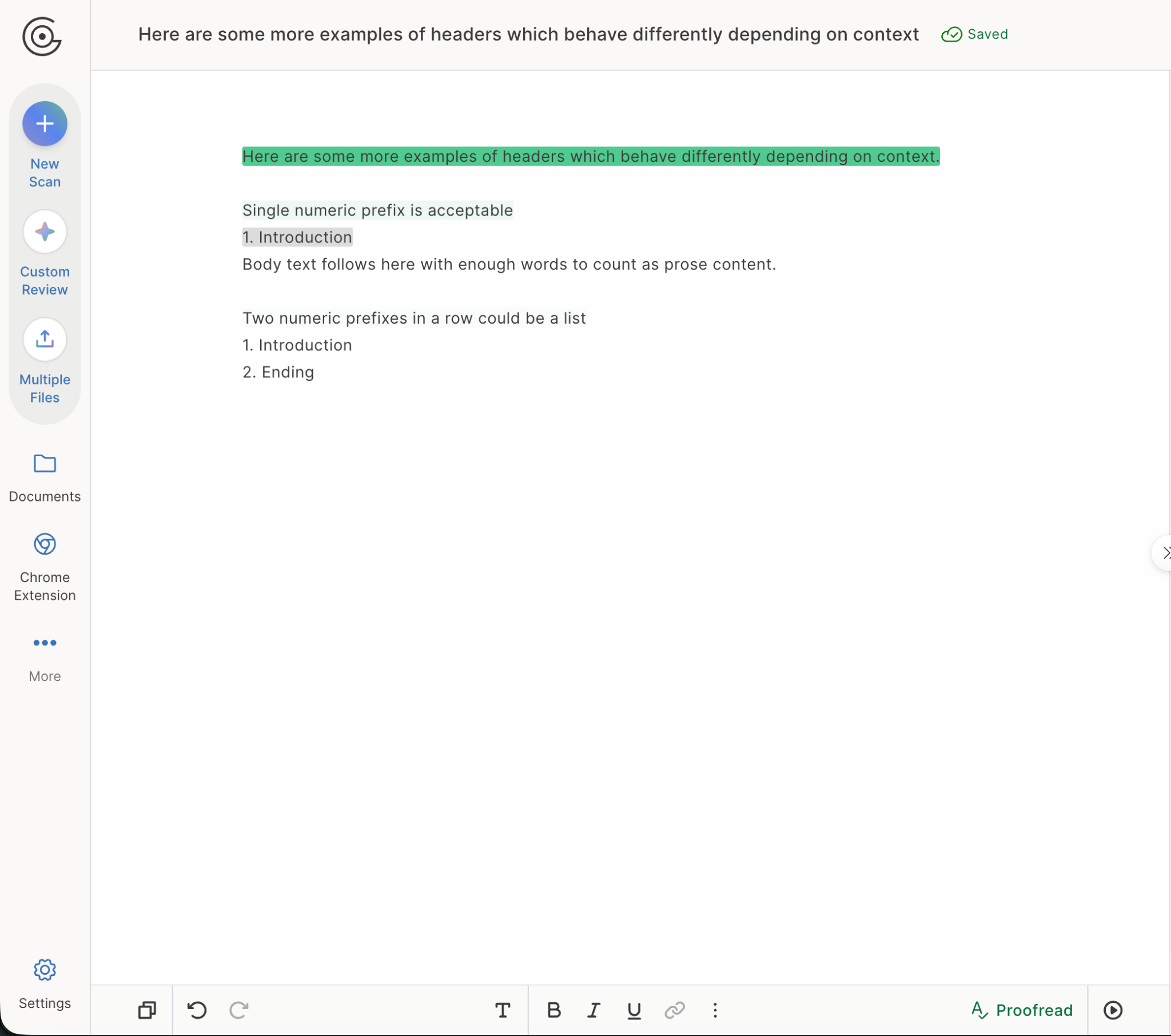
Header detection is also contextual. For example, Figure 4 shows that when there is a numeric prefix, such as “1. Introduction” can be detected as a header on its own, but when followed by “2. Ending”, that could potentially indicate a list, so it is not captured.
We welcome feedback from users regarding what style of headers they would like to see masked next.
Case Studies of Improved Predictions
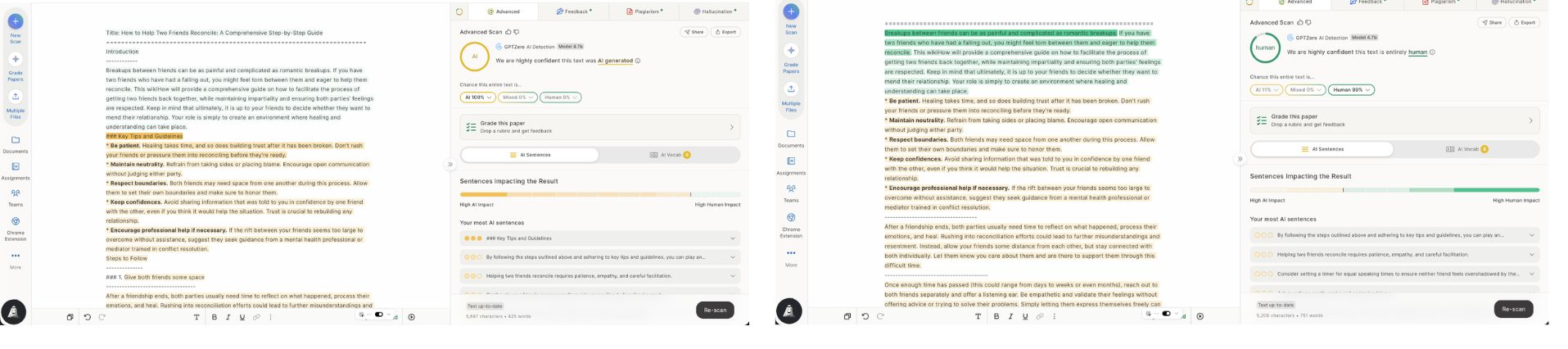
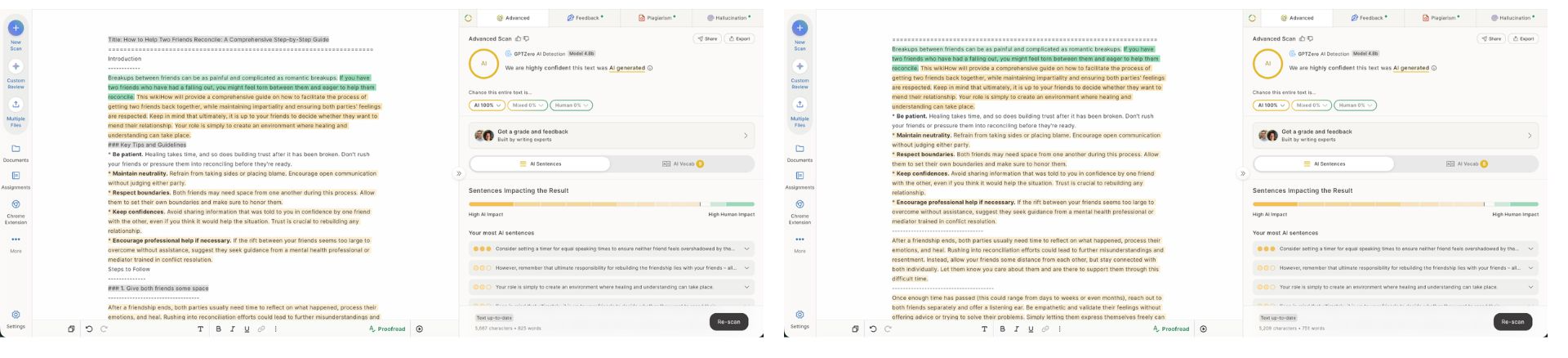
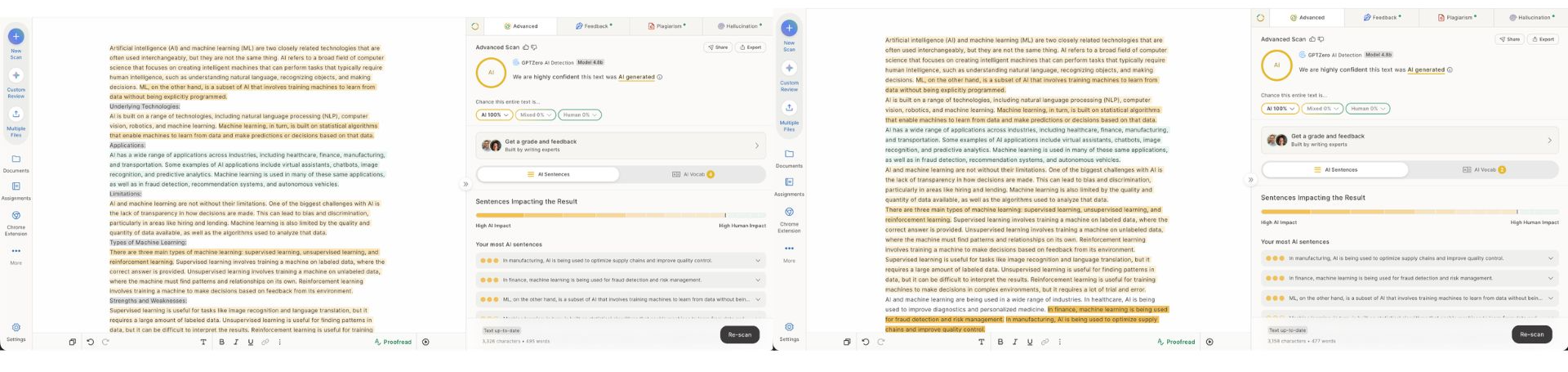
Below are some examples of texts that are now no longer subject to having different AI scores when headers are added or removed. Figure 5 shows the predictions of our previous model version 4.7b on an AI text with and without its headers. The AI score drops considerably when the headers are removed. Our new model version 4.8b ignores headers altogether, making the exact same prediction whether or not they’re included as per Figure 6.
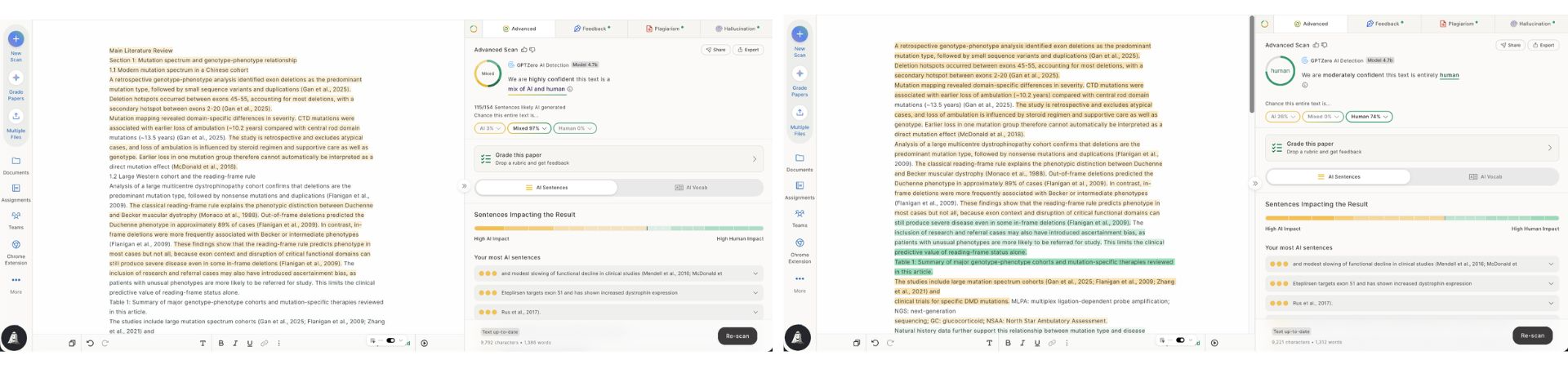
Likewise, Figure 7 shows that version 4.7b incorrectly predicted an AI text as mixed when headers were included, and then went on to incorrectly predict human when headers were removed. Version 4.8b confidently predicts AI in either scenario as per Figure 8.
We note that examples of predictions flipping on our previous model are very rare, and had to be mined from a large dataset. However, our commitment to making sure that our users get the best detection results means that we actively improve our detector, even if the issue happens on a small scale.
Looking Ahead
Headers are the first form of paratext that we are removing from AI Detection consideration. We continue refining our ability to detect headers, achieving the best possible tradeoff in terms of capturing headers while not masking out actual content.
Additionally, we will be expanding the set of paratext that is masked to other categories, including frontmatter and bibliographies. For bibliographies in particular, we believe that AI-generation here is best captured by our Hallucination Scan product, which verifies citation existence.
There may be formatting quirks and idiosyncrasies that LLMs exhibit when generating paratext that can be used to gain an edge in AI detection, but this is not robust. By improving robustness to paratext, and how these results are communicated to users, GPTZero paves the way for a new era of Meaningful AI Detection.