Writing Checklist for All Writers (Freelance, Academic & More)
Every type of writing has its own submission requirements, and you should make sure your writing meets all those requirements before submitting. Here's a writing checklist for all types of writers.

There was one time early in my career when I confidently submitted a 2,000-word blog post, only to realize (after the client's very confused email) that I'd somehow missed an entire section they'd requested in the brief.
When I looked back on what went wrong, I recalled that I hadn’t consulted my writing checklist before hitting send on that blog.
That was one hundred percent avoidable had I used a writer's checklist.
With this article, I want to share my writing checklist for freelance writers and writers of other formats like academic, workplace, and creative.
These writing checklists will save you from countless "oops" moments. And if you’re consistent, they’ll also help you build a reputation for being thorough and professional.
Let’s start with the freelance writer checklist.
TL;DR
Freelance Writing Checklist
Creating a writing checklist as a freelance writing professional is an absolute necessity if you want your deliverables to be up to the mark. Below are some pointers you should keep in mind.
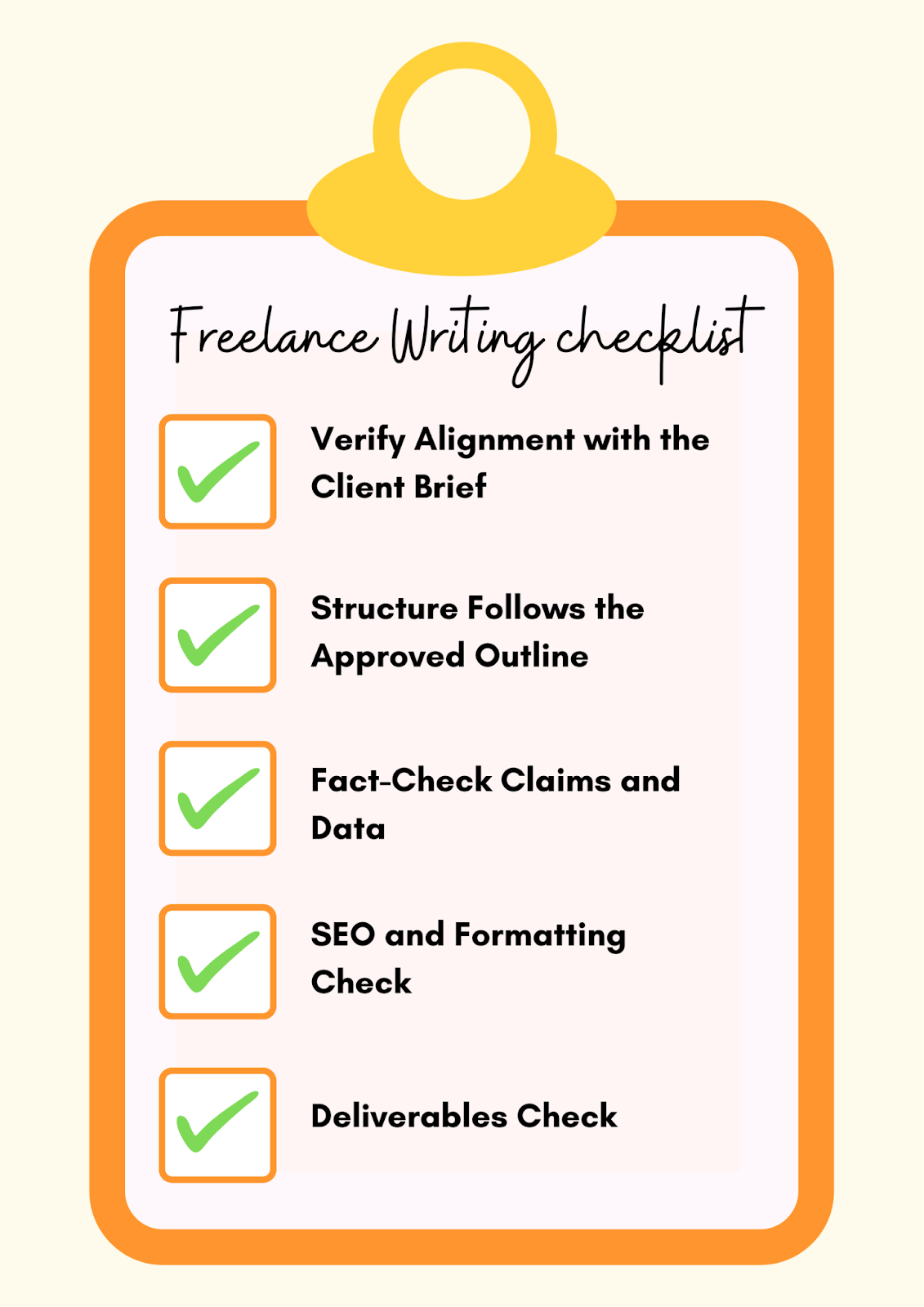
Verify Alignment with the Client Brief
This one can sound very basic.
But you’d be surprised how easy it is to lose track of the client brief when you’re on a writing spree.
Here’s what I do: when I’m done with writing, I open the original brief and read through it line by line with my finished draft open in another window.
When you have written enough times for a particular client, you might stop checking the client briefs or skim through them quickly.
But that’s a mistake. There can be specific points or questions for each project they might have wanted you to address or to avoid (could also be feedback based on your previous submission).
Sometimes clients mention things casually in emails or texts that don't make it into formal briefs. So also keep a mental note of that.
Confirm the Structure Follows the Approved Outline
Some clients stop giving you briefs after the first few times. Others who do give you briefs might stop including an outline in them. They can require you to make an outline and get it approved before you start writing.
But as a writer, it’s a common thing to make changes in your outline during drafting.
As you draft, you might find clearer ways to explain a concept, catch a mistake in your initial outline, or realize that a section needs to be split into two.
The trick is to make sure any deviations you’ve made have actually improved the quality of the article.
If you’ve taken care of that, there’s a good chance the client won’t make revision requests. They may even appreciate you for going the extra mile.
Fact-Check Claims and Data
Nothing tanks your credibility like a factual error. I learned this the hard way.
I once cited an outdated statistic in a healthcare article, which had long been challenged by more recent stats.
The client caught it. But imagine if the piece had gone live? Yikes.
So now I double-check every claim before submission.
For each piece of data, I'm asking things like:
- Is this from a reputable source?
- Is it current?
- Did I represent it accurately?
Also, make sure you’re not linking to a competitor’s website, especially if the client has explicitly told you not to do this.
Additionally, don’t fall for the kind of claims everyone has made but nobody's actually verified. Many a time, there’s no original source behind those claims at all. The websites are just citing each other in a loop.
So don’t be like them. Try to get to the source of the information and make sure that the source is credible.
SEO and Formatting Check
Freelance writers, especially SEO writers, mostly deal with on-page SEO, and keywords are a fundamental part of it.
For SEO, the first thing to do is to check that the primary keyword (based on which you’re writing the blog/article) appears in the title, introduction, a few subheadings, and naturally throughout the body.
Make sure it isn’t stuffed awkwardly. You should use it where it makes sense. If you have used it too many times, without an adequate gap, that’s also bad SEO.
Secondary keywords also play their part in ranking your article, so don’t ignore them either. Sure, you don’t have to incorporate the entire secondary keywords list, but make sure the most relevant ones are there.
You should also make sure you have used primary and secondary keywords in the alt text of your images.
Next, check the formatting. You can look at things like:
- Are my paragraphs short enough for easy scanning?
- Does a section look too long and need to be split into two?
- Are there bullet points or numbered lists where they'd be helpful?
- Is there a clear call-to-action if the client requested one?
Deliverables Check
This is the final item of a freelance writer's checklist.
When you’re done writing the draft and reviewing it, make sure to add a meta description, include internal links, and image alt texts for visuals.
Some clients give you a list of deliverables. But if yours don’t, make a list yourself and tick off each deliverable.
Student Essay / Academic Writing Checklist
We all have been students, and I was once a student too (still am, kind of).
Most of my writing mistakes in my student years taught me one important thing: it isn’t enough to be good at writing only. Meeting the criteria set by your professor is just as necessary.
This writing checklist for students will help you avoid the mistakes you might make otherwise.
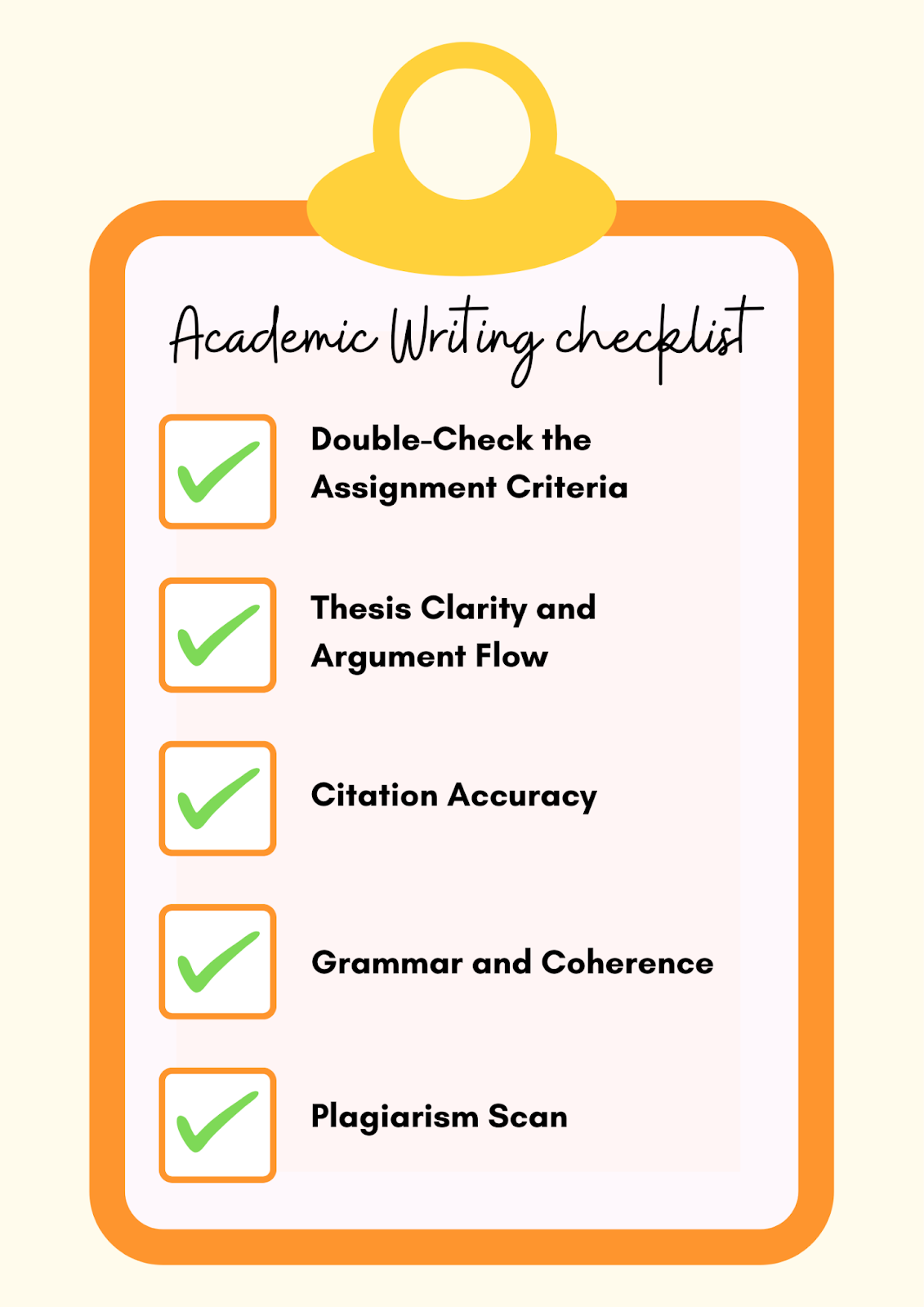
Double-Check the Assignment Criteria
Following a criterion is important because professors are strict about it.
So the first thing you should do is go through the original assignment sheet with a highlighter (physical, digital, or mental if you’re feeling lazy).
First, you should check the obvious:
- Word count
- Formatting requirements like font size, style, sentence and paragraph spacing, text alignment, margin size, etc.
- Deadline details
After this, the requirements boil down to the type of assignment.
If it is an essay, your teacher might have asked you to include a certain number of scholarly sources or counterarguments.
Sometimes, professors mention requirements in the classroom too, and those don't always make it onto the written assignment sheet.
If you missed the requirements being outlined during a class, you can ask your classmates if the teacher mentioned anything important.
Thesis Clarity and Argument Flow
Here's where I used to become my own harshest critic.
I’d try to read through my introduction from a reviewer’s POV to see if they’d be able to gauge my argument.
If my thesis was sharp, I’d move on to subsequent sections. I’d make sure each body paragraph was in line with the main point I was proving.
Your ideas should also flow with cogency. It shouldn’t make the reader feel like you’re jumping around or saying a bunch of things that actually mean nothing.
Citation Accuracy
Citations might feel like an annoying part of writing, but it’s an important requirement nonetheless.
Even if your arguments are strong and your essay has a logical flow, you can still get a bad grade if you fail to follow the proper citation format required.
For example, if your professor required Chicago-style citations and you followed MLA or a mix of different citation styles, it can affect your grade because it will come across as “sloppy.” The worst part is that you can also get accused of plagiarism if you don’t use the required citation style.
You’ll have to verify different things for different citation styles.
For example, in MLA style, in-text citations appear as the author's last name followed by the page number (Author Page), like (Smith 45). APA style requires the year instead, like (Smith, 2020).
Also, make sure every quote and external claim has a citation.
Every source you cited must also appear in your Works Cited or References page. Check the opposite of this as well. Every source in your Works Cited or References should also be cited somewhere in the paper.
You can use GPTZero’s source checker to provide citations and evidence for your work.
Grammar and Coherence
By the time we’re done writing something, our brains can be so fried that we miss very obvious typos.
That’s why experts advise building in some distance before proofreading.
Leave the paper alone for a few hours, or better yet, sleep on it (unless the deadline is near).
Coming back for a final grammar check with fresh eyes will help you spot mistakes even spellcheck doesn't catch. I personally sleep on my completed drafts for at least a full day before reviewing them.
Even if you’re working under tight deadlines, keep at least a 2-4 hour difference between completing the draft and giving it a final review.
It’s also a good trick to read the whole thing out loud. This is particularly good for catching poor sentence flow and issues with coherence between paragraphs.
Plagiarism Scan
Beyond citation accuracy, teachers can require you to run your paper through a plagiarism checker and attach a screenshot of the result to the document.
If they don’t, you should make it a habit to use a plagiarism checker before submitting your work.
You can use GPTZero’s free plagiarism checker or a paid Turnitin checker (if your school provides it).
It’s better to catch plagiarism yourself than have your professor find it first. It only takes a few clicks and can save you from getting a failing grade.
Professional / Workplace Writing Submission Checklist
Workplace writing is different from other types of writing previously discussed.
You're representing an organization, and sometimes your words carry legal weight or budget implications.
So here’s the checklist for it.
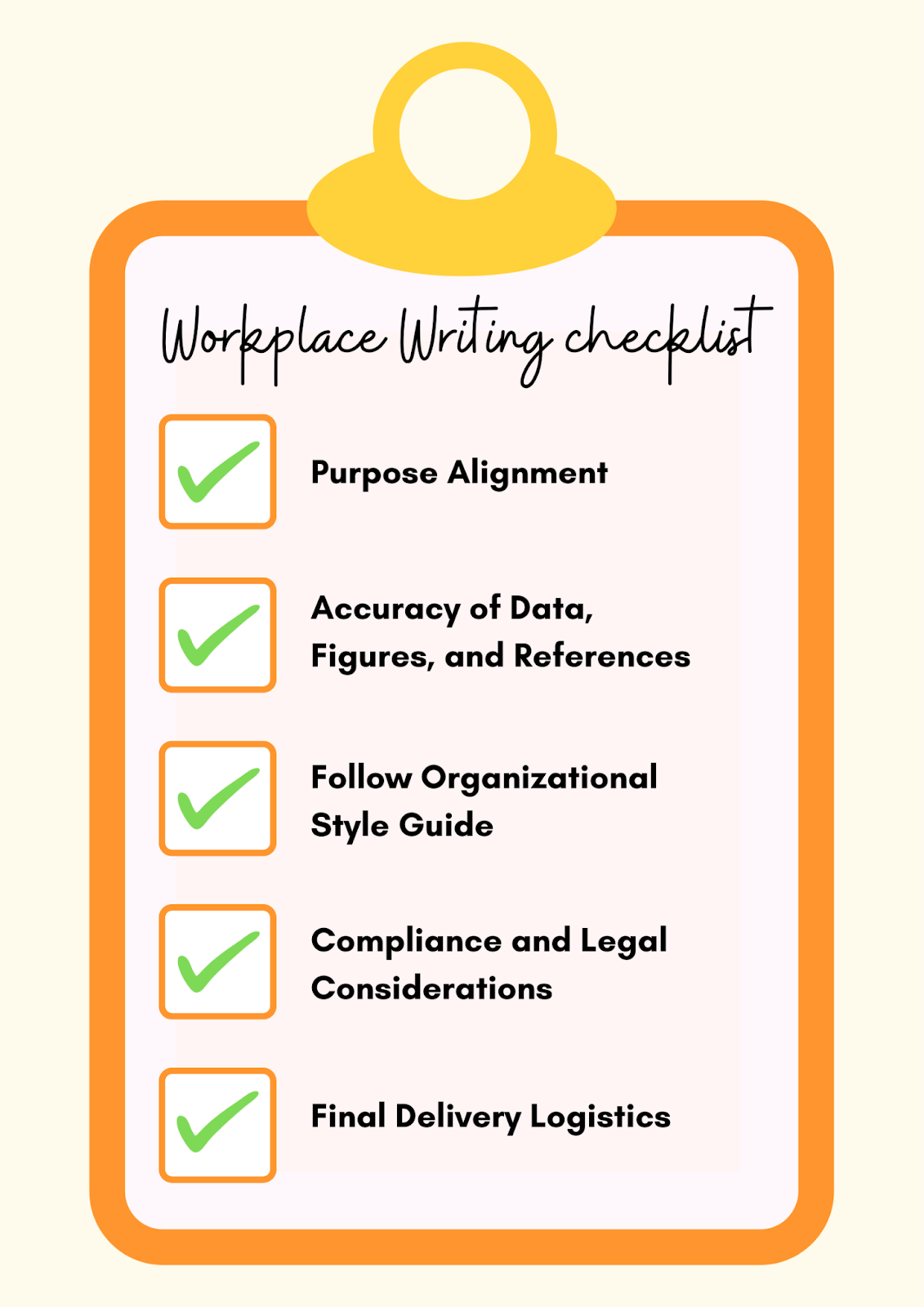
Purpose Alignment
Believe it or not, it’s quite possible to write something well-researched and thorough but still miss the mark.
Suppose you spend hours putting together an incredibly thorough analysis of a vendor partnership. It contains pros, cons, cost breakdowns, the whole nine yards.
But your boss gives you feedback that “This is great background, but I needed a clear recommendation for the executive team by Tuesday.”
All that work and you'd still missed the point entirely. So don’t make those mistakes.
Before anything else, make sure the document’s purpose is accomplished.
Check if you’re asked to present options without recommending one or advocating for a particular course of action.
You can also revisit the original request or meeting notes where an assignment came up.
You’ll get to know things like what questions you’re supposed to answer, who the primary audience is, what their takeaways should be, and everything in between.
If things are still unclear, it’s better to ping the person who requested the document than risk rewriting the whole thing later.
Accuracy of Data, Figures, and References
In a professional setting, numbers can make or break deals.
So be obsessive about verifying them.
For example, you should double-check that you’re using numbers from the most current version. I still remember the time I cited outdated data from "Final_Report_v3" when "Final_Report_v3_REVISED" was sitting right there in my inbox.
It’s easy to fumble calculations like percentages, averages, growth rates, and so on. So if you’ve done any calculations, verify that your math is right.
You should avoid citing external sources that aren’t relevant anymore, like quoting an outdated trend from 2009 in a 2025 report.
Consistency with Organizational Style Guide
Every organization has its unique voice and personality that the writing should include.
For example, some capitalize or hyphenate certain terms while others don’t.
You might submit a report to upper management, thinking that you'd nailed it because everything looked perfect.
But then your supervisor gently points out that you used a casual phrase ("Here we go") that didn't match the company's communication standards.
Find your workplace’s style guide and check if you need to maintain a formal, semi-formal, or conversational tone. Yes, it’s possible your company may require a casual tone even in official communications, especially if it’s a modern or Gen Z brand.
In addition to tone, check things like:
- Do we write email or e-mail?
- Is it team member or team-member or teammember?
- How do we format dates, month/day/year or day/month/year?
If you’re unsure about anything, look at recent examples of similar documents or ask a senior.
Compliance and Legal Considerations
A lot of writers, myself included, can get nervous when it comes to legal or regulatory implications.
After all, we are not lawyers, so we shouldn’t pretend to be. But we should know when to flag potential issues.
If your document mentions things like product capabilities, employee matters, contracts, or anything that could be interpreted as financial or medical advice, you should loop in the appropriate department before submitting.
It’ll depend on the content, which department should be pinged.
If a document contains sensitive information regarding the company or customers, make sure not to share it with people who shouldn’t have access to it.
Final Delivery Logistics
Lastly, your workplace writing checklist should also make sure the right document gets to the right people in the right format at the right time.
- Format: PDF, Word doc, Google Doc
- Delivery method: Email, shared drive, project management system, presentation
- Timing: 24 hours or more prior. Neither too early, nor too late.
If the delivery method is email, the "to" and "cc" line must have the correct persons.
You can ruffle feathers by sending something to a senior leader when it should have gone to your manager first.
Workplaces have subtle hierarchies and protocols that are taken very seriously.
Creative Writing Checklist Before Submission
Creative writing includes fictional works, poetry, novels, personal essays, and more.
And I can give you a rough idea of their submission essentials, too.
While this won’t be a full checklist for writing a book or submitting it, it’ll be enough to make rejections less likely.
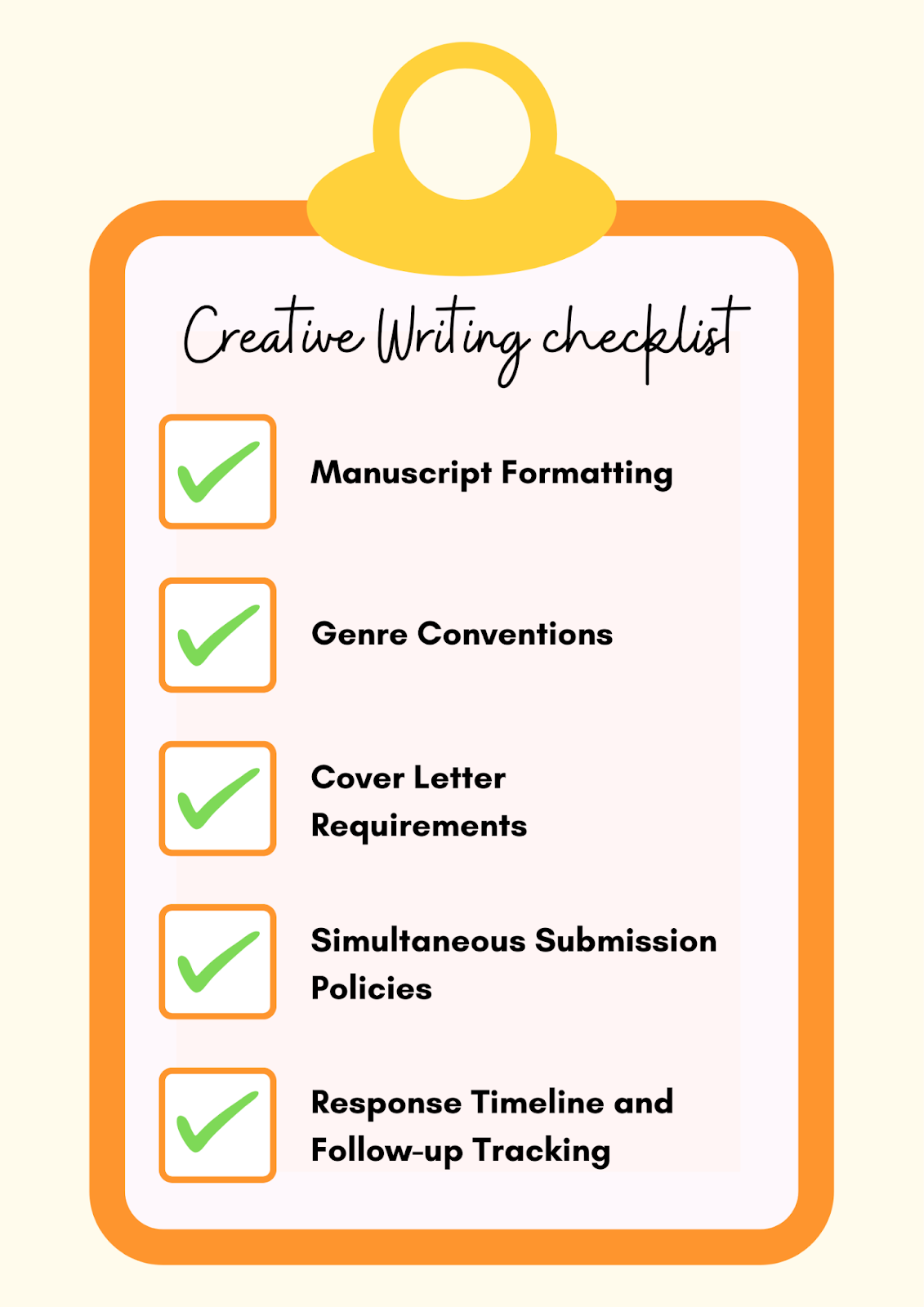
Manuscript Formatting
The basic manuscript formatting is pretty universal across most fiction and creative nonfiction submissions.
Most formats ask for:
- 12-point Times New Roman or Courier font
- Double-spaced
- One-inch margins all around
- Left-aligned (not justified)
- The header should include your last name
- Page number in the top right corner of every page after the first
- Contact info in the upper left corner of the first page
- Word count in the upper right
- Title centered about a third of the way down the page with your byline underneath
However, some publications have their own specific requirements. So don’t blindly follow these standards.
Poetry also has slightly different formatting rules. Some publications give you the choice to use whatever line breaks and spacing you intend.
But you should still avoid using random fonts or colors unless the publication specifically allows.
Genre Conventions
Every genre has unique reader expectations.
You can still bend or break conventions (like some of the best creative works), but that requires expertise.
You should get a thorough understanding of what you're working with first. Don’t mix up genres.
For example, if you're writing a thriller but spend most of your pages on internal character development and introspection, you might get feedback like “This reads more like literary fiction with thriller elements. Not quite what we're looking for.”
And honestly, that feedback won’t necessarily mean the issue is your writing quality. Instead, it might be that you haven't nailed the genre you're actually working in.
This doesn’t mean your work has to be formulaic. You can be experimental, but without drifting away from the defining characteristic of your genre.
Here are the defining characteristics of different genres:
- Mystery: Solving a puzzle
- Romance: Emotional arc between the main characters
- Science fiction: World-building that makes internal sense
- Literary fiction: Complex character development and expert prose
- Horror: Unease or fear
Cover Letter Requirements
Your work should speak for itself, so what are you supposed to say in the cover letter?
There’s a simple formula for most creative submissions like these:
- Opening: A brief greeting and the title of your work, word count, and genre.
- The pitch: One to three intriguing sentences about your piece
- Your credentials: Previous publications (if you have them), relevant awards, or your writing background
- Closing: A polite thank you and your contact information
Some publications clearly say they don’t need a cover letter. You might still send a cover letter, thinking it shows extra effort. But you’ll be wrong. To them, it’ll look like you didn’t read the guidelines.
Simultaneous Submission Policies
Simultaneous submissions mean sending the same piece to multiple recipients at once.
Whether you can do this depends entirely on each publication's policy.
Some magazines welcome them but ask that you notify them immediately if your work is accepted elsewhere.
If a magazine doesn’t state a policy at all, consider that a green signal for simultaneous submissions. But it still won’t hurt to follow professional courtesy.
You can track all your ongoing submissions in a spreadsheet. The columns can be:
Don’t think you can rely on your memory alone. Trying to remember which pieces are where and what the policies are could drive you crazy.
The table method is the best. After getting an acceptance, you'll know which other places you need to notify and withdraw your submission from.
Response Timeline and Follow-up Tracking
Most publications are transparent about their average response time.
The table you saw above also has a column where you can note this.
Make sure you don’t follow up too early from the average response time. It marks you as someone who doesn't respect their process.
But if you have waited well past the stated response time, a polite follow-up query is totally fine.
Just make sure the email is short and courteous. Most of the time, the follow-up prompts the publications to read the submission if it had gotten buried. They might even apologize for the delay.
Here’s a hypothetical tracking table with a few active submission examples:
One Thing Every Writer Must Check
Having checked off everything on your respective writing checklist, you can take a deep breath.
But don’t hit send yet. There’s a big requirement you’re missing.
Did you run your work through AI detectors? What if your work (or parts of it) gets detected as AI-generated after submission?
That can have detrimental consequences, regardless of the type of writer you are.
So this step should be a part of all writers' checklists.
As for which AI detector you should use, the answer is GPTZero because it is the most accurate commercial AI detector according to the latest benchmark.
GPTZero has a proven track record of delivering the most accurate AI detection results, with industry-leading accuracy rates and the lowest false positives, validated by both internal testing and independent benchmarks.
You can also test our tool for yourself. Give it human text, AI text, or a clever mix of both. It’ll accurately tell which is which, down to the sentence level.
Try GPTZero now for free.