Turnitin vs GPTZero: Key Differences for AI Detection in Education (2026 Guide)
Compare the functionality of Turnitin to GPTZero, an advanced AI and plagiarism detection tool.

If you’re new to AI detection, Turnitin and GPTZero can look pretty similar on the surface, in that they’re both popular AI detection tools used by thousands of educators around the world. However, when you dig below the surface, you’ll see that they are very different offerings.
Over 40% of surveyed 6th- to 12th-grade teachers used AI detection tools during the last school year, reported a nationally representative poll by the Center for Democracy and Technology. But what’s the best way to tell whether or not a student has used AI? Here, we cover how Turnitin and GPTZero differ as AI detection tools for educators and students.
Key differences: Turnitin vs. GPTZero
Turnitin grew up as a plagiarism detector, built primarily to catch misconduct after the fact; meanwhile, GPTZero is designed to help teachers and students understand how AI shows up in writing, and to use that insight to support better conversations and policies.
GPTZero starts from the belief that people have a right to know how AI detectors interpret their work, which is why we emphasize explainable scores and tools that surface the writing process. Basically, it is less about “catching” students and more about giving everyone involved better visibility into what’s happening on the page.
Turnitin is widely used across academia and is commonly deployed through institutional licensing – for many schools, it is a standardized, centralized layer for similarity checks and integrity reporting, often after a student submits their final work.
Meanwhile, GPTZero is designed specifically to distinguish between human-written and AI-generated text, with an emphasis on explainability, and is built to be used directly by educators and students.
At a glance
- In late 2023, GPTZero reported around 99% accuracy with 0% false negatives on a defined benchmark test set. While we often say that no detector is perfect, these results indicate strong performance on that evaluation. Turnitin is widely used across academia, but educators have also raised concerns about false positives and misinterpretation of legitimate student writing.
- Turnitin is typically licensed at the institutional level, while GPTZero offers a free tier so individual teachers and students can run quick checks on their own work.
The interface
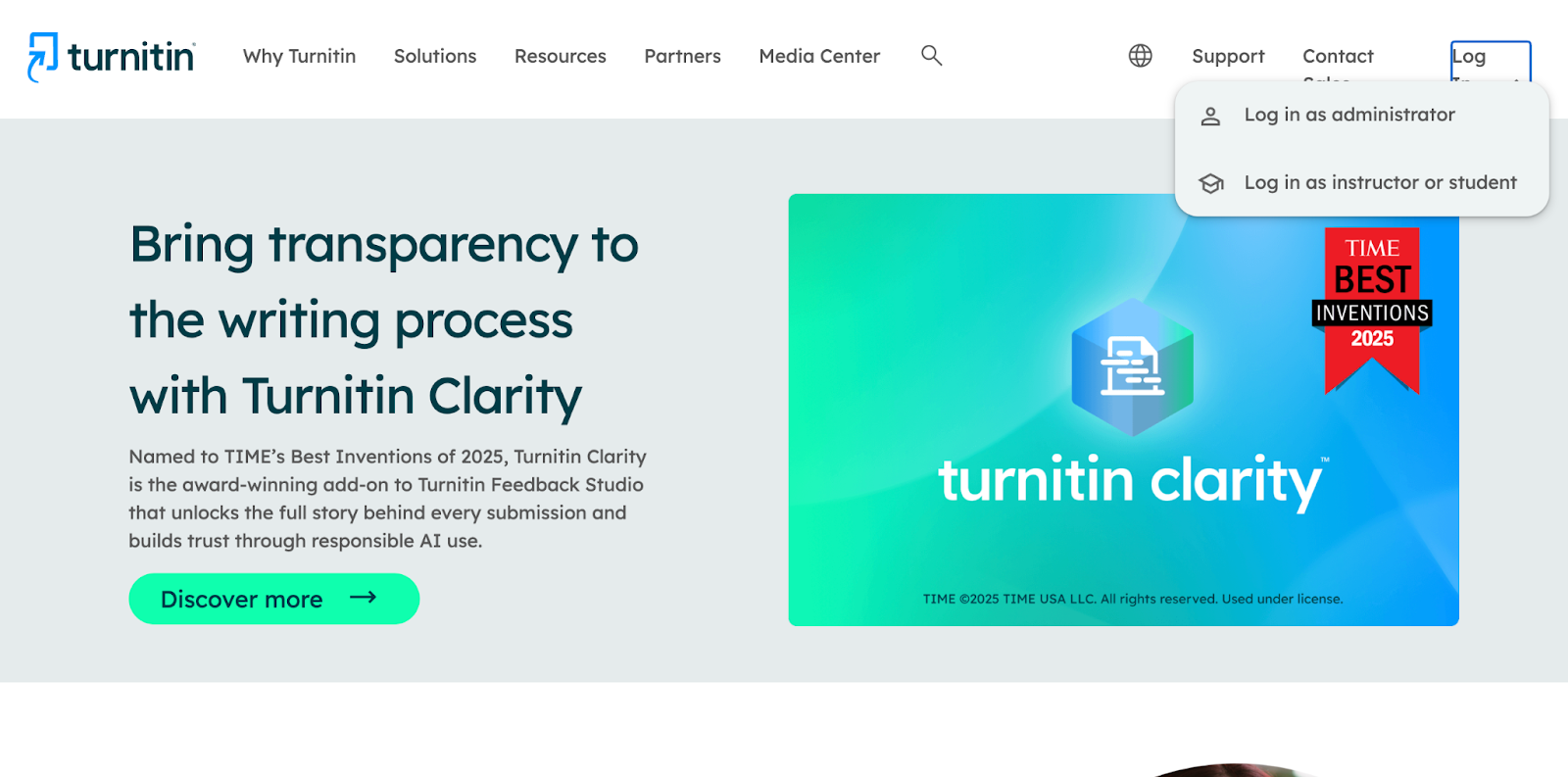
The differences become obvious as early as when you log in to Turnitin: you have to log in as an administrator, or choose as an instructor or student.
Meanwhile, you can still use GPTZero for a quick AI detection scan even if you don’t have an account: just copy and paste, or upload the document.
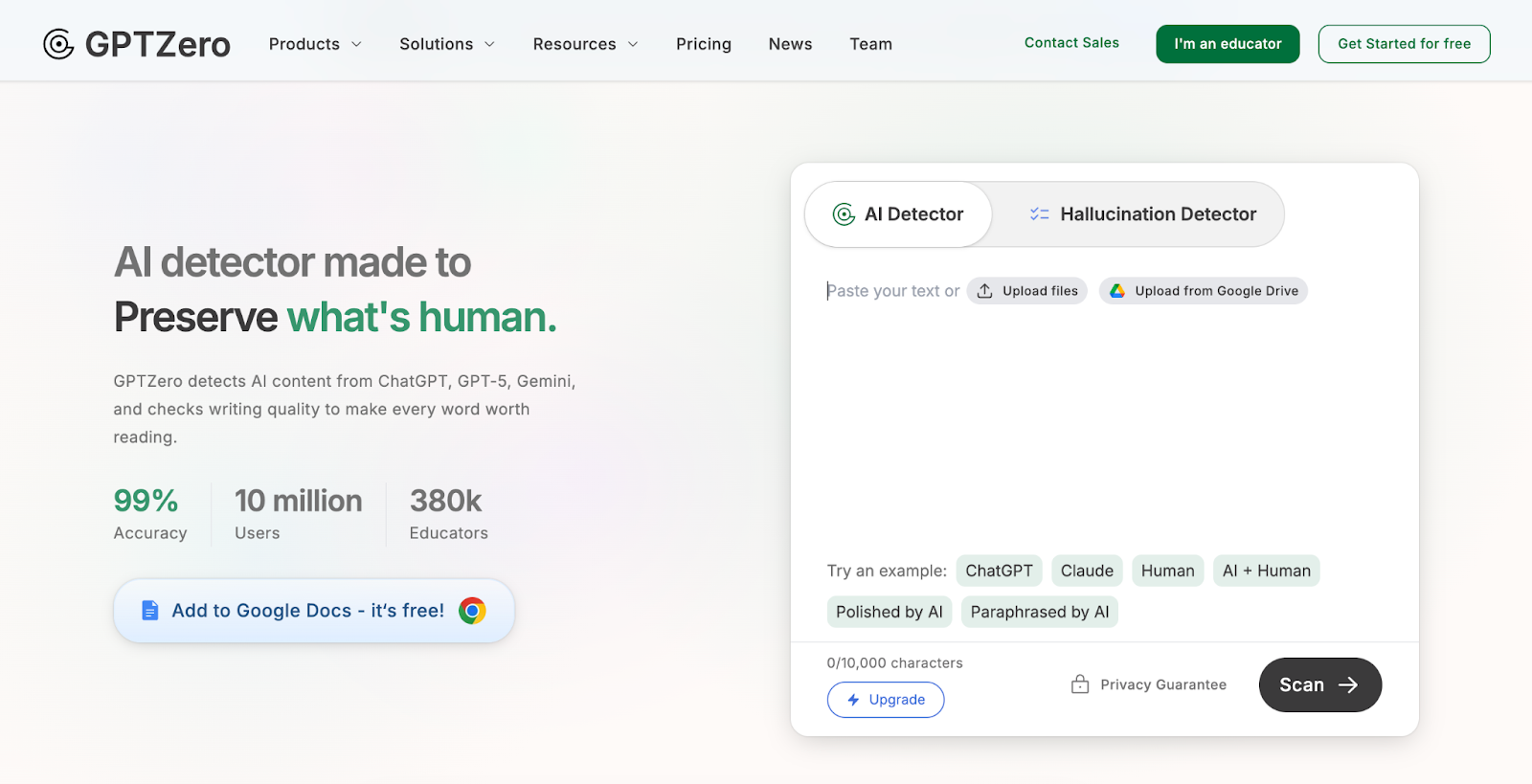
With Turnitin, you’re immediately forced to pick a role: administrator, instructor, or student. Meanwhile, with GPTZero, you don’t even need an account to get started. If you just want a quick check, you paste the text (or upload a document), run a scan, and see the results.
GPTZero is deliberately simple to use: the minimalist interface means there is a single place to drop your text and a results page that’s easy to read at a glance, with straightforward probability scores that make sense whether you’re a teacher or a student or unaffiliated with a particular institution.
“One standout feature of GPTZero’s interface is its transparency in explaining detection rationale. Rather than simply providing a binary judgment, the platform highlights specific textual elements that triggered AI identification, helping users understand why content was flagged,” says AmpiFire CEO Chris Munch. “This educational approach proves particularly valuable for students learning to distinguish their writing from AI assistance.”
Workflow differences
Turnitin is built first and foremost for instructors to uphold academic integrity and streamline grading, and functions as a post-submission check: a student uploads their final draft, the system processes it, and the educator sees a similarity score or AI score after the fact.
GPTZero, on the other hand, is used more like a pre-submission check: something you can use while you’re still drafting and figuring out how much your essay might sound AI-written (even if it’s not). It highlights specific sentences you might want to take a closer look at, and explains exactly which parts of your work seem suspiciously like they were created by AI.
College students we spoke to said they’ll often use ChatGPT at the start of an assignment to see what a plausible answer might include, but then they write their own version from scratch. Once they have a draft, they run it through GPTZero to spot the most AI-sounding sentences and use that feedback to reshape phrasing and sentence structure so the writing feels more authentically theirs.
A post-submission Turnitin report tends to frame AI and plagiarism as something to catch and punish, while a pre-submission GPTZero scan gives students a way to see how their process shows up on the page, so they can learn to sound more like themselves.
Detection capabilities
Turnitin is a closed program, and cannot be openly evaluated by the researchers. In contrast, we publicly provide our APIs for free to researchers to measure our accuracies.
“At GPTZero, we strive to be as rigorous and fair as possible in our evaluations so that users can easily decide if our detector meets their needs,” says GPTZero’s Head of Machine Learning Alex Adam. “This informs how we construct benchmarks, evaluate competitors, and provide API access to our detector for evaluation purposes.
On our benchmarking page, you’ll find the results of a comprehensive evaluation of our AI detector across a variety of domains, LLMs, and languages, showing how we outperform competitors on 5 different domains. Evaluations are updated quarterly, and raw predictions are available for researchers interested in reproducing results.
Due to the closed-source nature of TurnItIn, our last benchmarks available are from 2023. If you are an educator or researcher with access to TurnItIn and would like to conduct independent benchmarking, please contact us and we can provide free access to our service.
To push the limits of our benchmarking, we’ve also started testing our solution in the more nuanced case where a writer may have used some AI but has revised or paraphrased parts, making a “mixed” document.
Unique GPTZero capabilities educators often use
GPTZero is more focused on supporting the student writing process. Since 2023, we have had a disclaimer on our website scan page saying ‘These results should not be used to punish students. We recommend educators use our behind-the-scenes Writing Report for a holistic assessment.’ We mix other holistic approaches to detection such as hallucination and citation checks.
Chrome extension
A unique feature of GPTZero is its Chrome Extension. This brings AI detection, citation checks, live essay feedback, and writing replays directly into Google Docs. You don’t have to export anything or learn a new platform; you keep writing where you already work, and the checks run alongside you.
Writing transparency features
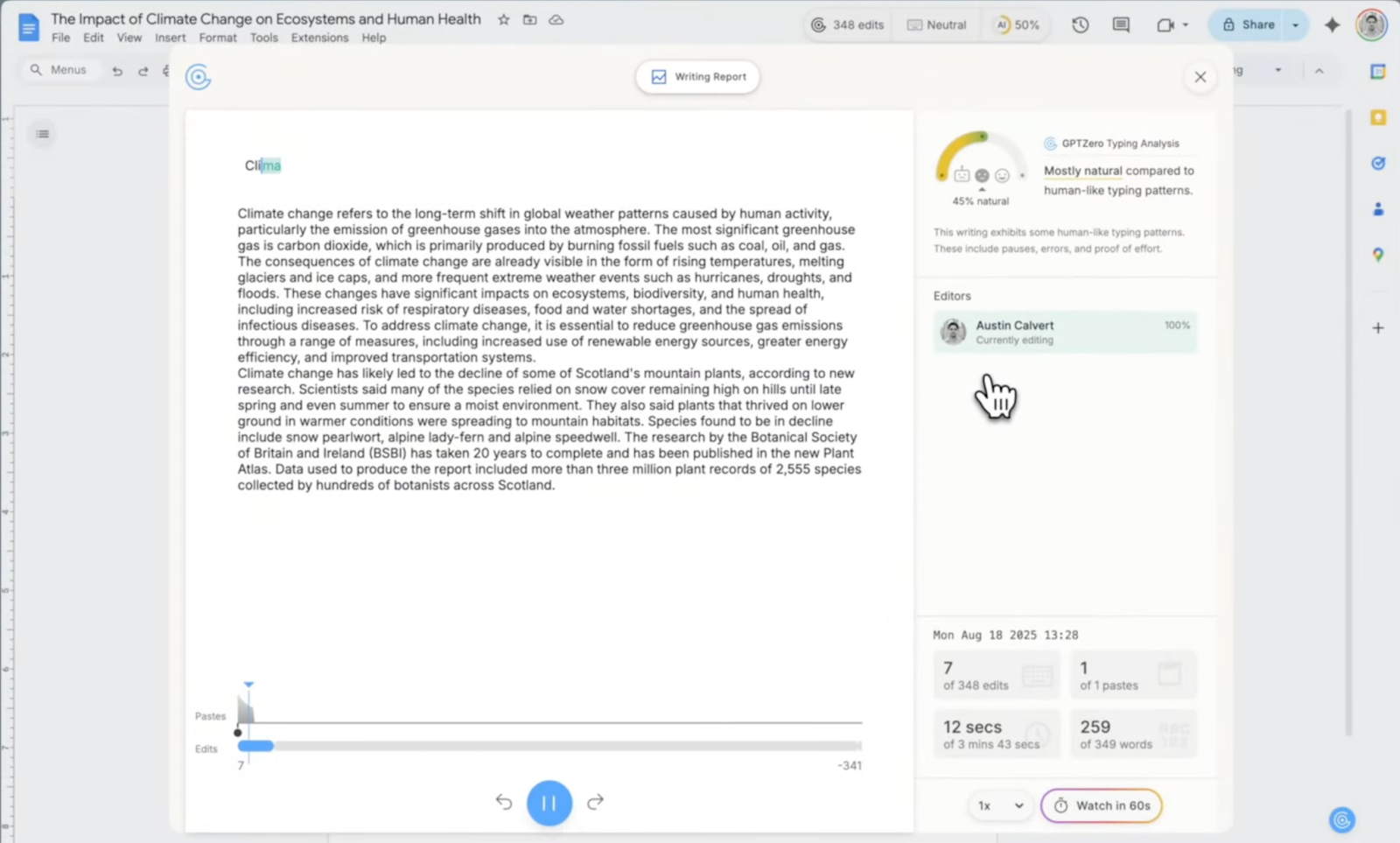
Inside Google Docs, the Writing Report experience is built specifically for teachers, students, and researchers. As you type, live AI detection quietly scans for large copy–pastes and AI-like text, so you can catch potential issues early rather than at grading time. You can customize feedback by uploading your rubric and assignment brief, and GPTZero will draft targeted comments directly into the doc.
The Writing Replay is where you see the process, as GPTZero reconstructs how a document was written (where text was typed, where it was pasted). If there are multiple collaborators, you can switch views to see how much each person contributed, and when. The Writing Report layers in extra insight: multi-user contribution percentages, fast, high-resolution playback, patterns of bursts and edits, built-in AI flags on large pastes or unnatural text, and typing-pattern analysis.
For educators who need more than a single score, writing transparency features can help contextualize what happened on the page (for example, distinguishing typed drafting from large paste events). This supports fairer review and clearer conversations, especially for mixed authorship scenarios.
Batch workflows for educators
Another key feature is batch upload, which is particularly useful for anyone with lots of files to mark. Instead of opening each file one by one, you drop in multiple assignments, run AI, plagiarism, and writing checks in one go, and then zoom in on the few scripts that actually need a closer look. As Bladimir (HS Literature/Spanish) on Al reviewer: "One of the things that we always look for in any technology is to save time... If I have to go back and think that I have to look at every single thing... I won't be using the tool a lot."
Hallucination Detector
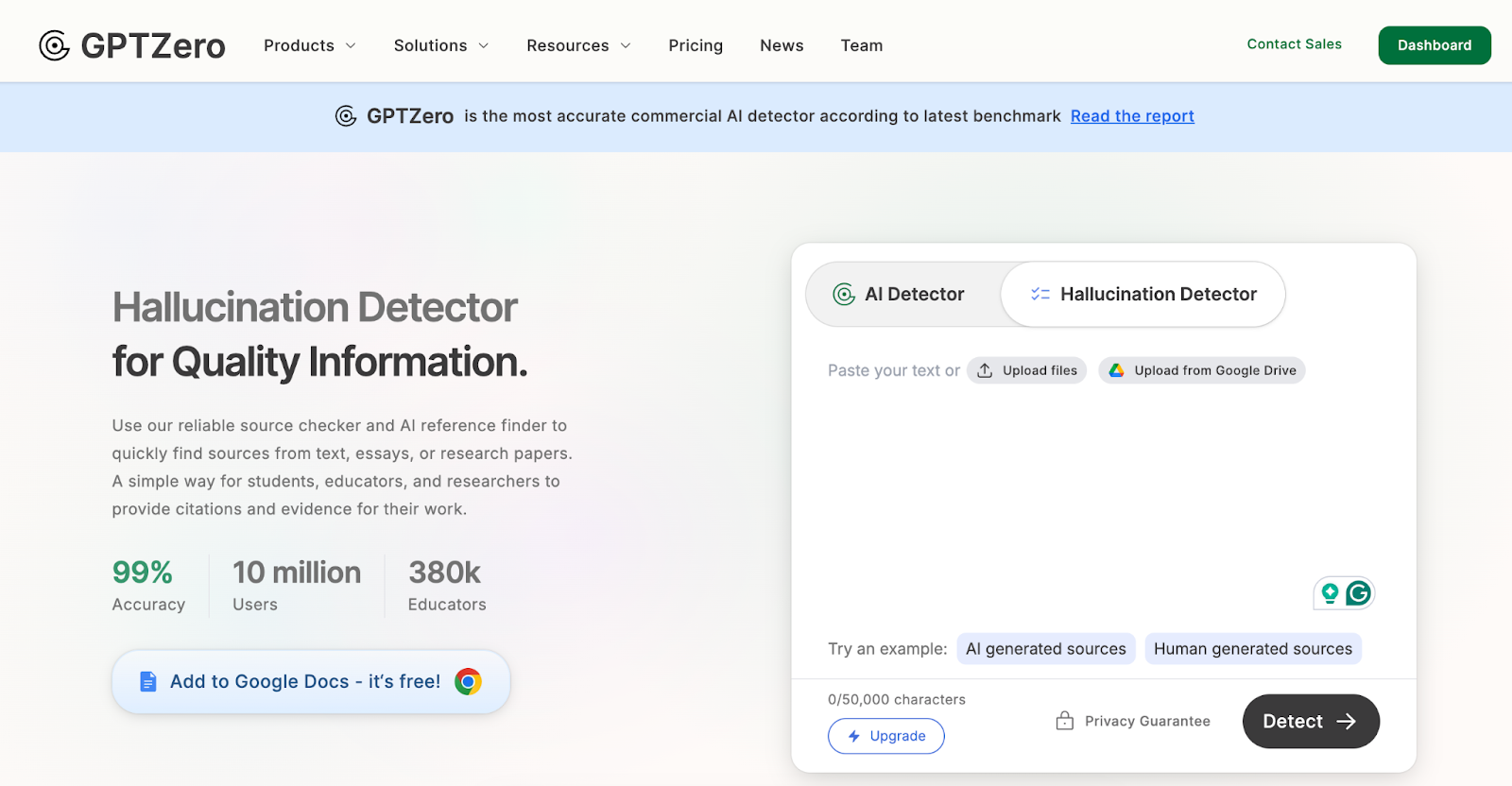
Lastly, GPTZero’s Hallucination Detector looks for AI-hallucinated or inaccurate references, uncited claims, and weak or missing sources, and suggests improvements. It’s a simple way for students, educators, and researchers to provide citations and evidence for their work.
Pricing for Turnitin vs. GPTZero
How much does Turnitin cost?
Turnitin is currently not public with its pricing structure as it is implemented at an institutional level versus individual teacher accounts. It is typically purchased and deployed at the institutional level, and students often cannot access full reporting independently and may only see outcomes tied to submission workflows.
How much does GPTZero cost?
GPTZero offers a self-serve model that includes a free tier, making it easier for individual educators and students to run checks during drafting, without needing an LMS deployment to get started. There are four pricing options. (These prices are for 2026 and reflect the price per month when billed annually.)
The Free plan (no credit card required) gives you up to 10,000 words scanned a month, advanced AI detection, multilingual detection, and writing feedback.
Premium is $12.99 per month and increases your capacity to 300,000 words a month. It includes Advanced AI Scan, multilingual AI detection, and the ability to download AI reports.
Professional is $24.99 per month and includes everything in Premium, plus up to 10 million overage words, the ability to scan up to 250 files at once, and page-by-page scanning for long documents. It also adds enterprise-grade security and LMS integration.
For teams, Enterprise gives you everything in the Professional plan for every member, along with shared team credits and unified billing. As one example, a 2-seat Enterprise plan is $599.76 per year in total, which works out to $299.88 per member, billed annually.
Conclusion
While Turnitin AI detection is no stranger to institutional systems and post-submission checks; GPTZero AI detection is more transparent and built to be used directly by individual educators and students. If you’re looking for a Turnitin alternative for AI detection that you can turn on without an IT coordinator, which doubles as an AI detector for students to self-check their work, then GPTZero is likely the better fit.
FAQs
What AI detector does Turnitin use?
Turnitin and GPTZero both built their own model leveraging Natural Language Processing that looks for similarities in submitted student work. Turnitin’s AI detection model is trained to detect AI generated content from GPT-3 and GPT-3.5 language models. Since inventing AI detection, GPTZero incorporates the latest research in detecting ChatGPT, GPT4, Google-Gemini, LLaMa, and new AI models, and investigating their sources.
How does Turnitin work?
According to Turnitin, “Turnitin’s software takes what a student submits and we compare it to a massive database of content, including internet, academic, and student paper content, and we look for similarities. We report those similarities with a percentage, the percentage of the work submitted by the student that is similar to the content in our databases. In the report, a student or educator can dig into the details to see what, exactly, is matching, and how much.”
Turnitin’s AI detection uses algorithms to find patterns within student work that indicate plagiarism. It looks for “matching phrases, sentences, and paragraphs, as well as a shift in the writing style or tone, which could be a sign of irregularities.”
How does GPTZero work?
GPTZero uses a proprietary deep learning approach that combines information at both the sentence level and document level to make a prediction. We regularly adjust our architecture with the latest developments in language model research, along with our own optimizations for efficient inference. In addition to distinguishing between human and AI generated text, our model is also trained to identify text which is a combination of the two.
This is an important distinction which helps accommodate a wider range of human-LLM interaction behaviors. We have a training database of over 30 million documents covering a broad range of writing styles, genres, and abilities, allowing us to tune our model to perform well on a set of documents that is most representative of our user submissions. What further distinguishes GPTZero from other approaches is an important post-processing step that is applied to adjust predictions such that false negatives are favored over false positives. This works by transforming low confidence AI/mixed predictions into human predictions at an appropriate rate as determined by a large validation set.
How does Turnitin detect plagiarism?
According to Turnitin their plagiarism detection software, “takes what a student submits and we compare it to a massive database of content, including internet, academic, and student paper content, and we look for similarities. We report those similarities with a percentage, the percentage of the work submitted by the student that is similar to the content in our databases. In the report, a student or educator can dig into the details to see what, exactly, is matching, and how much.”