Top Challenges Teachers Face Right Now
We spoke with educators in our community about the biggest pressures they’re facing right now, and this guide breaks down what they told us.


Over half (53%) of teachers reported burnout last year, with teachers working 49 hours per week on average, around ten hours more than their contracted hours, according to RAND’s 2025 State of the American Teacher survey. While some things about teaching remain the same as they were twenty years ago, today’s teachers face a new range of hurdles.
Much is likely to change in the years to come with AI, but our commitment to educators remains steadfast – and we’ve spoken to those within our community to look at the top challenges teachers face right now. This guide breaks down the biggest classroom pressures educators are naming right now, along with practical ways to respond without adding more work to your plate.
TL;DRTeaching today is a unique kind of pressure cooker – while teachers are still dealing with familiar pressures like grading, behaviour, burnout, and student disengagement, they are now doing so in a world reshaped by AI, policy ambiguity, and a growing erosion of trust around student work. In our conversations with educators in the GPTZero community, the biggest challenges included the “cat and mouse” game of cheating, loss of student critical thinking and originality, the heavy burden of grading, flawed detectors and unfair policies, the need to overhaul curriculum, and the emotional disconnect of online learning.
What Challenges Do Teachers Face Today?
Modern teaching is its own unique kind of pressure cooker in a way that just wasn’t the case years ago. As our founder Edward Tian has said, “In November of 2022, ChatGPT’s release opened the Pandora's box on massively available AI-generated content. At GPTZero, we immediately knew the new challenge that AI could pose to information transparency and academic integrity.”
Teachers have always been asked to prepare students for a world that does not yet exist, but the pace of change is now so fast that teachers are still adjusting while guiding students through it too. Brookings encourages a “prosper, prepare, and protect” approach in a future shaped by AI – but what that means in practice is something many institutions are grappling with.
Top Challenges Teachers Face Right Now
In conversations with the educators within the GPTZero community, these are the top challenges that teachers have said they are facing.
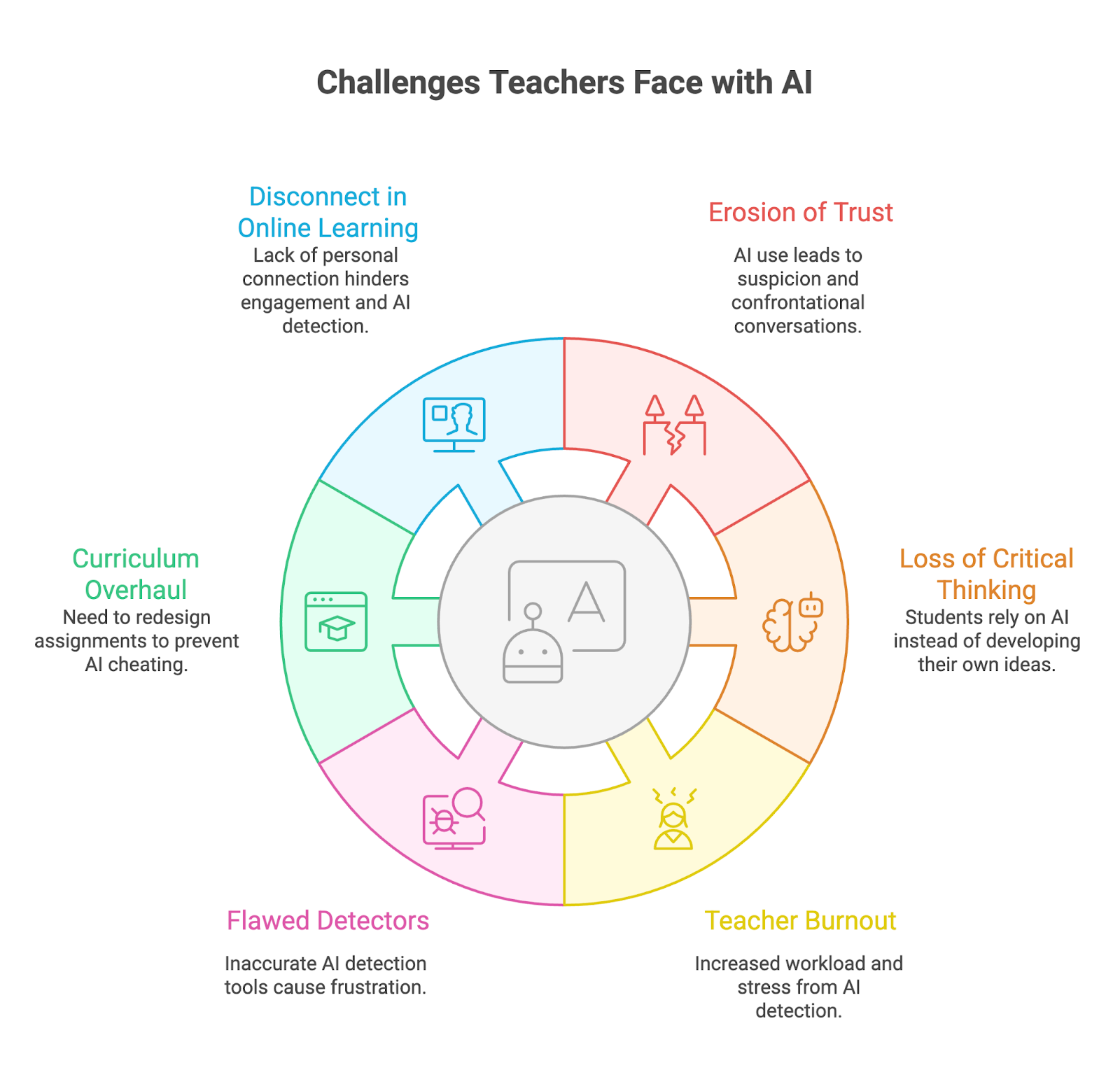
The Erosion of Trust and the "Cat and Mouse" Game of Cheating
Unethical AI use has introduced an ongoing battle between students and educators. As one college professor said, “I would say 100% of students use AI, as in, the grammar checkers, Grammarly, the built-in copilots and Google's platforms and things they can use ethically. Where we draw the line is where we have to define that.”
According to the teachers we spoke to, the difficult part is that students are continually finding new ways to bypass AI detectors, such as using secondary devices to type out AI-generated text to avoid copy-paste flags or trying “TikTok hacks” to bypass detection tools.
This need to police students has broken down classroom trust and educators confess that they now regularly doubt genuinely good writing and worry about unfairly accusing students. It is also highly stressful to have confrontational conversations with students and defensive parents regarding AI cheating allegations, because as proven cases become more common, so too do reports of students being falsely accused of using AI.
Loss of Student Critical Thinking and Originality
Students are often using AI as a replacement for their own thinking, rather than an assistive tool, which compromises their ability to wrestle with complex problems. One teacher shared:
“I want students to be able to think for themselves and to use AI as a tool, but my worry is that it is currently being used as a crutch. We have to prep our kids for any classroom, and we need to prep our kids to trust their own ideas before what they read from a machine. I want our kids to think that they are enough, even if they're not polished and perfect to the standards of an AI bot.”
As a result, many teachers say students are struggling more with independent problem-solving and original thinking. In many cases, students use AI to write their assignments entirely, presenting work and passing classes without ever actually having to work through or deeply understand core concepts, with AI plagiarism becoming only more common.
“You give them articles to read,” one teacher shared. “But what they do is tell AI to summarize the points and then from there they can be able to make notes. And even if they have to present in class, you think that they understand everything. But the truth is most of the whatever they are saying has been summarized by AI.”
Teacher Burnout and the Heavy Burden of Grading
The sheer volume of grading has always been a challenge, with some teachers managing up to 200 students per assignment or needing to grade 70 essays a week, and AI has only added to this, as teachers now spend upwards of 15 to 20 additional minutes per essay just trying to verify if a paper was written by a computer or a human.
This is a tedious process that has led to extreme teacher fatigue, with some veteran educators citing the exhaustion of checking for AI as a major relief upon retirement.
“I am so sick of checking for AI to see if they're cheating,” one teacher shared. “I’m over it. And then, at the same time, even my school district – is trying to make sure that kids know how to use AI because we have a lot of second language learners and people whose parents don't speak English.”
If you’re reviewing a long stack of essays, GPTZero’s AI detector can help you spot likely AI use, review mixed writing, and bring more context into the conversation.
Navigating Flawed Detectors and Unfair Policies
It’s hard for teachers to uphold academic integrity when the detection tools mandated by their institutions are flawed. Detectors such as Turnitin have been reported to frequently yield false positives, especially unfairly flagging non-native English speakers or students who simply used basic grammar-checking tools like Grammarly.
As one grader told us, “If a person is not a native English speaker and you are assessing their English, it's not that straightforward – you know they would use a lot of the vocabulary that we see in the LLMs.”
Adding to this frustration is a lack of cohesive, department-wide AI policies, often because older faculty members are afraid of the technology and refuse to engage in conversations about standardizing its use. Also, no AI detector should be used as a final verdict on its own. At GPTZero, we treat detection as a signal that supports human judgment, responsible AI policies built on ongoing conversations around AI use in the classroom.
The Need to Entirely Overhaul Curriculum
Now that AI is here, there’s an enormous and daunting task for educators ahead: redesigning their curricula so that AI cheating becomes impossible. This means moving away from traditional assignments and rote memorization toward highly specific, critical-thinking-based assessments, which is easier said than done.
Teachers are also tasked with teaching "AI literacy", as many students struggle to differentiate between hallucinated AI facts and reality. Finding the balance between teaching students how to use AI ethically, and for the modern workforce, while ensuring they still possess the basic skills required to pass handwritten, standardized exams (like the AP tests) is a huge struggle.
As one high school teacher said, “Being able to hold the kids accountable is hard... I let our district know that this is something I noticed, and they said that they're going to meet and they want to give them opportunities to use AI effectively and prepare them for things that they might encounter in the workforce in the future. But that balancing act between that and still needing to be able to create and do certain things on our own. It’s a big challenge.”
The Disconnect of Online Learning
For professors managing asynchronous or online classes, there is a massive lack of personal connection, as without regular face-to-face interaction, it is difficult to gauge student engagement, read their tone, or establish a baseline for what a student's authentic writing voice actually sounds like, making it even harder to identify unethical AI use.
As one college professor said, “I can meet via video or email, but it’s all up to them to come to me if they want to talk about it. So not knowing them, not knowing their backgrounds, not knowing if they're writing stuff themselves, not knowing if they're getting help, not knowing if they need help – that kind of lack of in person connection is a huge issue in my world.”
Role of AI in Education
Taking into account all of the above, it’s no surprise that teachers are turning to one another to figure out how to move through this new world. This might explain why our recent peer-to-peer webinar series, “Teaching Responsibly with AI”, had over 1000 attendees over a series of 6 one-hour lessons on topics like AI and Ethics, AI Literacy, and Using AI Effectively.
It was obvious that AI is already changing classrooms in a variety of ways, by resetting the social contract between teacher and student (as we’ve outlined above) and causing a whole range of practical new headaches for teachers who now have to continually watch out for AI use (which GPTZero is a key tool to help).
In Jubilee Media’s episode, “Teachers vs Students: Is AI Destroying Education?”, students and teachers sat face-to-face to read passages aloud, guessed which ones were written by humans and which were written by AI and then checked their instincts using GPTZero
On a practical level, AI is helping teachers to create differentiated materials, generate practice questions, support feedback, and reduce repetitive admin. And in theory, it can help students brainstorm and get faster support. However, the heart of the tension is that in reality, it can be difficult to use AI without developing an over-reliance on AI, which can in turn weaken crucial critical thinking skills.
GPTZero exists to help teachers find their way through this new world. As our founder Edward Tian has said, “We’re evolving to keep up with the latest in AI detection and offer educators more holistic education solutions: writing reports, origin analysis, advanced scan, and interpretability metrics. With teachers, we want to empower you with the guardrails on technology in the classroom to foster originality, encourage critical thinking and prepare your students for the future with AI.”
Current Education Trends Right Now
It’s important to zoom out on the broader context in which all of this is taking place. According to Forbes, the most important trends affecting skills and education this year will include a new emphasis on AI literacy, as knowing how to navigate AI tools (and when to question them, and push back on them) will be a key skill in the year so come.
In that analysis, Bernard Marr shares that learning will also be, in and of itself, a more explicit outcome. As automation shifts the type of roles available, education will move more towards emphasizing adaptability, and helping students build the capacity to reskill and upskill across changing contexts.
At the same time, thanks to virtual reality and augmented reality, classrooms are likely to leverage gamification and experiential learning: “Research has repeatedly shown that adding rewards, competition, and the potential to iteratively improve our performance increases our ability to absorb and retain knowledge, and applying technology to achieve this will be a key trend in 2026.”
Conclusion
What teachers need right now is practical support, including modern policies, and tools that help them respond to real classroom problems without adding to the workload. AI is throwing up new questions in the classroom and the biggest issue teachers are trying to solve is finding the balance between preparing students for the future with AI while making sure they know how to think for themselves as well.
FAQs
What are the biggest challenges teachers face today?
Some of the biggest challenges teachers face today include burnout, classroom management, student disengagement, diverse learning needs, policy ambiguity around AI, grading workload, and the pressure to integrate technology without losing control of the classroom.
How can teachers use technology effectively?
Teachers can use technology effectively by focusing on tools that solve real problems, such as reducing admin, supporting differentiation, or reviewing student work more fairly. The most effective approach is selective, purposeful, and backed by clear policy rather than constant experimentation.
What do you think is the biggest problem teachers are facing today?
There is no single answer, but one of the biggest problems is the collision between old pressures and new ones. Teachers are still dealing with workload, behaviour, and burnout, while also being asked to navigate AI, shifting assessment norms, and trust issues around student work.