
Presidents Say the Same Things: Analysis of 81st United Nations General Assembly Speeches


Our first analysis looked at how much of what was said at this year's General Assembly came from speeches GPTZero flagged as AI-generated.
This post is an addendum to that one. Here, we look at a few examples of world leaders saying the same things, sometimes in nearly the same words, and at whether those were the speeches GPTZero flagged.
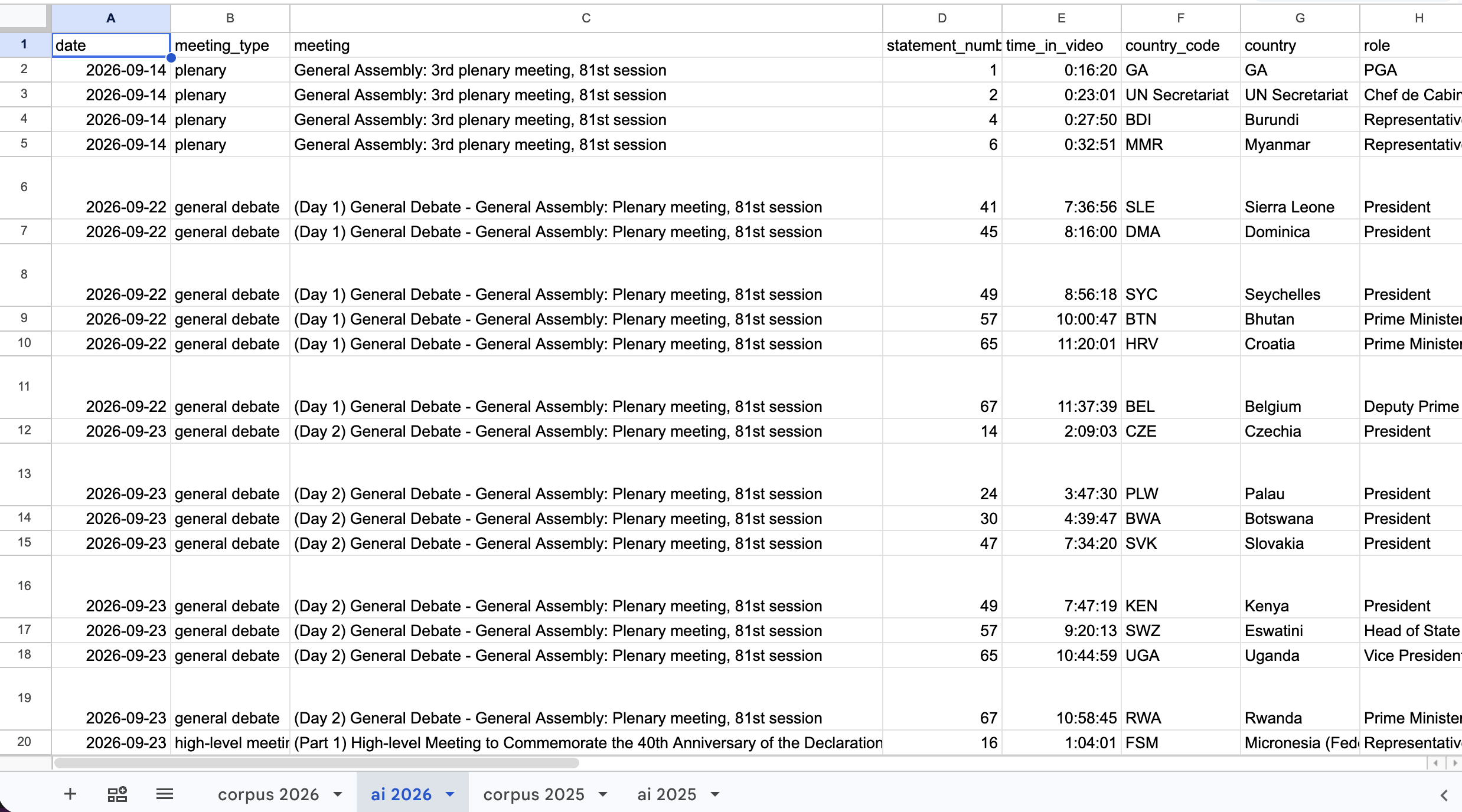
We covered every General Assembly meeting with a UN transcript from September 8 to 26, which comes to 16 meetings, including the first five days of the General Debate. The last day of the debate, September 28, still had no transcript when we ran the numbers. The full dataset, with a link to the video of every speech, is below.
We compared every speech against every other speech in those 16 meetings, looking for identical runs of words as well as sentences that make the same point in different words. Anything every delegation says (greetings, the session theme, quotes from the UN Charter) we filtered out. Then we read each remaining match in context.
Most of the numbers below refer to the 174 national statements given during the General Debate by heads of state and government, vice presidents and ministers. GPTZero flagged 30 of them as AI-generated. Over the same five days of last year's debate, it flagged 6 of 174.
We did not find any leader reading another leader's speech. The longest distinctive passage shared by any two leaders is 10 words long. What we found instead were phrases and sentence structures that turned up again and again, in speeches from countries that have little else in common.
"Regardless of its size, wealth, or..."
Two speeches on day one of the General Debate, a few hours apart: Dominica's President Sylvanie Burton, then Croatia's Prime Minister Andrej Plenković. Both said every country deserves a voice "regardless of its size, wealth, or" something. Botswana's President Duma Gideon Boko said the same thing the next day, except he was talking about the equal dignity of nations. Burton finished the list with influence, Plenković with power, and Boko with military power. All three spoke in English.
The only three uses in 16 meetings
Sylvanie BurtonPresident of Dominica · Sep 22
“We need a system in which every country, regardless of its size, wealth, or influence, has a voice and a meaningful place at the table.”
Andrej PlenkovićPrime Minister of Croatia · Sep 22
“Credibility which is strongest when every country, regardless of its size, wealth, or power, has a meaningful voice.”
Duma Gideon BokoPresident of Botswana · Sep 23
“Respect for sovereignty, territorial integrity, and equal dignity of every nation, regardless of its size, wealth, or military power.”
Quotes from the UN's automatic English transcripts. The label is GPTZero's classification of the whole speech; the number is its AI probability. Links open the transcript at the quoted sentence.
Nobody else said it. Across all 16 meetings, these are the only three speeches with the phrase "size, wealth," and GPTZero flagged all three as AI-generated.
The phrase is also new this year. We found no trace of it in the 3,687 transcribed speeches and remarks from last year's session, which ran from September 2025 to September 2026 and includes the 2025 General Debate. It doesn't appear in the 2022 General Debate either, the last one held before ChatGPT was released.
"Trust is not built through declarations"
This year's theme was "Restoring trust, managing transformation: A United Nations that delivers for all," so it's no surprise that trust came up in speech after speech. One version of the argument came up often: that trust can't be restored by declarations, only by what comes after them.
Three presidents went further than that. Each one dismissed declarations and then listed what does build trust, and it's the same list, in the same order, four items long. Promises or commitments get kept. The law or the rules get applied. Institutions do their job. People see the results.
Same four-part answer, same order, different words
Julius Maada BioPresident of Sierra Leone · Sep 22
“The experience taught us that trust cannot be commanded by declaration. Trust grows when promises are honored, when the law protects everyone, when institutions serve their people and when citizens can see a future for themselves.”
Jakov MilatovićPresident of Montenegro · Sep 23
“Trust is not built through declarations. Trust is built when commitments are honored, when rules are applied consistently, and when institutions act with transparency, and when people can see that international cooperation produces tangible results in their lives.”
Ratu Naiqama LalabalavuPresident of Fiji · Sep 24
“Trust, therefore, is not restored by declarations alone. It is restored when commitments are kept and when international law is applied consistently and when institutions listen and when people can see and feel the results of multilateral action in their daily lives.”
The three sentences follow the same order, but the wording changes from one to the next. The longest stretch of identical words between any two of them is five words, so none of them is quoting another.
They weren't the only ones. In all, nine leaders told the Assembly that trust isn't built by declarations, and not all of their speeches were flagged.
Everyone else who said trust isn’t built by declarations
William RutoPresident of Kenya · Sep 23
“Trust cannot be restored by declaration. It must be earned by consistent application.”
King Mswati IIIHead of State, Eswatini · Sep 23
“Restoring trust cannot be achieved through declarations alone. It requires that promises already made be honored and that our institutions demonstrate the capacity…”
Hassan Sheikh MohamudPresident of Somalia · Sep 24
“Trust in the UN will not be restored through declarations alone. It will be restored when institutions act consistently, uphold international law, and produce results that people can see and experience.”
Aleksandar VučićPresident of Serbia · Sep 23
“We will not restore trust through grand declarations if we then continue to act as before.”
Godwin FridayPrime Minister of Saint Vincent and the Grenadines · Sep 25
“Trust cannot be built or restored by declarations alone.”
Prak SokhonnDeputy Prime Minister of Cambodia · Sep 26
“Trust is not restored by declaration alone. It is earned through consistency.”
General Debate national statements, Sep 22–26. The label is GPTZero's classification of the whole speech; the number is its AI probability. Links open the UN transcript at the quoted sentence.
None of the speeches in the 2025 or 2022 General Debates used the line. That fits a year whose official theme was restoring trust, and because human-rated leaders used it as well, we don't consider it a sign of AI on its own.
We think we might know where it came from, too. On September 14, eight days before the General Debate started, the President of the General Assembly gave a tribute to Norway's King Harald V that included this: "King Harald reminds us that trust is not proclaimed. It is built patiently by seeing one another and working with each other." GPTZero flagged that speech as AI-generated as well.
Three phrasings that show up more in flagged speeches
Is there a flagged-speech style? We tried to find out by counting more than a hundred rhetorical habits in flagged and human-rated speeches. Most of the differences went away once we adjusted for the number of comparisons. Three didn't.
Human-rated leaders use all three, so none of them tells you whether any one speech was flagged. They're just much more common in the flagged ones. The counts are out of 30 flagged and 127 human-rated national statements.
"…taught us a simple lesson." Six of the 30 flagged statements used it, compared with one of the 127 rated human.
- Patrick Herminie, President of Seychelles (AI): "Half a century of self-determination has taught us a fundamental lesson." 9:01:59
- András Bálint Baka, President of Hungary (AI): "That work taught me a simple lesson." 3:36:26
- Norway's foreign minister, the one human-rated example: "But history teaches us a simple lesson." 11:42:25
"The true test (or measure) of…" Eight of the 30 flagged statements, against five of the 127 rated human.
- King Mswati III of Eswatini (AI, low confidence): "The true test of international cooperation is whether a child in a conflict-affected community can live without fear." 9:22:57
- Joseph Boakai, President of Liberia (AI): "The ultimate measure of governance is inclusion." 3:10:37
Declarations versus deeds. Nine of the 30 flagged statements, against eight of the 127 rated human. Some of these overlap with the trust line above, but many have nothing to do with trust.
- Andrej Plenković, Prime Minister of Croatia (AI): "The international system stutters when the distance between declaration and delivery becomes too wide." 11:32:37
- Tshering Tobgay, Prime Minister of Bhutan (AI): "I am here not to sell you a product, or a policy, or yet another declaration." 10:01:05
- Matthew Wale, Prime Minister of Solomon Islands (AI): "For my people, what is said in this hall is measured not in declarations, but in results." 3:58:00
What Didn't Show Up:
If you were expecting the usual ChatGPT giveaways, you'd be disappointed. Nobody at the General Assembly said "delve," and nobody said "the stakes have never been higher."