
Decopy AI Detector Review: Accuracy Test on AI & Human Samples
I tested the Decopy AI detector on both AI-generated and human-written samples, and the accuracy wasn’t what I expected. Read the blog to see what I found.


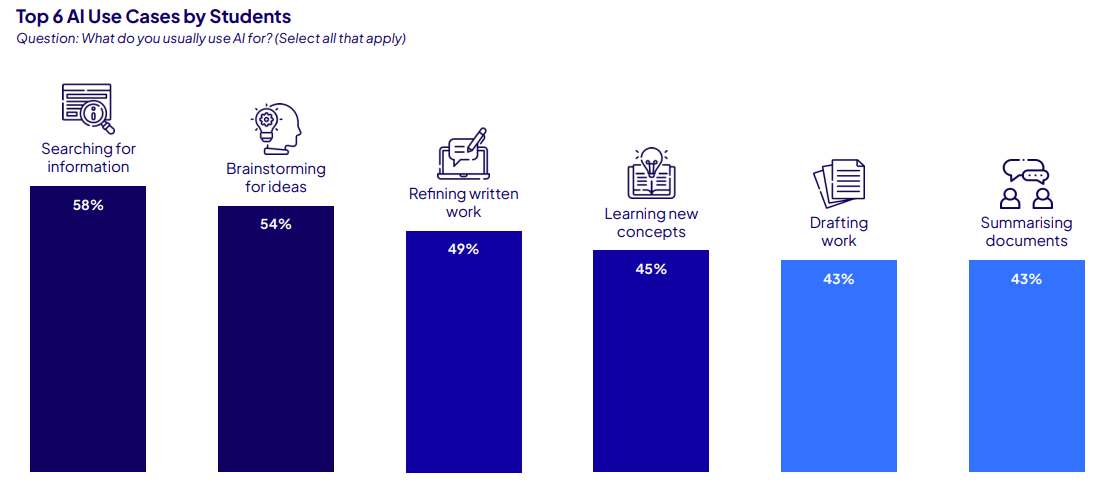
The world’s largest and most geographically diverse survey on AI adoption in higher education was conducted by the Digital Education Council in 2026. It surveyed a total of 45,398 students and faculty members across 35 countries.
The survey found that 88% of students use AI tools globally and 43% of them use AI to draft their work, among other use cases.
This increase in the use of AI tools, and particularly for generating work, has made AI detectors more important than ever. That’s why there are many AI detectors available today, but not all of them are accurate.
Decopy AI is one of the many platforms that offer an AI detector.
I put Decopy's AI detector through a detailed test to see whether its detection is accurate. This Decopy AI detector review details my experience using the tool and the findings.
Let’s start with a brief overview of the Decopy AI detector.
What is Decopy AI Detector and How It Works
Decopy AI detector is one of the many tools offered by the Decopy AI platform.
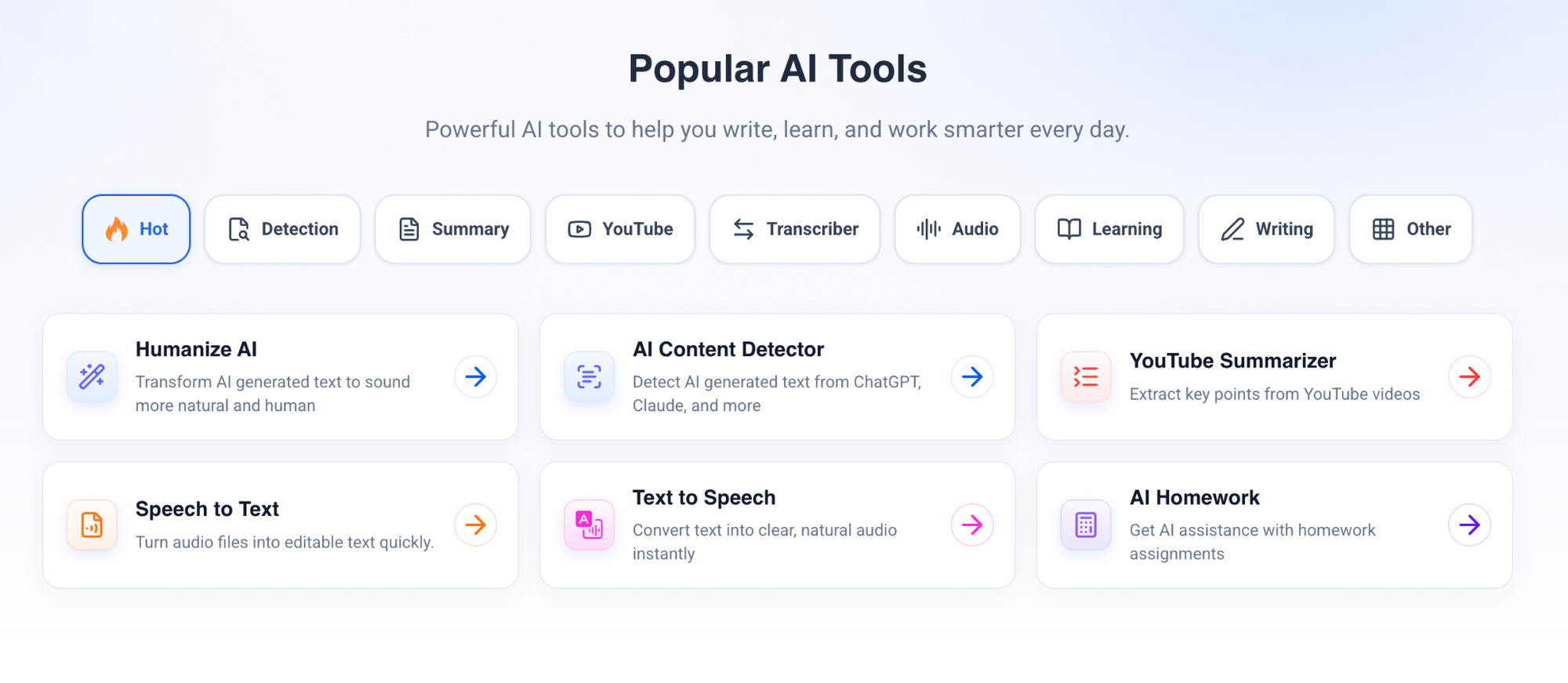
You can use its AI detector for free and without an account for the first 5 scans, after which you are prompted to create an account and scan text using premium credits.
There’s no word-per-scan limit during your 5 free scans.
The AI detector calculates the probability of the text being AI and shows you the result as a percentage.
The scan verdict can be Human, Mixed, or AI and appears next to the AI percentage.
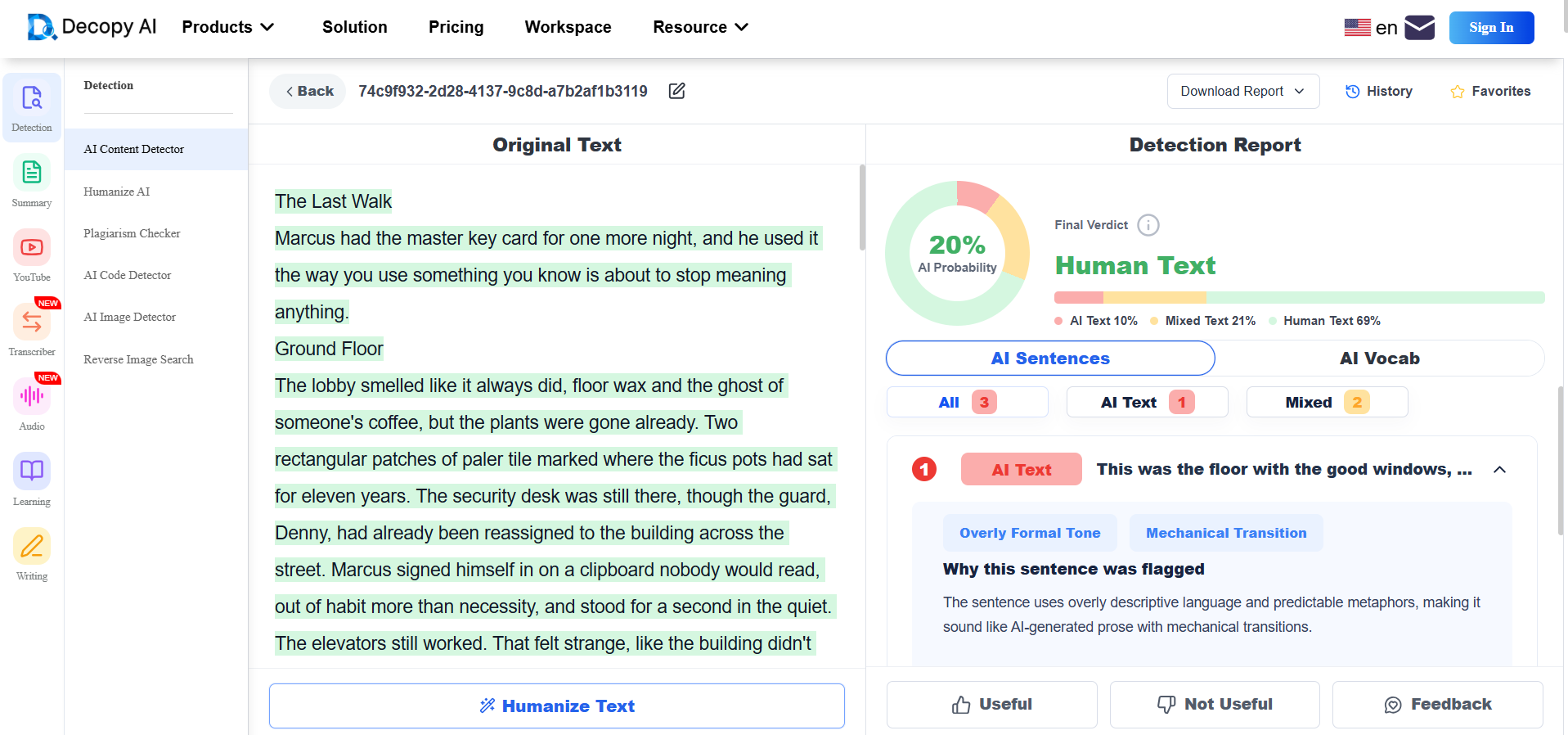
But there are three other percentages that make Decopy’s detection report confusing to understand.
Those three percentages are:
- AI text
- Mixed text
- Human text
These percentages are based on the number of words in the text. I wouldn’t have understood what these percentages exactly mean had I not downloaded the detection report PDF of a scan (shown below) because that’s only where Decopy mentions what these scores are based on.
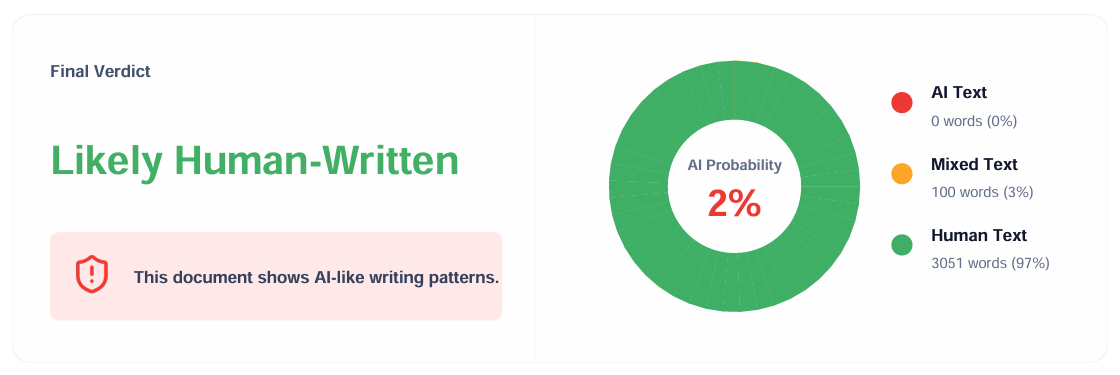
[Screenshot from the PDF version of a Decopy scan]
So don’t confuse the AI text percentage with the AI probability percentage. They are not the same thing and won’t necessarily be equal every time. Decopy AI does not make it clear why the two numbers differ. In my opinion, that could be because the AI probability is calculated from AI text and mixed text percentages combined.
Decopy appears to calculate AI probability by taking the AI text percentage and adding half of the mixed text percentage. Here's how that held up across four of my scans:
One thing is clear that the verdict of a scan is always decided by the greatest of the three additional percentages in Decopy’s detection report.
Decopy also highlights the text blocks in different colors based on whether they're predicted to be AI, mixed, or human. It also gives a reason why a block of text was flagged as AI or mixed.
Now let’s test the AI detector and figure out whether it’s worth scanning text for AI with Decopy.
How I Tested the Decopy AI Detector
I didn’t want to perform basic testing because that wouldn’t give us a strong idea of Decopy’s accuracy.
That’s why I used the same testing methodology I have used in the past to review other AI detectors, like the ZeroGPT AI content detector.
This methodology uses multiple AI-written and human-written samples in order to expose an AI detector's accuracy at detecting both AI-written text and human-written text.
The testing also reveals some other patterns that basic testing doesn’t.
These are the details about the two sets of text samples I used to test the Decopy AI detector:
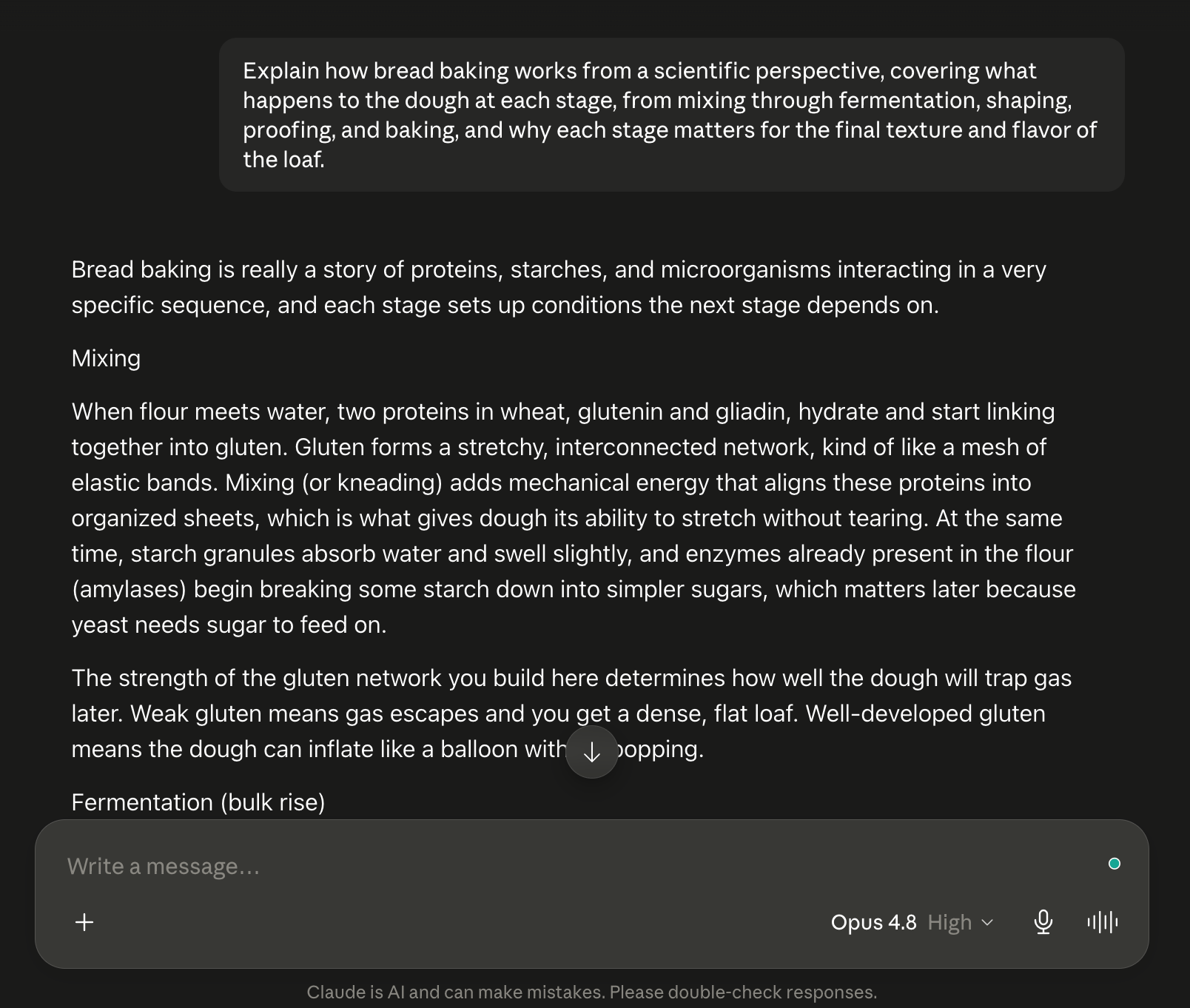
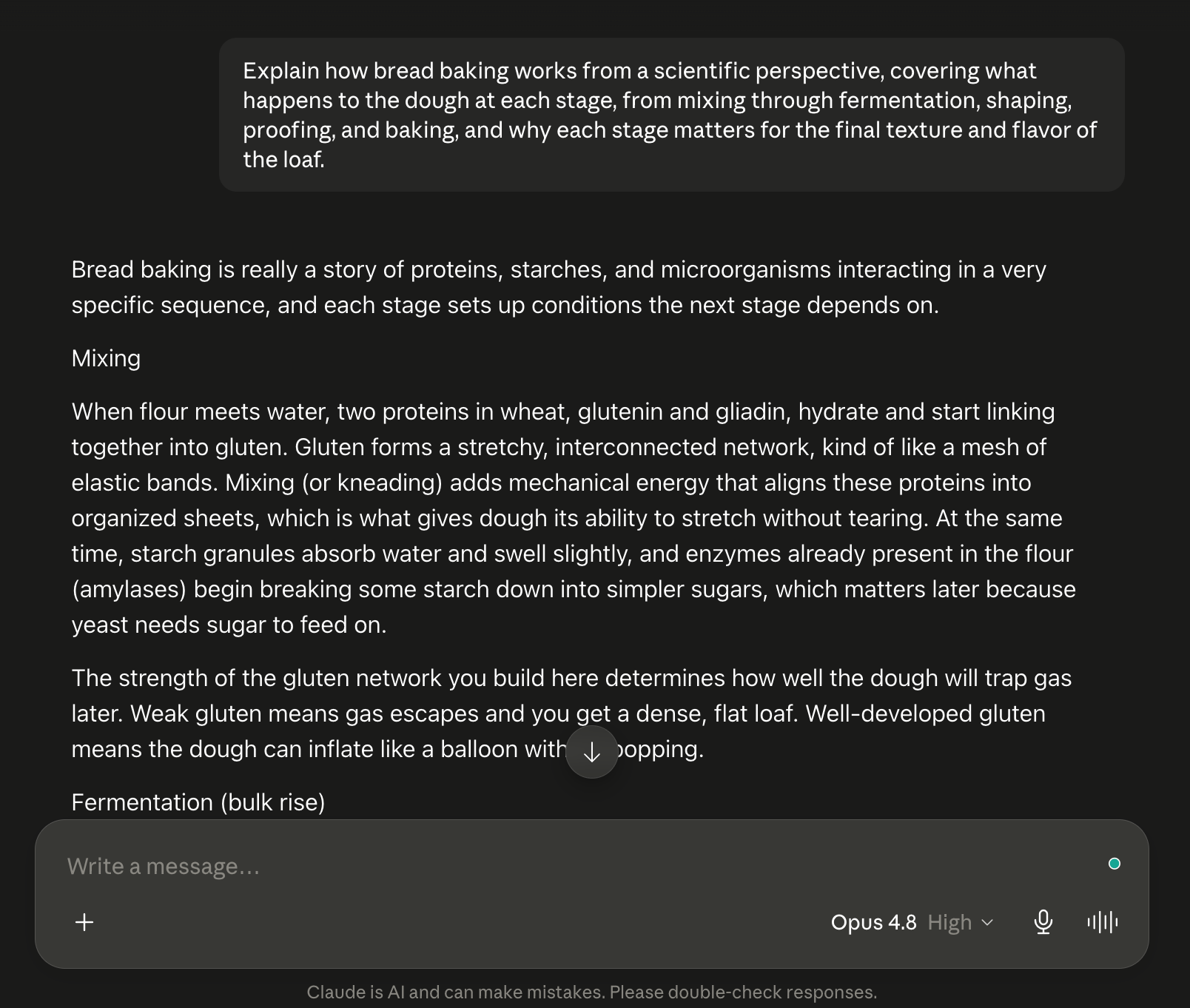
- The AI-written set: I used two prompts to generate two text pieces each from Claude, ChatGPT, and Gemini. So the set contains six 100% AI-written samples in total. The two prompts were:
- Prompt 1: Explain how bread baking works from a scientific perspective, covering what happens to the dough at each stage, from mixing through fermentation, shaping, proofing, and baking, and why each stage matters for the final texture and flavor of the loaf.
- Prompt 2: Write a detailed account of someone's last walk through an office building at night before it closes for renovation, including what they notice, remember, and feel as they move from floor to floor.
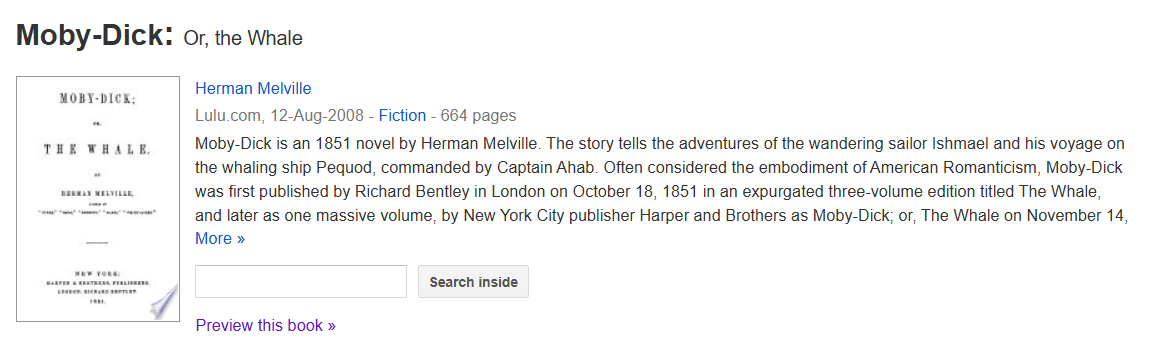
- The human-written set: This is a set of seven 100% human-written samples published before 2020. I have even included a classic novel (Moby Dick) from 1851 in this test.
Now let’s start scanning these samples using the Decopy AI detector. I will also scan them through GPTZero’s AI detector to show the contrast in accuracy.
Is Decopy AI Detector Accurate?
In my testing, the Decopy AI detector showed poor accuracy in identifying AI-written text. But when the text is 100% human-written, its verdict was correct.
Read below for how Decopy scored each of the samples.
Decopy AI Detector vs. AI-Generated Text
I generated two types of text samples from the three AI models.
One sample was informational and had a formal-leaning tone.
The other sample had an anecdotal style that tends to be more casual in tone.
Decopy’s AI detector gave the wrong verdict for almost all of these samples. Only one sample was correctly identified as being 100% AI-written.
All the other samples were given very low AI scores and either declared to be human-written or mixed.
But even in this, there was a pattern. The informational samples generated by each AI model received lower AI scores in general compared to the narrative-style samples.
Claude’s informational sample was the most successful at bypassing Decopy’s AI detection, as it received a 0% AI score.
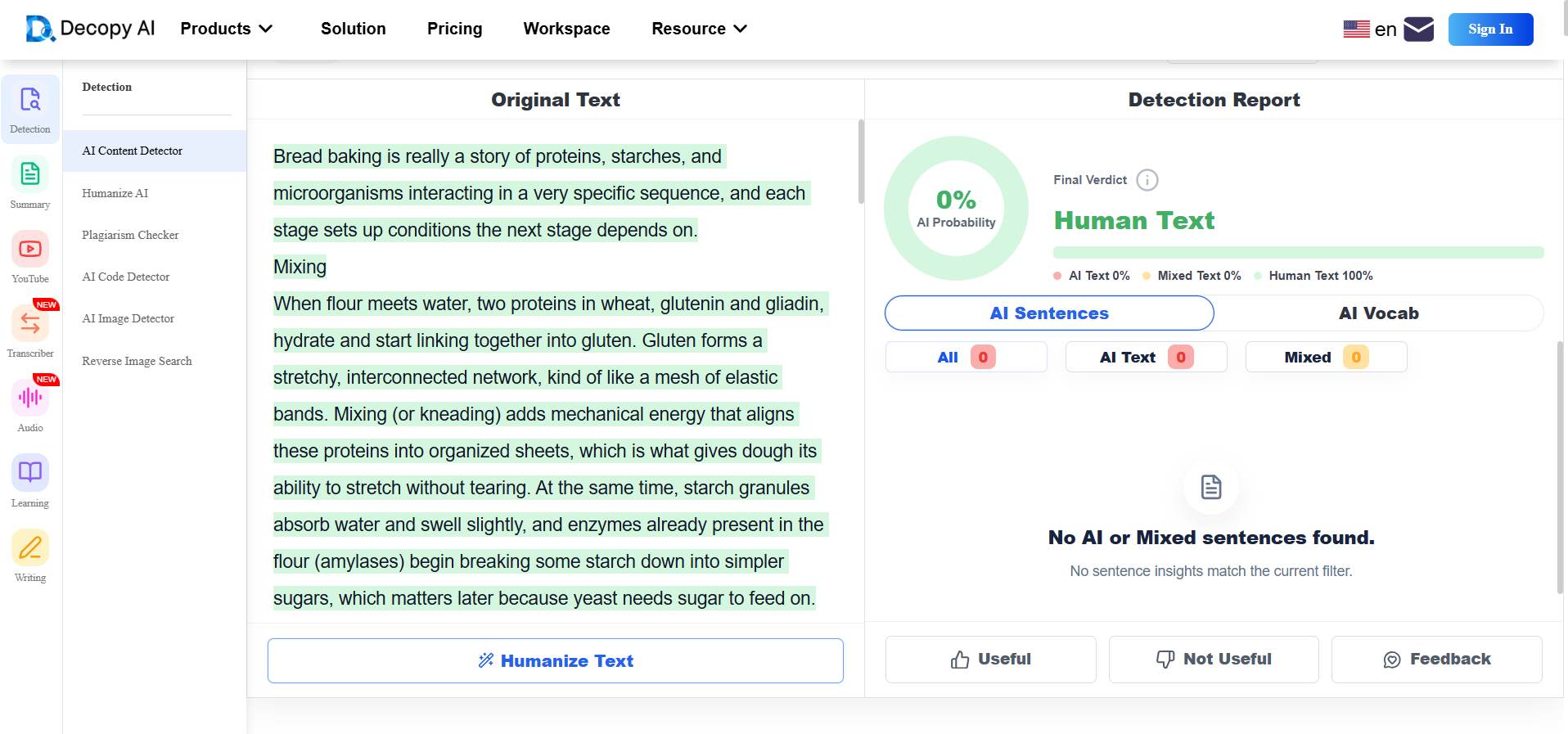
Even Claude’s sample No. 2 (Last Walk one) received a low 20% AI score. Decopy's AI detector identified both samples as human-written. When in reality, they were 100% AI-generated.
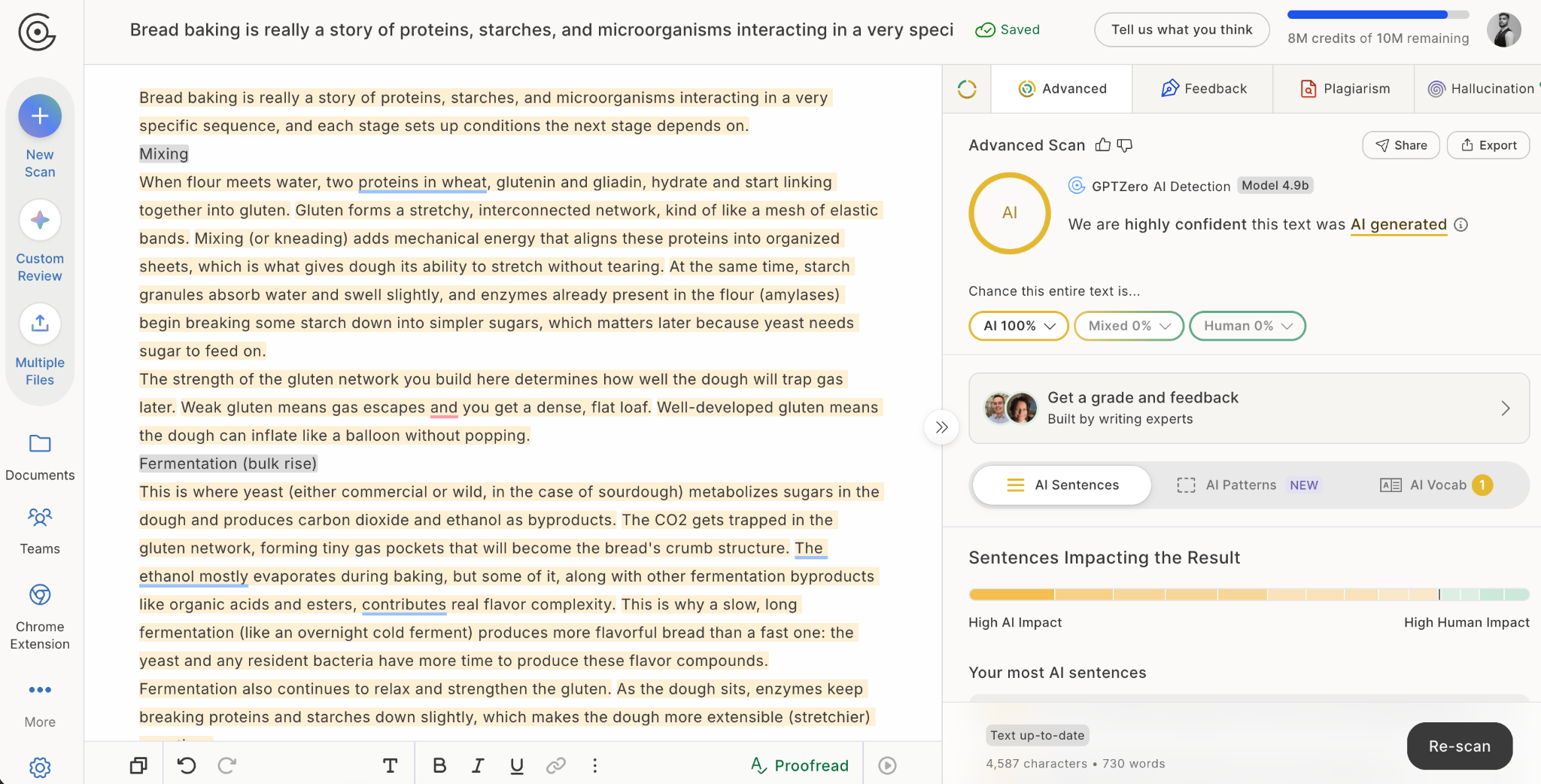
I went ahead and tried scanning both of these AI-generated samples through GPTZero. GPTZero flagged both of these samples generated by Claude as 100% AI.
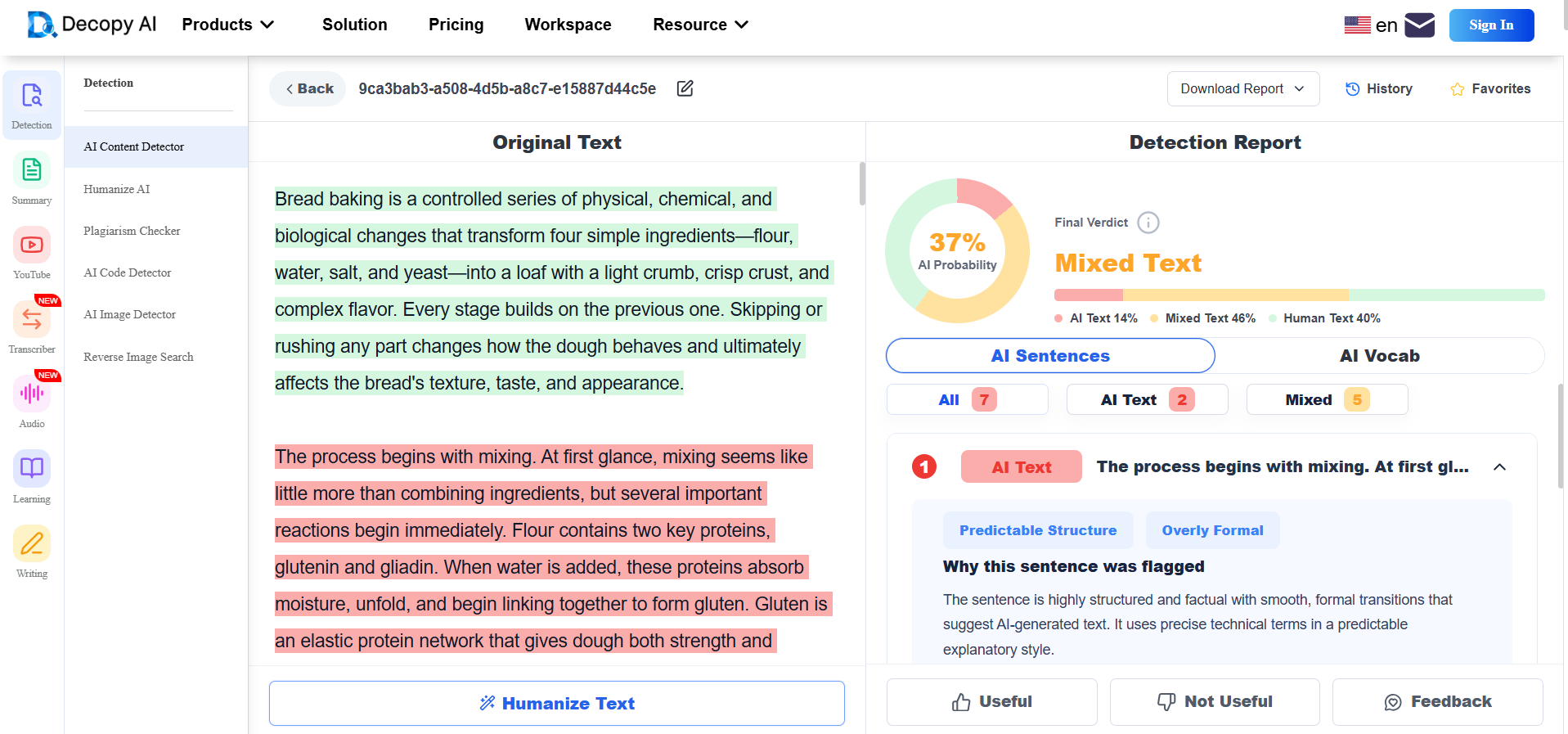
Decopy’s only correct verdict was on the narrative style sample generated by ChatGPT. It correctly flagged the content as 100% AI.
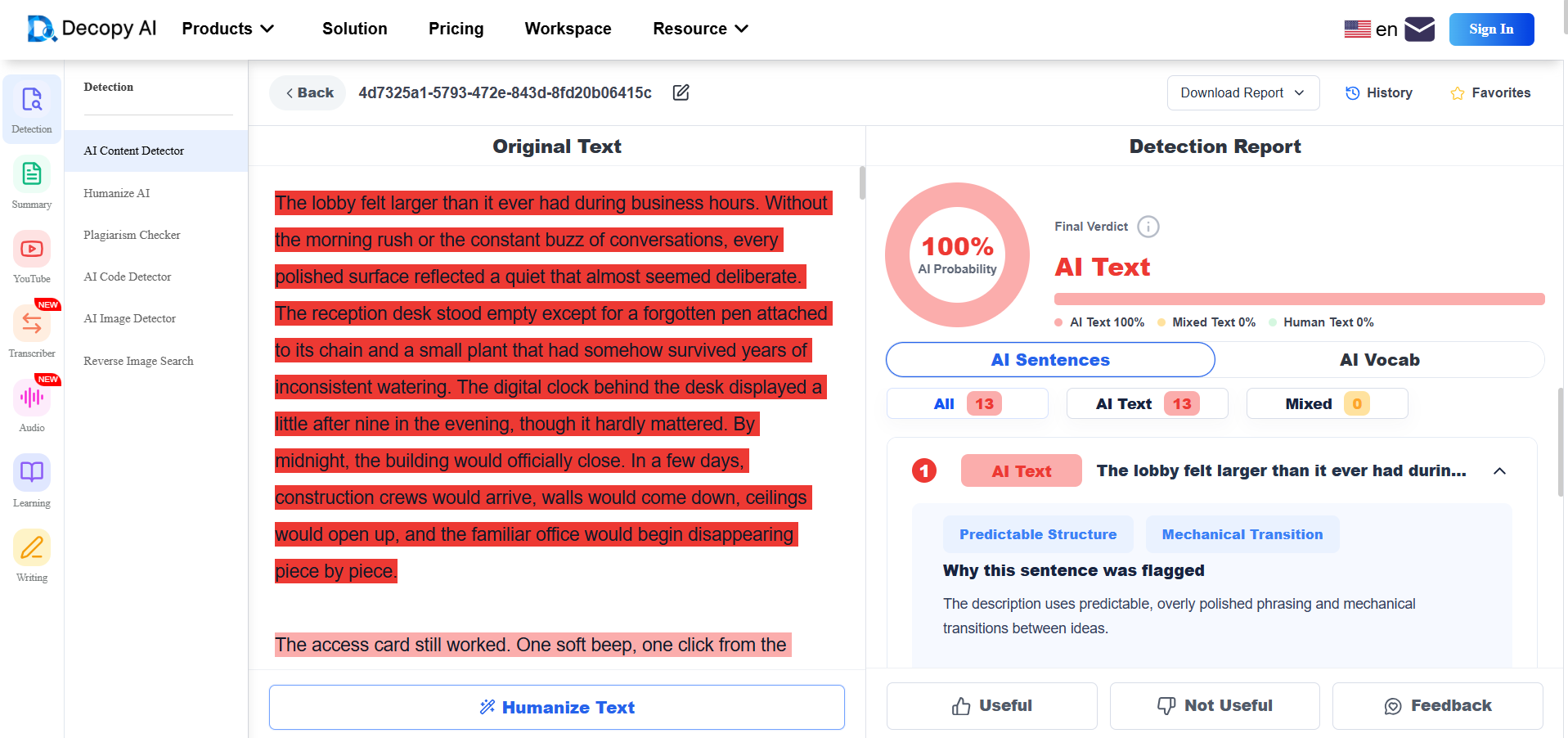
ChatGPT’s informational AI-generated sample (Break baking) also received the highest AI probability score at 37% AI, compared to the informational samples generated by Claude and Gemini. Of course, the Decopy AI detector is still off by a wide margin, but it looks like it recognizes ChatGPT text better than text generated by other AI models.
The two Gemini samples were given one human and one mixed verdict.
What this tells us about Decopy is that it performs poorly on correctly identifying AI-written text. Its lowest accuracy is against text written by Claude, followed by Gemini. It may perform a little better against ChatGPT-generated text.
The table below shows Decopy’s AI score and verdict for all six AI-generated samples. “Sample 1” refers to the informational write-up and “Sample 2” refers to the narrative-style write-up. Also notice GPTZero’s AI score in comparison.
If you want to see my full testing, including the AI-generated text samples and all the detection screenshots, please refer to this PDF. In this document, you will also find GPTZero’s detection results on all these AI-generated samples.
Decopy AI Detector vs Human-written Text
Decopy’s AI detector performed consistently and reliably on all 7 human samples.
All of them received the correct verdict that they were human-written.
Most of their AI scores were also lower than 5%. Only two samples received 9% and 6% AI scores.
Decopy identified two samples with great accuracy. They both received 0% AI scores. Both of these texts were historic. One was a news excerpt from a 1922 issue of a historic American newspaper. The other was the Moby Dick novel that was published in 1851.
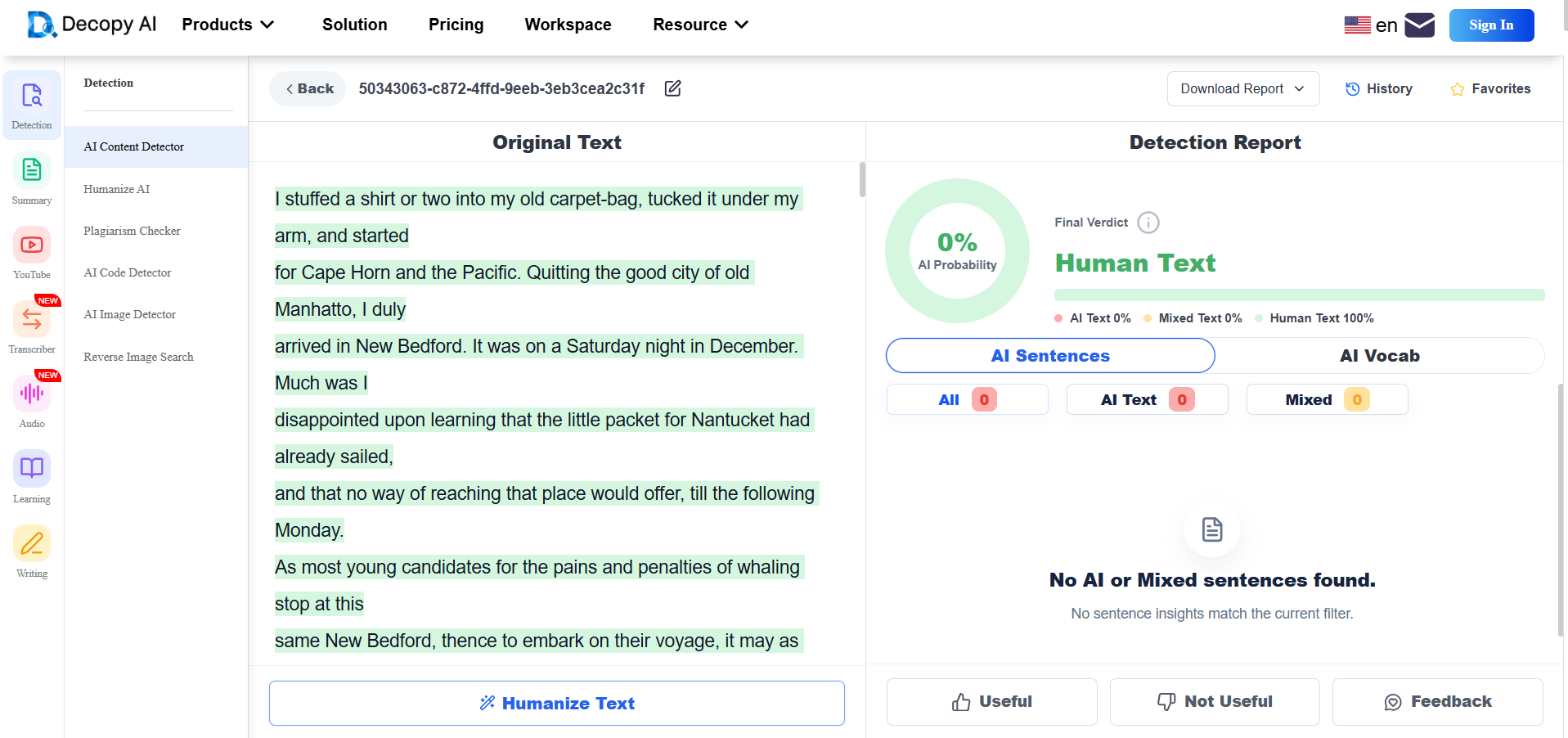
So this could be Decopy’s strength. Based on my testing results, Decopy AI content detector performs well on 100% human-written samples.
Here’s Decopy’s AI score and verdict for all 7 human-written samples. Compare the AI scores with the accuracy achieved by GPTZero.
I have compiled all the screenshots from my testing of the Decopy AI content detector on human-written samples in this PDF document. You may refer to it for a detailed view.
Decopy AI Detector Pricing
You can’t buy Decopy’s AI detector separately.
The first 5 scans are free whether you’re logged into Decopy or not. After you’ve used your free tries, any further AI detection scan will consume premium credits at a rate of 500 characters/credit.
Decopy AI gives 10 premium credits for free every month.

After you have consumed your free premium credits, Decopy AI asks you to purchase a plan to perform more scans.
There are three monthly plans priced at $9.99, $14.99, and $29.99, offering 800, 2000, and 5000 premium credits, respectively. These credits expire after a month, meaning you will lose your unused credits after a month.

If you want permanent credits, you can instead buy credits only. But those are only available for users who are already subscribed to any of the paid plans. The starting rate for credits is $0.003 per credit. But if you choose to buy a pack of 10K or 25K credits, you get a discounted rate.

Use GPTZero for Accurate AI Detection
An AI detector's primary job is catching AI-written text. If it fails to do that, or does it with low accuracy, it’s hardly of any use.
And Decopy AI detector stands in that category based on the testing I conducted in this Decopy AI detector review. You saw that it gave highly inaccurate AI percentages on 100% AI-written text, except for 1 ChatGPT sample.
At the same time, you saw that GPTZero’s accuracy rate was 100% on all human and AI-generated samples used.
GPTZero’s AI detector was the pioneer of the AI detection industry. It launched in January 2023, soon after the release of ChatGPT in November 2022.
Since then, GPTZero has maintained the highest AI detection accuracy rate globally, on both company and independent benchmarks.
Try GPTZero for free today and witness its accuracy on your own samples.
FAQs
Is Decopy AI detector accurate?
Based on my testing, the Decopy AI detector is not accurate on AI-generated text. I tested it on 6 AI-written samples, which I generated using 3 AI models (Claude, ChatGPT, and Gemini) and 2 different prompts, one informational and one narrative. Out of these 6 samples, Decopy could only correctly flag 1 ChatGPT sample as 100% AI. It gave a human verdict on 3 samples and a mixed verdict on the remaining 2.
The AI scores were way off too. Claude's informational sample got a 0% AI score, and Gemini's got 8%, even though both were 100% AI-generated. I scanned the same samples through GPTZero, and it flagged all 6 as 100% AI.
Decopy did perform well on human-written text, though. I tested it on 7 human-written samples published before 2020, including a 1922 newspaper excerpt and Moby Dick from 1851, and it correctly identified all of them as human. Most of these human-written samples scored under 5% AI.
Is Decopy AI free?
Decopy AI has a free plan that gives you 10 quotas in monthly usage and 10 premium credits for free every month. But the free plan gives you access to limited features, and you can only try the premium features a couple of times.
For example, if we talk about Decopy’s AI detector, the first 5 scans are free whether you’re logged into Decopy or not. After you’ve used your free tries, any further AI detection scan will consume premium credits at a rate of 500 characters/credit. Also, you can’t buy Decopy’s AI detector separately.