
What To Do Before Submitting Your College Application
College applications are time-consuming. You could be impatient to just press submit. But first, make sure you’ve proofread it closely. Read about the 7 things to check before submitting.


College applications are exhausting. You have to put in so much work that by the end, you just want it over with.
But don't rush to submit just because you've filled out the last field, or because your classmates already have.
Take the time to review your application thoroughly, since it’s going to decide if you’ll get admitted or not.
Here’s a complete college application submission checklist. You’ll learn seven things you need to check before submitting your college application. We’ll also cover one common mistake that you need to avoid at all costs. So let’s begin.
College Application Submission Checklist
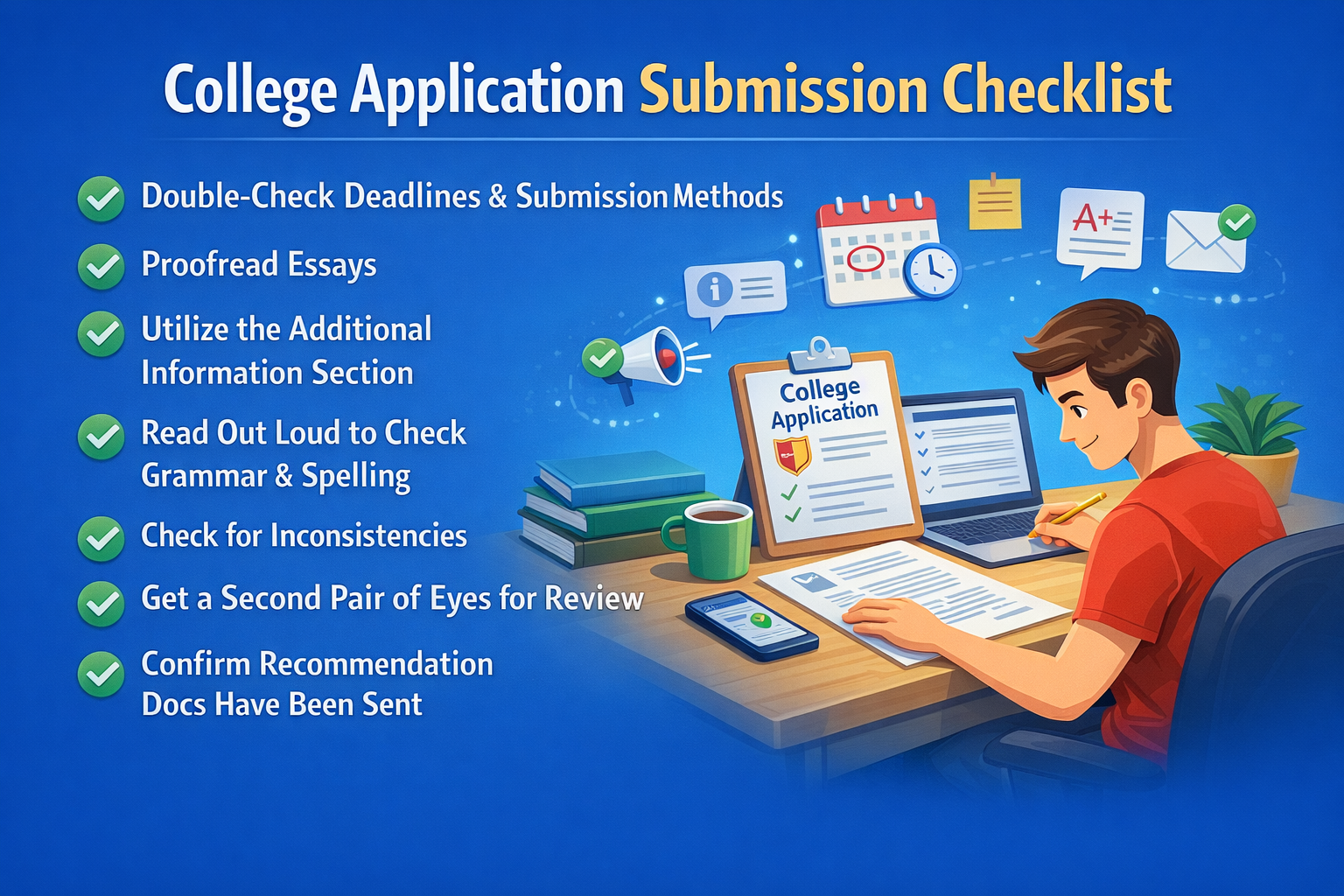
Double-Check Deadlines & Submission Methods
There are different types of admission rounds, each with different deadlines and admission pools.
You’ve got Early Decision and Early Action, which commonly fall around November 1 or November 15. But they can also have an earlier or a later deadline. It depends on the colleges. They can have a deadline in October or give you until mid-January or sometimes February.
Regular Decision rounds also typically take place in January. But again, the date can be different.
Regarding financial aid applications, the main FAFSA deadline is June 30th for each academic year (e.g., June 30, 2026, for the 2025-2026 year). However, specific states and colleges could have a much earlier date for institutional aid forms submission.
Whatever the deadline is, you should set your own deadline at least three or four days before the actual deadline. Submitting even earlier would be even better because, as the deadline looms nearer, the load on admission portals increases. They have crashed on deadline day in the past. Sure, colleges usually extend deadlines when this happens, but it’s better to get things done earlier instead of taking a chance and hoping for an extension.
Speaking of admission portals, you should also confirm which application system each college uses. Most of them use the Common App, but some use the Coalition for College app. However, don’t assume that for all colleges. For instance, MIT and Georgetown have their own application systems entirely. The UC system has its own portal, too.
Proofread Essays
The essay is probably the single most important piece of writing in your entire application.
Admissions officers are going to read this essay and form an impression of you as a person.
What you write and how you present it can shape the outcome of your entire application, which is exactly why proofreading your essay deserves serious attention.
So how do you proofread this essay properly?
Properly proofreading anything requires a fresh pair of eyes. And that’s possible if you step away from the finished essay for a few hours or even a day or two.
Then, when you come back, look at the bigger picture.
- Does your essay answer the essay prompt of the current application you’re filling out?
- Or have you repurposed an essay from another college’s application?
This happens a lot, and you need to avoid it. Colleges can have different essay prompts, and you should write based on that only.
Also, check the word count. If a range is given (e.g., 250 and 650 words), try to hit the higher end if you can while maintaining quality. But avoid forcing it by padding your essay with clichés and generic statements.
The tone of the essay also matters. It should sound like you. Don’t deliberately stuff big words hoping to impress admission officers. But at the same time, avoid writing so casually that you come across as disrespectful or immature.
Utilize the Additional Information Section
All college applications have a section for Additional Information that a lot of students leave blank when they should be making full use of it.
Your grades, test scores, and activity list don’t paint a full picture of you. Instead, they can raise more questions in the minds of admission officers. And answering those questions or clearing other potential doubts is why this section exists.
While admission officers don’t know you personally, they know life happens, and they just need you to give them the context.
Maybe you only have two extracurricular activities listed, while other applicants have seven or eight. But that’s because you were working thirty hours every week to support your family. With this context, those two activities might start looking even more impressive to admission officers.
But avoid making things up or exaggerating.
Also, this section isn’t necessarily for major crises only. Anything worth noting can go here.
Read Out Loud to Check Grammar & Spelling
You and your batch mates are submitting college applications for the first time. So mistakes will be commonplace.
But there’s a difference between making a few small typos and making plenty of them. You don’t want to appear careless to the admission officers. And fixing grammar and spelling mistakes is the easiest way to avoid that.
You have many free word processors for this job. But avoid using Microsoft Word, because it isn't great at understanding context and commonly misses errors. Use modern tools like GPTZero’s free grammar checker. The tool is made specifically for fixing grammar and spelling issues as well as improving the overall quality of any text.
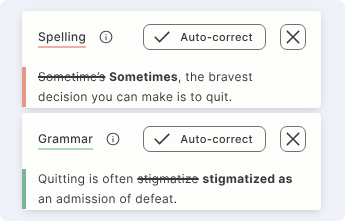
GPTZero’s grammar checker can also suggest rewording of entire sentences if the original isn’t up to the mark. You can also chat with the tool and ask for its feedback on specific sections of the text.
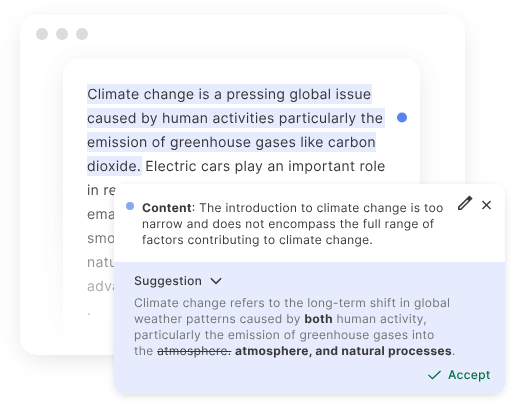
But make sure to do a final read yourself afterwards. In fact, read your entire application out loud.
That’s because when you read silently, you see what you meant to write instead of what’s actually on the page. But read the same thing out loud, and you’ll catch both obvious and non-obvious issues, such as starting three sentences in a row the same way.
Check for Inconsistencies
Providing inconsistent information in your application can seriously damage your admission chances.
At best, inconsistencies make you look careless. At worst, they make it seem like you're lying, and that is solid grounds for disqualification.
You may have unintentionally mentioned different periods for when you were the president of the debate club. The activity list could say you were president from September 2023 to June 2024. But then you might have mentioned 2022 to 2023 in the essay. This could purely be a mistake on your end. But the admissions officer reading your application might start questioning whether you were actually president at all.
Check for similar inconsistencies throughout your application and fix them. And don’t just focus on the dates. You can also have claimed wrong roles or responsibilities.
So make sure everything aligns across the different sections of your application and your documents.
Get a Second Pair of Eyes for Review
Nothing beats getting someone else to review your application. They aren’t in the same state of mind as you are. You could be working on the college application for days, if not weeks, and that could have muddled everything in your mind.
Moreover, you are naturally less critical of yourself.
Therefore, you should ask for a review by an independent source.
Teachers or school counselors make great reviewers, though they may be swamped with other students' applications during peak season. Parents and friends are solid alternatives in such instances, but just make sure they provide you honest critique, and not just reassurance.
Oftentimes, their opinions about you are too strong to allow them to critique you.
Whoever reviews your application, give them a list of things they should look for (could be this entire checklist you’re reading):
- Spelling and grammar errors
- Inconsistent dates or details across sections
- Essay responses that don't match the prompt
- Tone that doesn't sound like you
- Missing or incomplete information
Last but not least, avoid involving too many people. You'll drive yourself crazy trying to incorporate all their feedback. But if multiple people point out the same issue, that's probably something you should address.
Confirm Recommendation Docs Have Been Sent
Sending letters of recommendation on your behalf is the responsibility of your school counselor and teachers, among others.
But making sure they have sent those docs is still on you.
You’ll need to figure out what recommendations a specific college needs. Institutions can require a combination of recommendations, i.e., one from a STEM teacher and one from a humanities teacher. But some might not require any recommendation at all.
Once you know that, you can line up the right people and inform them about the deadlines well in advance.
Most colleges manage applications and recommendations separately. You don’t have to wait for all your letters to be submitted before submitting your part of the application. It’s normal for recommendation letters to arrive after your application does.
You can check the application portal you used to check if recommendations have been submitted. But not all portals show you that.
If a deadline is approaching and a recommendation letter hasn't been submitted yet, you can send a polite reminder to your recommender through email.
Here's a simple email you can send to request a recommendation:
Once they have sent over the recommendation letter, write them a thank-you note for their time and help.
One Thing To Never Do in Your College Application: Use AI
AI tools can help you research topics, brainstorm ideas, or understand difficult concepts. But when you’re filling out your college application form, set AI tools aside. Particularly, don’t make AI write the college application essay on your behalf.
Your essay should reflect your unique voice and personality, and that distinctness should carry through the rest of your application too.
AI fails at this. It has a generic writing style that fails to imitate your voice. Many other students might have used AI to write their essays, so if you do that too, you’re going to end up sounding like them. You can end up making admission officers add your application to the less desirable candidates list.
Moreover, AI doesn’t know your story better than you do. It cannot incorporate your lived experiences as you can.
So that’s another reason why you should write by yourself. It’s a small one-time effort, and the stakes are high.
Some colleges, if not most, might also be running an AI detection scan on student applications as they arrive. And you wouldn’t want to be eliminated or blacklisted like that in the initial phase.
If you have written most of your application by yourself and only taken a little help from AI, you should scan your entire app or specific parts of it with GPTZero’s AI detector. It’s the most accurate AI detector in the world, and many educational institutions already trust it.
The AI detector will pinpoint which specific sentences were likely written by AI. You’ll only have to rewrite those sentences, and your human score will be back to 100%. That’s where our guide on how students can avoid AI detection will help you.
We also have a Chrome extension that can check for AI right inside the admission portal you’re using.
You can start scanning for AI with GPTZero for free.