Top Challenges Principals Face in 2026
We examine the biggest challenges principals face in 2026, why they matter, and what can be done to address them next.


Being a principal has never been an easy job, but recently, it seems to have gotten even harder: one survey showed 63% of principals describe their workload as unsustainable and 83% report that their mental health has suffered due to the job. As leaders of the school community, it’s important to examine what is driving these difficulties and explore how principals can respond.
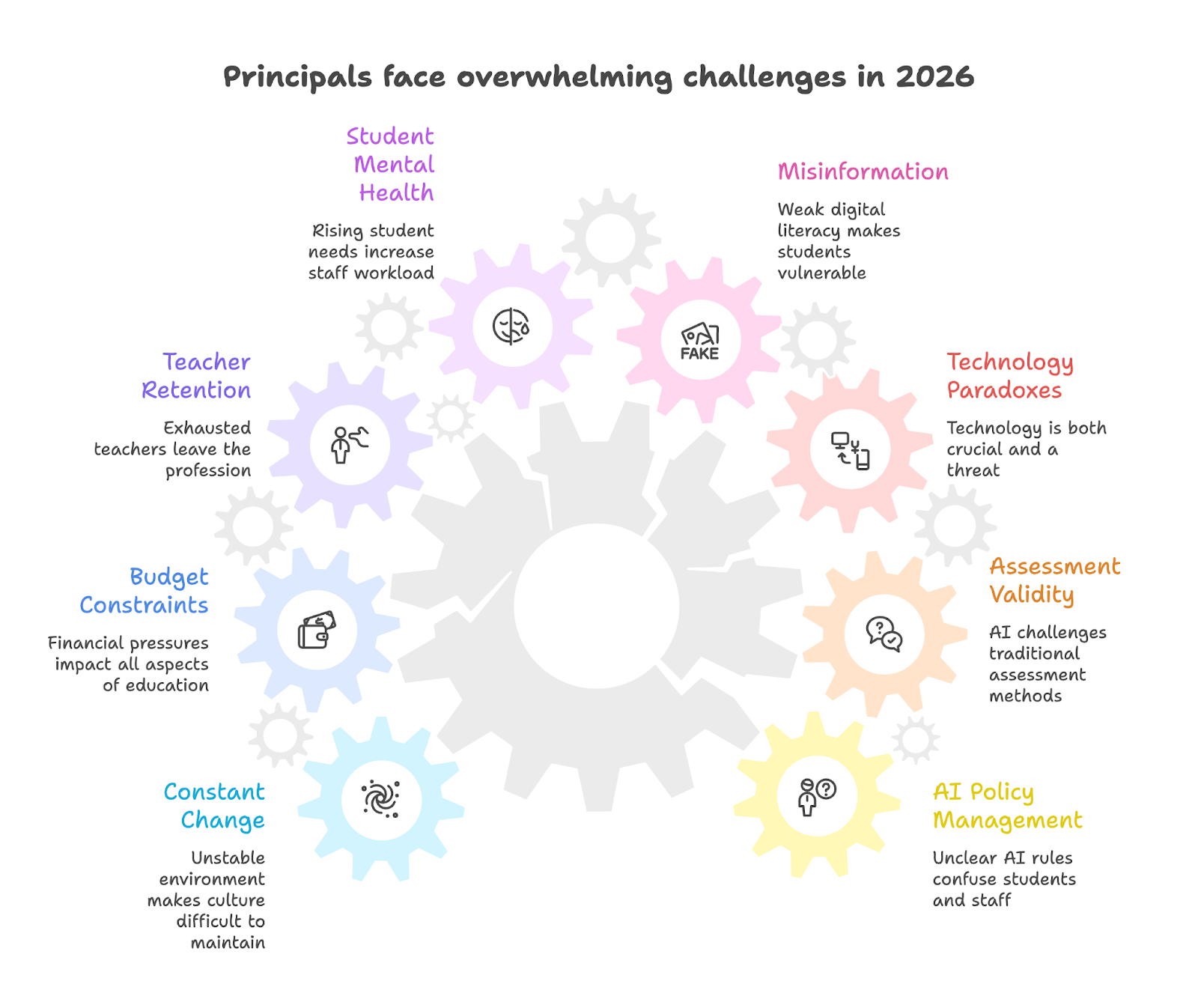
This article breaks down the eight biggest challenges principals face in 2026, why they matter, and where possible, the practical steps school leaders can take next.
TL;DR
Principals in 2026 are facing a mix of old pressures and new ones. The biggest challenges include building a workable AI policy, keeping assessment valid, supporting teacher retention, responding to student wellbeing needs, managing technology change, and leading school culture through uncertainty. The most effective response can include practical systems that reduce confusion for staff and students, but also a recognition of how much the job has changed in recent decades so that principals can manage their own wellbeing.
Top 8 Challenges Principals Face in 2026
1. Managing an AI policy that is fit for purpose
There are no easy answers around exactly how AI is used in education, as while blanket bans might be tempting, principals themselves can benefit from the efficiencies of AI tools.

“While AI cannot replace the human element needed to engage students and staff, it can free up more time for principals to focus on what matters most: relationship building,” says S. Kambar Khoshaba, a high school principal in Lorton, Va.
Many principals are trying to figure out where the boundaries are, and know that hazy rules can confuse their school very quickly. For example, if one teacher allows AI-assisted planning and another treats any use as misconduct, students get mixed messages and staff are left making difficult judgement calls on their own.
When it comes to establishing AI policies, it’s important to treat any policy as a living document, and set up a governance structure to keep it updated. This means regular reviews, ideally annually, to make sure the policy adjusts alongside technology and the needs of the campus community and adapts accordingly.
2. Deciding whether task assessment remains valid

“The biggest challenge any academic institution has to contend with these days is whether what we are testing and measuring can remain valid and reliable,” says Lorenzo Mulè Stagno, Dean of Malta Business School.
“When we provide an assessment through some task, what we are supposed to be claiming is that the student has some measure of skill or knowledge in that subject. Hence the result or measure is reflecting the student’s ability in the subject being tested, showing both validity and reliability.”
He makes a comparison to the arrival of the calculator: once the technology became unavoidable, schools had to rethink what they were actually assessing. The same is true now, and he admits, “We are still at the frontier of this new paradigm, which means that we are all bound to make mistakes. That’s how we learn.”
For principals, the practical next step can be to work with teachers on assessment design, which may include more in-class writing, oral defense, staged drafting, process checks, or assignments that ask students to reflect on how they used tools.
3. Navigating the paradoxes of technology

“Technology has shifted from a niche interest in the schools of the 1980s to a constant preoccupation as we enter 2026,” says Melvyn Roffe, former principal of George Watson’s College. “But even if you strip away the arguments of zealots, you are left with a series of paradoxes. Technology is now simultaneously crucial to an education that prepares children for their futures and a potential threat to those futures.”
Schools are often expected to move quickly while capacity moves slowly. Teachers may be asked to use tools they have not been trained on, and students may have inconsistent access, while budgets may not stretch far enough to support implementation properly.
This is where principals need to slow the pace of confusion, even when they cannot slow the pace of change. That means choosing a small number of priorities, setting clear expectations, and making room for staff training before rolling out new systems too widely.
Peer-to-peer community can be the most helpful way to face these new questions – one example is GPTZero’s webinars around Teaching Responsibly with AI, the replays of which are available online.
One of our webinars around Teaching Responsibly with AI
4. Fighting misinformation and weak digital literacy
OECD research has highlighted the growing importance of media, information, and digital literacy in a world where young people are constantly navigating online sources, recommendation systems, and misleading claims.
Those without media literacy only become more vulnerable to misinformation and disinformation – which means that for principals, this means that digital literacy has become part of academic readiness.
For principals, a practical starting point is to support teachers with clear classroom strategies. Here are some ideas on improving media literacy in the classroom, which include specific teaching exercises.
5. Supporting student mental health and wellbeing
According to the WHO, globally, one in seven 10-19-year-olds experiences a mental disorder, with depression, anxiety and behavioural disorders among the leading causes of illness and disability among adolescents.
This can affect attendance, behaviour, focus, relationships, and learning, as well as staff workload, because when students’ needs rise, the pressure on the adults around them rises too.
Since schools have direct contact with more than 94% of school-aged children, they are an extremely relevant setting to helping support students. Although the issue of mental health is not for principals to solve alone, they need to make sure their schools have referral pathways, realistic staff training, and a culture where wellbeing is taken seriously.
6. Retention pressure and supporting teachers
No principal can build a stable school culture on top of chronic staff exhaustion, and teacher shortages remain a major challenge. NCES reported in October 2024 that most U.S. public elementary and secondary schools faced hiring challenges for the 2024-25 academic year, with too few applicants and a lack of qualified candidates among the top-reported barriers.
Burnout among teachers has been well-documented – Lauren Lowder, founder of Burnt Out Teachers, is a former burnt-out teacher with hundreds of thousands of followers, who wants to bring awareness to problems in education through humor.
Lauren Lowder is the founder of Burnt Out Teachers
It is a global issue – in England, a summary report commissioned by the Department for Education showed “teachers and leaders continue to be overwhelmed by unmanageable workload and long working hours… only one in four believes their workload is acceptable.”
For principals, retention goes beyond an HR issue as teachers are demanding priorities, protected time, useful training, and a sense that new initiatives are being managed rather than simply added. Teachers are more likely to stay when priorities are clear, planning time is protected, training is useful, and every new initiative is managed rather than simply added on top of everything else.
7. Working within budget and resource constraints
According to the McKinsey School Funding Model, K–12 school districts are likely to face a couple more financially difficult years: even if funding stays the same on paper, inflation means that money will buy less, so schools will effectively have less to spend per student until funding starts rising again around 2027–28.
Principals cannot control funding levels, but they can improve decision-making clarity. Better use of financial dashboards, longer-range planning, and transparent communication around trade-offs can help reduce uncertainty and keep staff aligned around what matters most.
Classroom Direct recommends using digital tools to track real-time insights into expenditures and revenue streams, building transparency and allowing administrators to make informed financial decisions promptly.
8. Leading school culture through constant change

Underneath all of these challenges is a bigger leadership task around holding a coherent school culture together when the environment around it feels unstable. Culture is what shapes whether staff trust leadership, whether students understand expectations, and whether parents believe the school knows what it is doing.
Yet right now, burnout is a huge issue, as Imed Bouchrika, PhD explains: “Teachers bear the brunt of criticism in the modern era of social media and helicopter parenting. They face enormous pressure from parents, students, and the public to pass students or increase student outcomes, while in many cases receiving fewer resources.”
Larry Ferlazzo, a former award-winning teacher who now writes for Education Week, says: “Find a way to let everyone share their ideas, push back, and pull forward, as you model pursuing purpose to make a difference. Know that more of your staff will follow you as the messenger before we follow your message.”

Principal Burnout in 2026: Key Facts and Trends
Knowing all of the challenges above, it becomes easy to see how principal burnout is on the rise. As leading education thinker Dr. Brad Johnson shares, “Today’s principals are expected to be everything to everyone: instructional leaders, safety coordinators, community liaisons, and champions of equity. They juggle these roles while navigating a sea of accountability measures and shrinking resources. It’s no wonder that stress, burnout, and turnover have reached critical levels for school leaders in the modern era.”

Here is an overview of where things stand.
What is principal burnout?
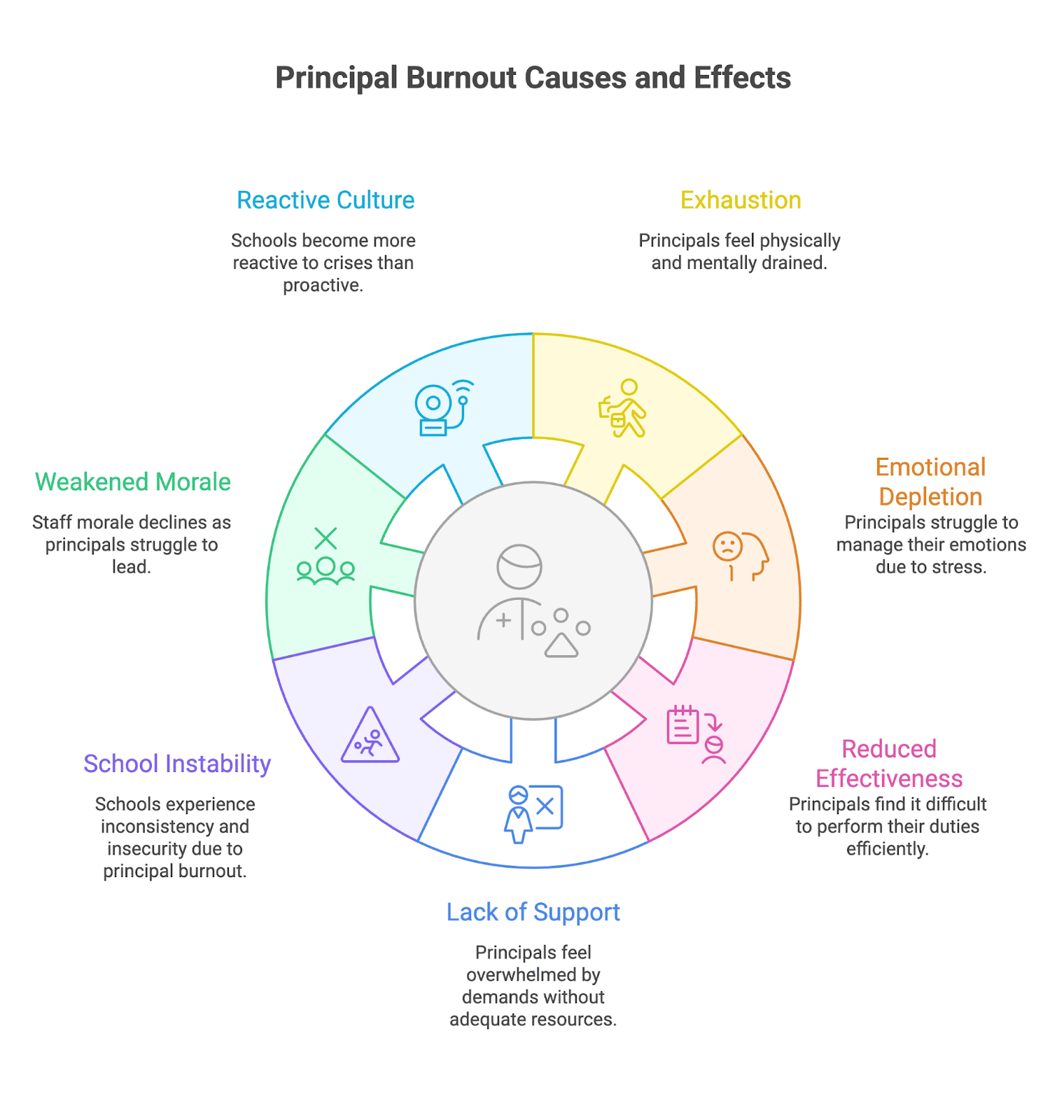
Principal burnout is chronic work-related strain that can show up as exhaustion, emotional depletion, reduced effectiveness, and a sense that the role’s demands are persistently outstripping the support available.
What is causing it?
The causes are structural, as the job has expanded, with principals expected to lead on a broad range of issues including staffing, safeguarding, mental health, curriculum, behaviour, technology adoption, parent communication, and AI policy, just to name a few.
“Principals are tasked with being instructional leaders, operational managers, and community liaisons—all while navigating the complex needs of students, staff, and families. It’s a role that often feels impossible to manage alone,” says Dr. Johnson.
What are the effects on schools?
When principals burn out, schools lose consistency, decision-making capacity, and strategic focus; while staff morale can weaken, and school culture can become more reactive. There’s likely to be more instability and insecurity, which doesn’t tend to create an environment where staff and students can do their best work.
What can principals do?
Dr. Johnson advises, “As a principal, you are constantly in demand. There’s always a meeting to attend, a parent to talk to, a crisis to manage, or a new initiative to launch. But to avoid burning out, it’s crucial to set and maintain clear boundaries. Not only does this allow you to recharge and focus on what matters, but it also teaches your staff how to prioritize their own well-being.”
Self-Assessment for School Principals
These challenges are complex, and there are no easy answers. In many cases, the best starting point is to step back and assess where your school stands now.
Education leader Don Marlett has adapted leadership guidebook The CEO Test into The Principal Test, specifically for school leaders. It outlines the critical challenges that every school principal must master.
Here are five useful questions to ask:
- Is our school vision clearly communicated to staff?
- Are teachers receiving enough support and training?
- Are we effectively managing AI use in assignments?
- Do staff feel supported and valued?
- Are student wellbeing programs working?
While answering these questions might not solve everything immediately, they provide a solid starting point for building progress going forward.
Conclusion
The biggest challenges principals face in 2026 are far from isolated issues, and instead are connected pressures that affect how schools function every day: AI policy, assessment design, staffing, wellbeing, budgets, and school culture all shape one another.
Instead of more noise, what principals actually need is more visible priorities, more consistent systems, and practical support that helps schools respond without losing trust.
If your school is reviewing how it handles AI use, academic integrity, or policy consistency, GPTZero can support those conversations with tools and resources designed for education. Used well, detection should help schools start better conversations, instead of perpetuating a culture of rushing to final verdicts.
FAQs
What are the biggest challenges principals face today?
The biggest challenges include managing AI in education, keeping assessment fair, supporting teacher retention, addressing student mental health needs, adapting to rapid technology change, and leading through policy ambiguity.
Why is AI becoming a challenge for schools?
AI is changing how students research, write, revise, and complete assignments. That creates new questions around academic integrity, assessment validity, digital literacy, and policy consistency across schools. UNESCO has specifically warned that AI’s rapid development is outpacing policy and regulatory frameworks in education.
How can principals help prevent teacher burnout?
The most effective steps include reducing unnecessary workload, protecting planning time, improving communication, giving staff practical training, and making priorities clearer during periods of change. Research points to workload and wellbeing as major factors shaping retention and workforce stability.
How should schools use AI detection tools?
AI detection tools should support review and discussion, not act as a final verdict. Schools need clear policy, human judgment, and consistent processes. Detection works best when it is part of a broader approach to transparency, assessment design, and responsible AI use.