Mathematicians Are Worried About AI Proofs. But GPTZero Spotted Them All
One of the biggest days in mathematical history, or the Doomsday of mathematics? In any case, we put GPTZero to the test.

On October 6, 2026, OpenAI released 722 manuscripts produced by an internal OpenAI model. OpenAI presented them as 372 families of new results, each aimed at an important open problem in mathematics. It went viral on social media, and Scott Aaronson called it one of the biggest days in mathematical history, while some called it the Doomsday of mathematics.
Whatever these preprints end up meaning for mathematics, we already have a clear answer to one question. Despite the model's unsettling ramifications for mathematics, GPTZero is able to detect it despite having never been trained on its data.
The OpenAI Math Dataset
OpenAI published the 722 manuscripts as a GitHub repository. It claimed that the majority of results were produced by an unreleased internal model with the following procedure: roughly 4,000 problems were given to the model, and it spent an average of about three hours of ChatGPT Pro-level thinking to produce each result. One manuscript’s write-up was edited by a human for readability.
On October 7, OpenAI withdrew three manuscripts after an error was found in their proofs, bringing the repository to 719. Our evaluation is based on all 722 manuscripts as originally released. We built the evaluation set by converting the public LaTeX source to plain text, removing figures and the reference list from every manuscript. For one preprint with 13 pages of pure numerical tables in the appendix, the appendix section was removed as well.
GPTZero Confident Evaluation Result
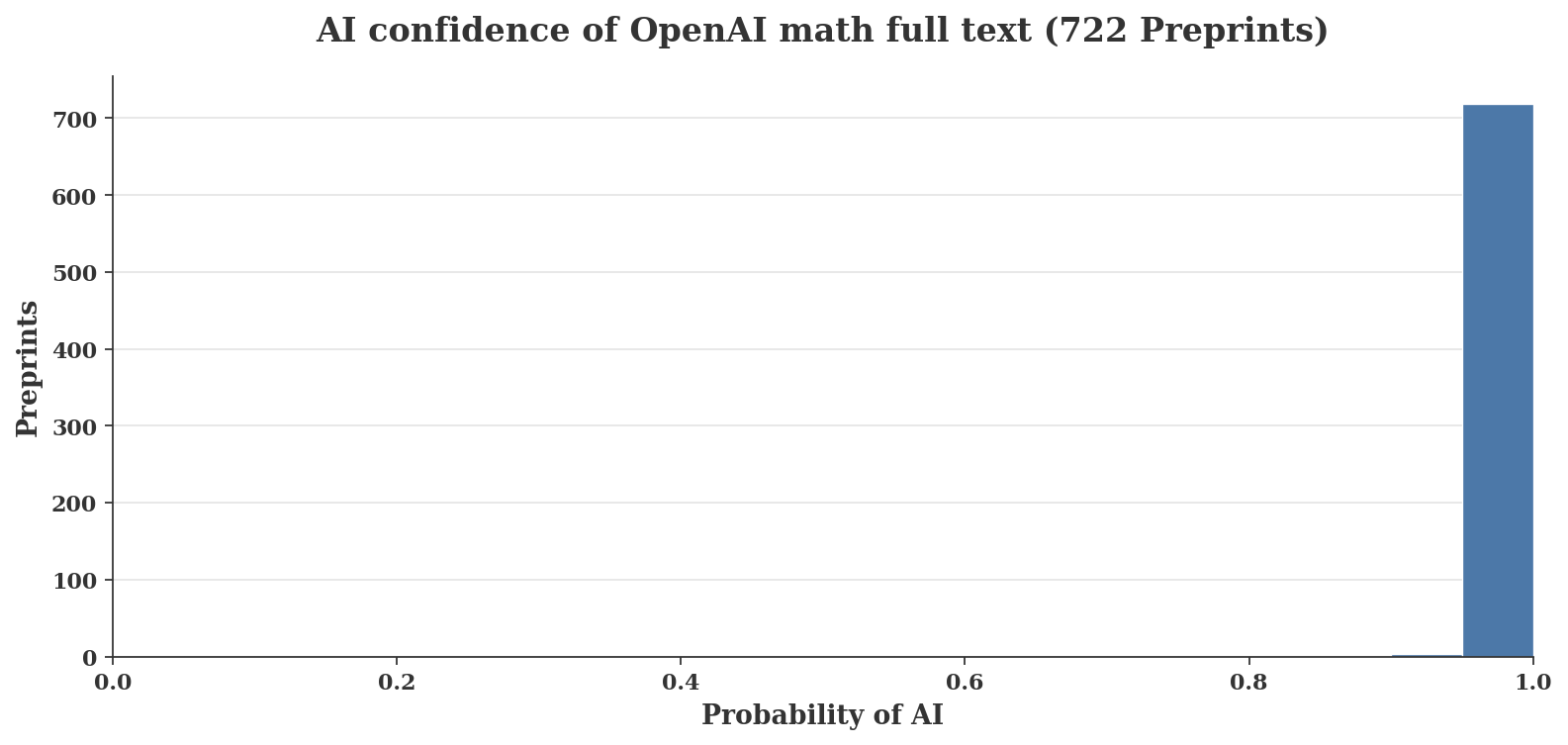
We put GPTZero to the test on all original 722 preprints. GPTZero classifies all 722 preprints as pure AI-generated.
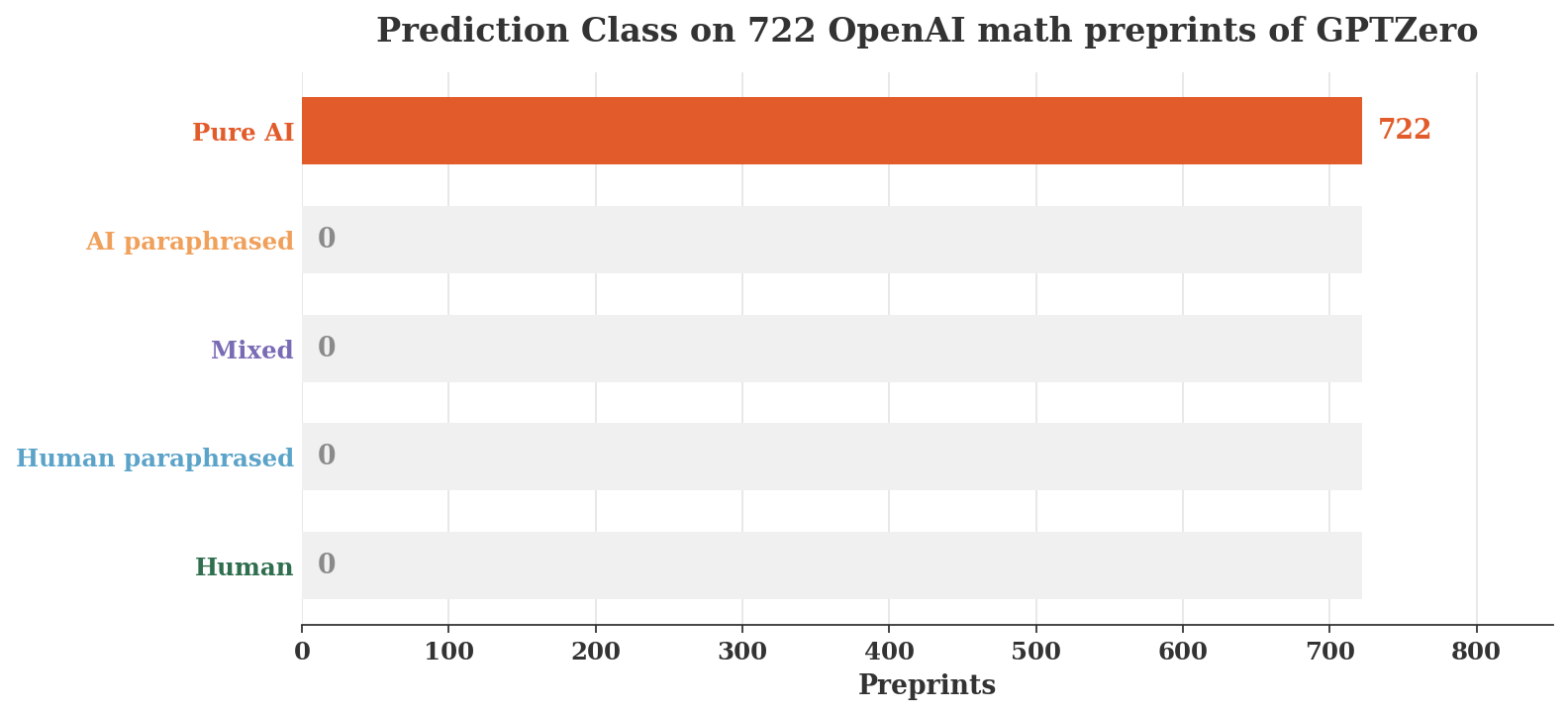
On closer inspection, GPTZero not only caught them all but did so with high confidence.
Can GPTZero Handle Math?
One question our team often hears is: can GPTZero still detect AI when a text is full of math formulas? The answer is yes. On the OpenAI manuscripts, GPTZero's advanced scan flags math-heavy paragraphs as AI as well.
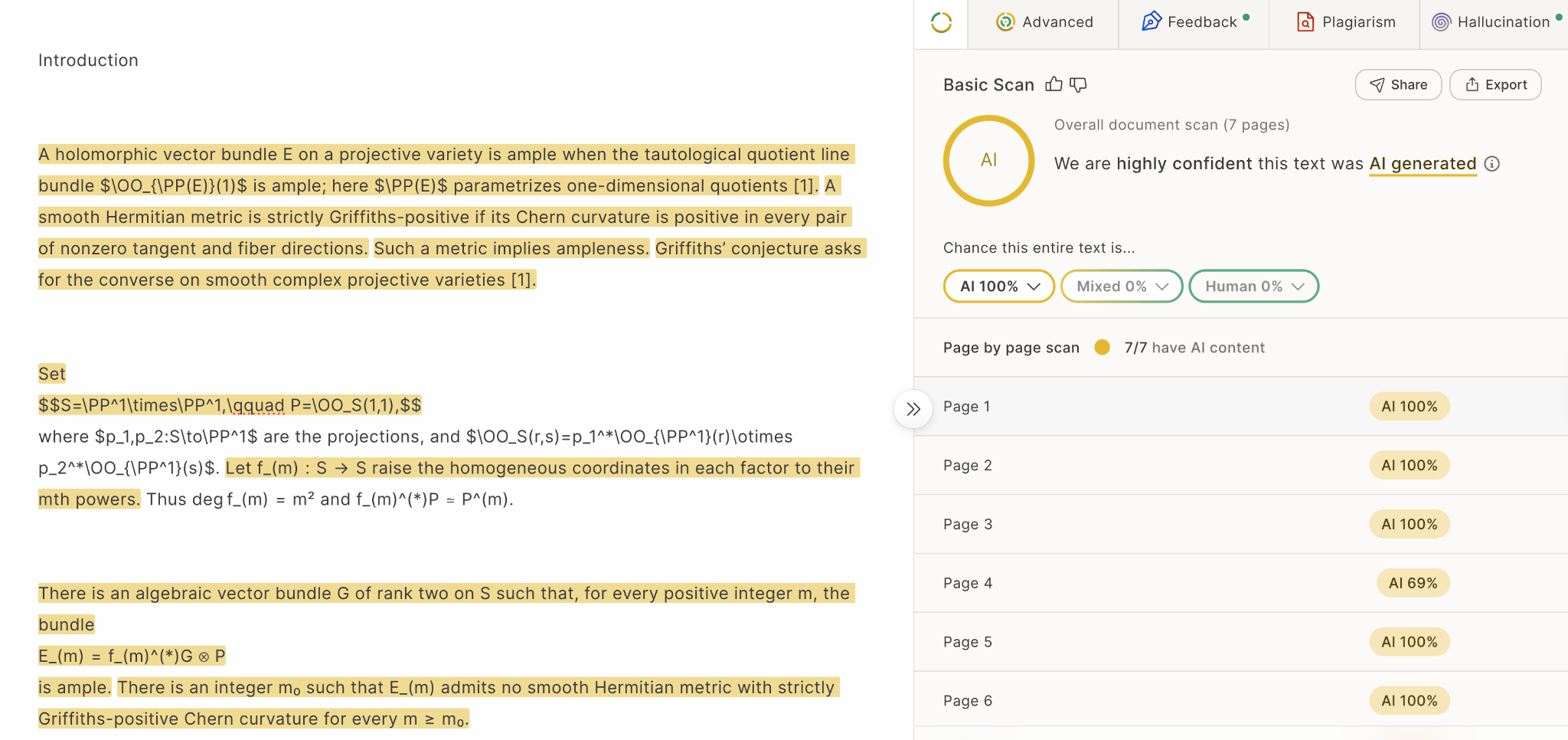
This is a page from the manuscript Ample rank-two bundles on the quadric surface without griffiths positive metrics, GPTZero detects AI signals even when the text is dense with formulas. Check here for its full advanced scan result.
What Does It Mean For Academia
As AI models and agents become more capable and accessible, writing a paper becomes easier. This raises serious problems in academia.
When a paper can be generated in hours, it no longer tells readers anything about its authenticity. Unverified papers can be cited and spread widely before anyone has reviewed them. Researchers are concerned about a review system flooded with AI-written works. As time and attention of reviewers are expensive, it's important to distribute limited peer-review resources to works that deserve the most recognition.
OpenAI Math Release is a good example: within a day of release, three manuscripts were withdrawn after a fundamental error was found that broke a proof two other manuscripts depended on. And 14 others were revised with proof repairs, corrected statements, and one correction to an obsolete citation. The flawed papers had been dated weeks before the release, yet the errors surfaced only once the work was open, where more human experts could check and question it.
This is why AI detection matters. When AI-generated papers can be identified, they can be disclosed and triaged, thus avoiding being blended with verified human academic works. Transparency is essential for academia; readers and reviewers deserve to know where a piece of text came from, so they can make up their own minds about it. GPTZero is trying our best to safeguard the sanctity of academia. As AI-generated research work grows, we'll keep improving at answering the question of who wrote this.
References
- OpenAI. “Sharing AI progress in mathematics.” October 6, 2026. https://openai.com/index/sharing-ai-progress-in-mathematics/
- OpenAI. openai/math (GitHub repository). https://github.com/openai/math
- Scott Aaronson. “The Mathocalypse.” Shtetl-Optimized, October 7, 2026. https://scottaaronson.blog/?p=10169