How to Write Like a Human (Without Sounding Like a Robot)
Want to stand out in the age of AI? Learn how to avoid repetitive, formulaic phrasing and edit for a unique voice and point of view.


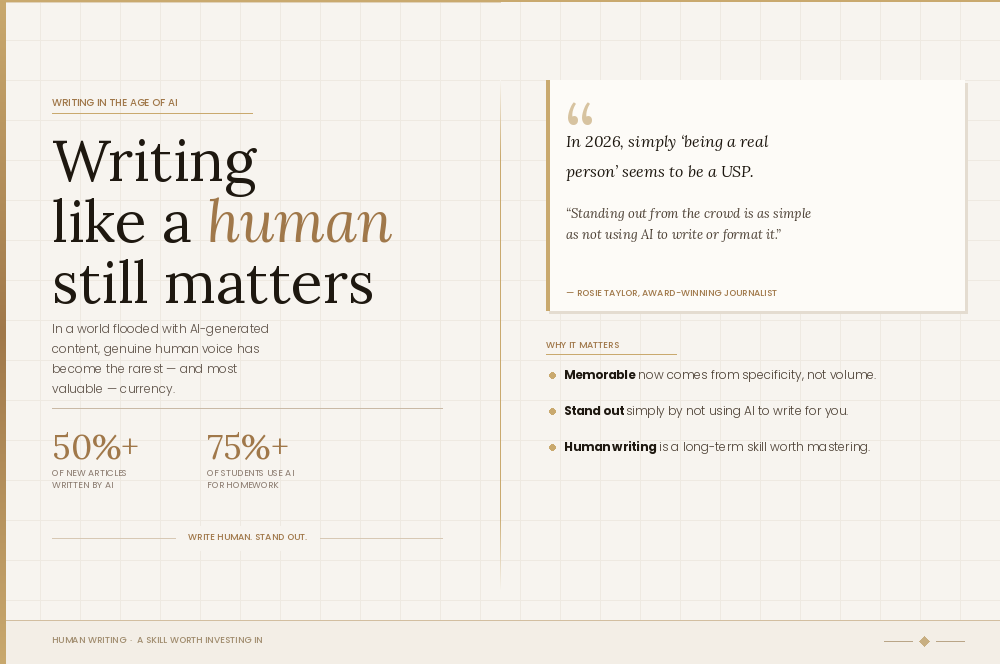
These days, we’re all getting better at spotting the polished but vanilla writing by ChatGPT. There is more content than ever, but less of it feels high-quality: more than half of new articles on the internet are being written by AI, and over 75% of students use AI for their homework. So how do you train yourself to write like a human, to stand out from the slop?
To move ahead in the years to come, this might be one of the most valuable skills to refine – but like anything worth mastering, it takes practice. Here, we’ll look at the most common “robotic” tells, as well as the practical side of editing your writing to make it feel human.
Writing like a human: why does it matter?
Award-winning freelance journalist Rosie Taylor put it bluntly: “It feels ridiculous to say this, but in 2026, simply ‘being a real person’ seems to be a USP.” She is talking about pitches to media publications, and says that while AI is capable of creating readable content, it isn’t particularly memorable. That point applies far beyond journalism: whether you’re writing an essay, a cover letter, or a marketing page, “memorable” now comes from specificity.
“When journalists are getting dozens, if not hundreds of these a day, they all look extremely similar. You can make your pitch stand out simply by not using AI to write or format it.”
She adds: “I’m not anti-AI and I know it can be useful for many things - but standing out from the crowd is not one of them.”
This is why writing like a human is a skill worth investing in for the long term. See it as practice, a mastery, something that is meant to be hard because it’s through the hard part that you eventually start to get better.
Robotic writing: signs your content sounds like AI
When it comes to AI content, there are typically some obvious signs to watch out for that reveal whether a machine or a human has generated the text. These are the most obvious signs that a work might have been generated by an AI tool:
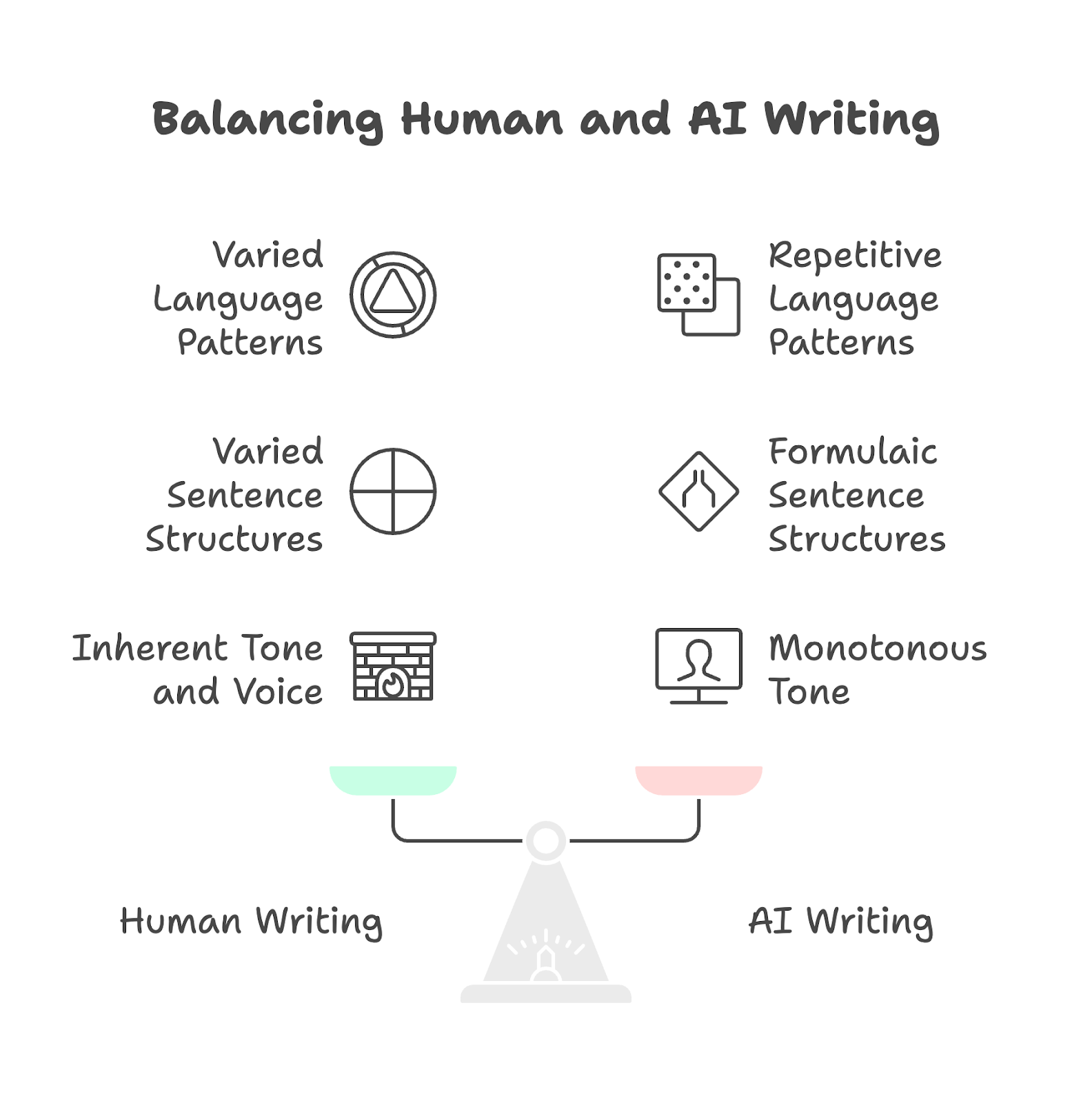
Repetitive Patterns in Text
Writing as humans means we tend to mix and match our language, with a rhythm that isn’t identical to someone else. In AI-generated writing, the text patterns can get overwhelmingly repetitive. The giveaway is how it feels to read: you can sense the paragraph stalling, looping, and “saying the thing again” instead of moving forward.
Formulaic Sentence Structures
Humans tend to write with a variety of sentence types and usually, there’s a varied structure throughout their work. However, with AI text, even with the right prompting, there can be a rigid and formulaic style. With AI writing, if every sentence lands with the same neatness, your reader stops listening, because real thinking has bumps and pauses and moments of landing a point.
Monotonous Tone
Human writing tends to have an inherent sense of voice, even if it doesn’t always come across straight away or takes a while to develop. On the other hand, AI-generated writing can feel quite flat, and completely lacking in personality. This is what makes a reader lose attention quickly.
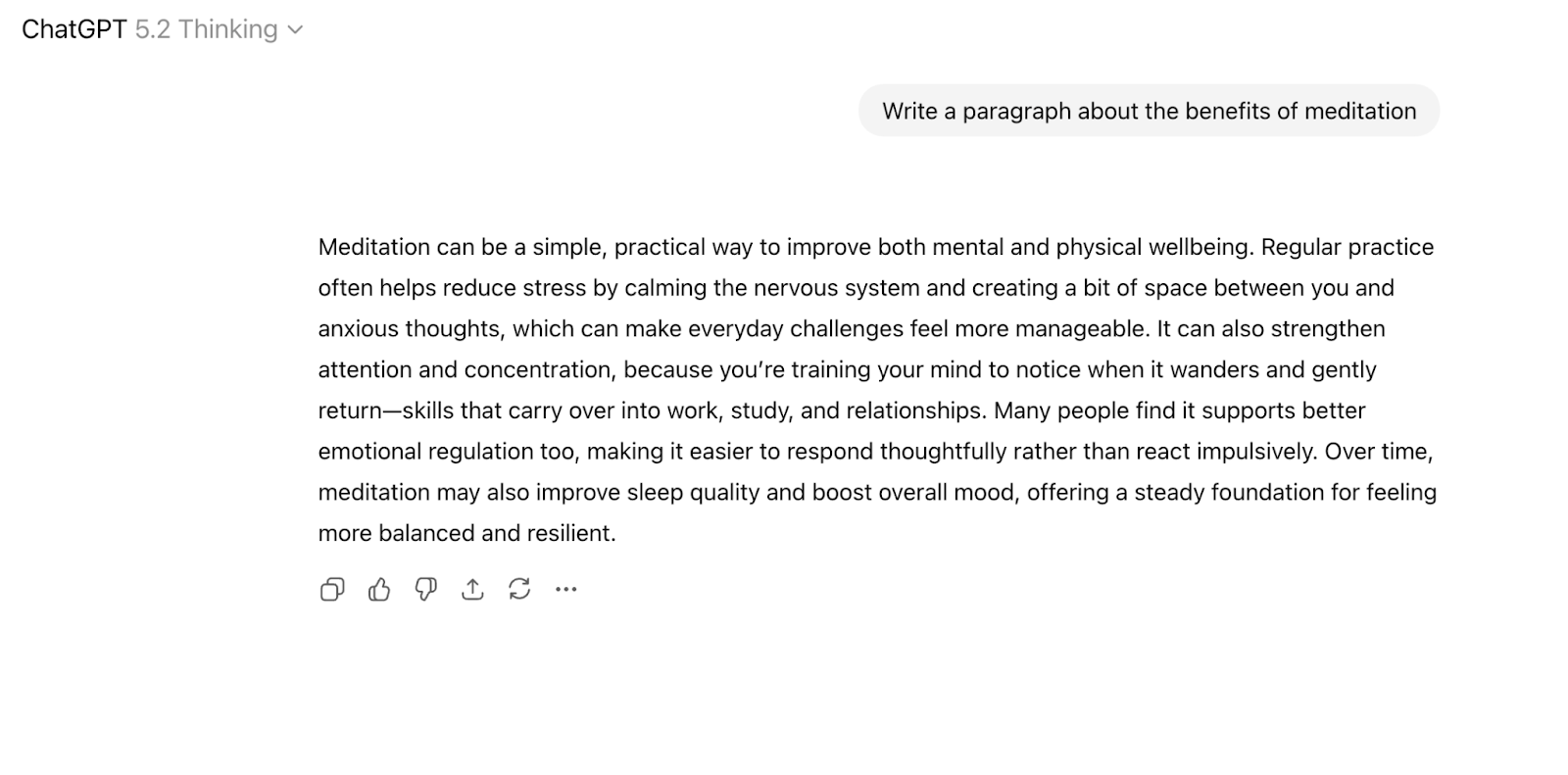
Here’s an example of what AI writing looks and sounds like. This is what came back from ChatGPT when we asked it to write about the benefits of meditation:
Meditation can be a simple, practical way to improve both mental and physical wellbeing. Regular practice often helps reduce stress by calming the nervous system and creating a bit of space between you and anxious thoughts, which can make everyday challenges feel more manageable. It can also strengthen attention and concentration, because you’re training your mind to notice when it wanders and gently return—skills that carry over into work, study, and relationships.
Writing like a human: Top 6 useful tips
So what does that mean in practical terms, for your own writing? It starts with the following:
- Mix up your sentence length. Make sure that not all of your paragraphs and points are structured in the exact same way or length.
- Where you can, be unpredictable. This is something great writers have mastered; it’s the specific word choices or unexpected insights that make a reader feel there’s a real mind behind the page.
- Lead with the actual point (no warm-up paragraph). If your first line could be swapped into any blog post, delete it. Start with a sentence that answers: what are you saying, and why should I care?
We also love these two brilliant tips, which we’ve taken directly from The Intuitive Writing School’s advice on ‘You're a human. So write like one. How to do it in an age of AI.’:
- Write how you speak: This is the easiest place to start. Of course, you don’t want to write exactly the way you speak because regular speech is filled with lots of fillers like “Ums” and "ahs", and tends to be more rambly than most writing. If you’re struggling to get started, try using talk-to-text to talk out an idea. I like Otter.ai. Then, you can edit from there.
- Read your writing out loud. When you're finalizing a written draft of semi-important, read it out loud. If you feel weird doing this, just whisper it. If you notice that you stumble on your words as you speak, that’s a cue to revisit your word choices. Find some more intuitive editing tips here.
Lastly, there’s this useful tip that Corwyn B shares:
“If you really like the voice of some writers, it is probable that they speak to you on some fundamental level because there is a connection with your ideal of how you should write (and speak). If you figure out some writers whose style you cannot get enough of, read as much of them as you can, reread them, and try to absorb the sound and the rhythm of their prose.”
Top 50 AI Words and Phrases
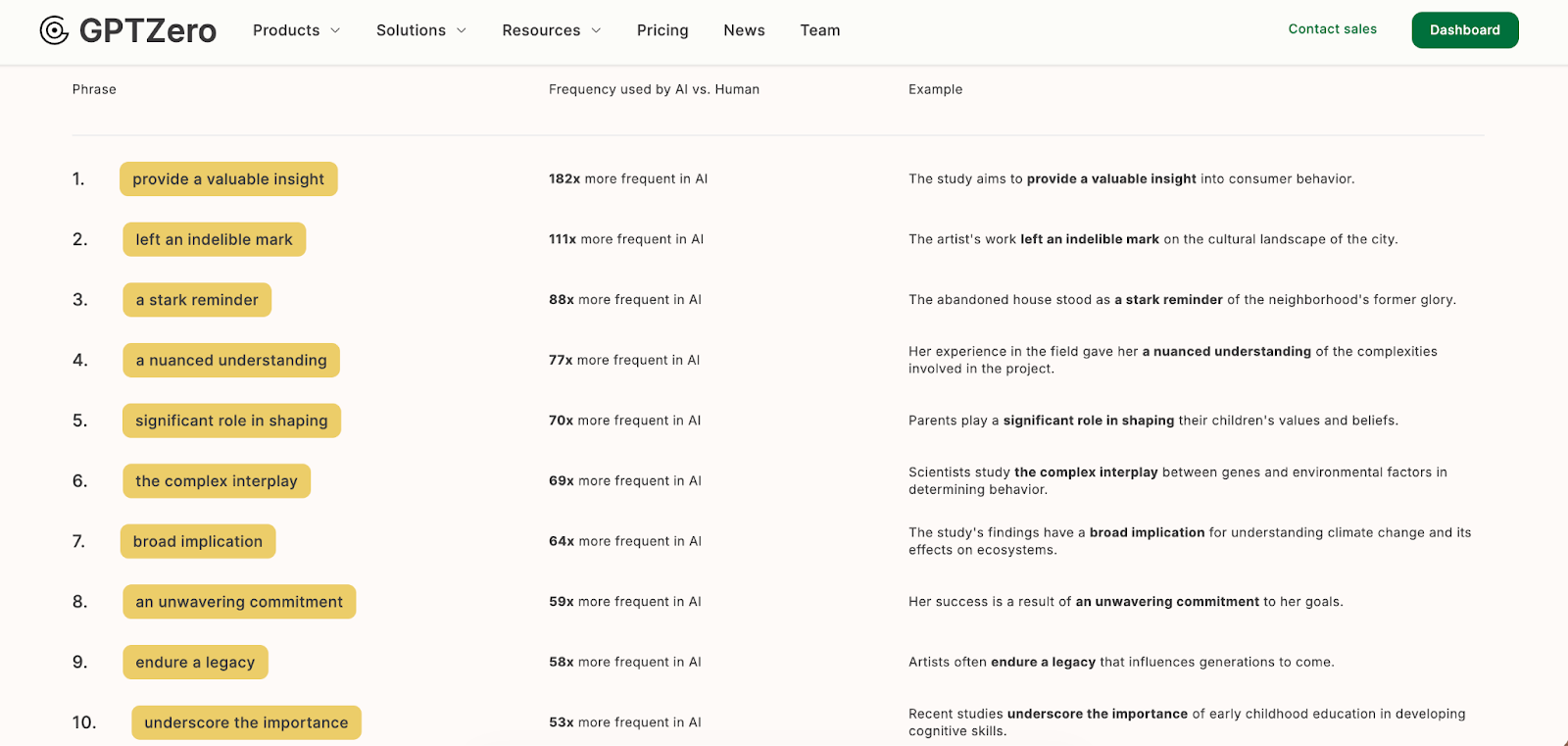
By now, we also know the most common AI vocabulary words (you can see the full list here). AI overuses certain words as it is a “stochastic parrot”, meaning it repeats back what it’s learned over millions of iterations. Reinforcement training on human data tends to make AI models “overfit” to small variations in their training data.
We’ve seen reports that the human data ChatGPT uses to train makes it amplify some word choices much more than others. There are specific words and phrases ranked based on the frequency they appear in AI documents, compared to human documents in our research of 3.3 million texts.
Human writing vs. AI writing: advantages and limitations
While AI writing might appear smooth and flawless, it can also be hollow, as it lacks a strong opinion. Human writing, on the other hand, is more likely to be memorable. As an article in the European Journal of Education put it: “Human-generated content is created with the intention of reflecting intent. AI-generated content, on the other hand, is created by algorithms designed to generate text in response to prompts. AI-generated text may contain repetitive or stereotypical phrases or patterns, while human-generated text is more likely to be original and creative.”
That’s not to say that there aren’t pros and cons of both types of writing. Ken McCarron, Head of Content at The Content Company, explains that there are certain advantages of AI content writing, including:
- Speed and Efficiency - AI can produce content much faster than humans, making it ideal for those needing enormous volumes of content at a rapid pace.
- Tone & Style - AI is meticulous with its tone and style, reducing the risk of errors that human writers could make in a similar exercise.
- Reducing Human Errors - AI's insistence on pre-set patterns and rules can minimize spelling, grammar, and formatting errors.
However, he also outlines certain limitations, including the following:
- Challenges in Producing Unique and Creative Content - AI often cannot generate truly unique and creative content and instead defaults to existing data patterns.
- Difficulty Grasping Complex Contexts and Subtle Nuances - AI may miss the nuances of human communication, which means less engaging content.
- Potential for Large Numbers of Websites to Have Similar Content - As more people use AI for content creation, the risk of homogenized content across websites in similar industries goes up.
The risks of becoming too dependent on AI
This is why it’s worth discussing the dangers of becoming too dependent on AI writing.
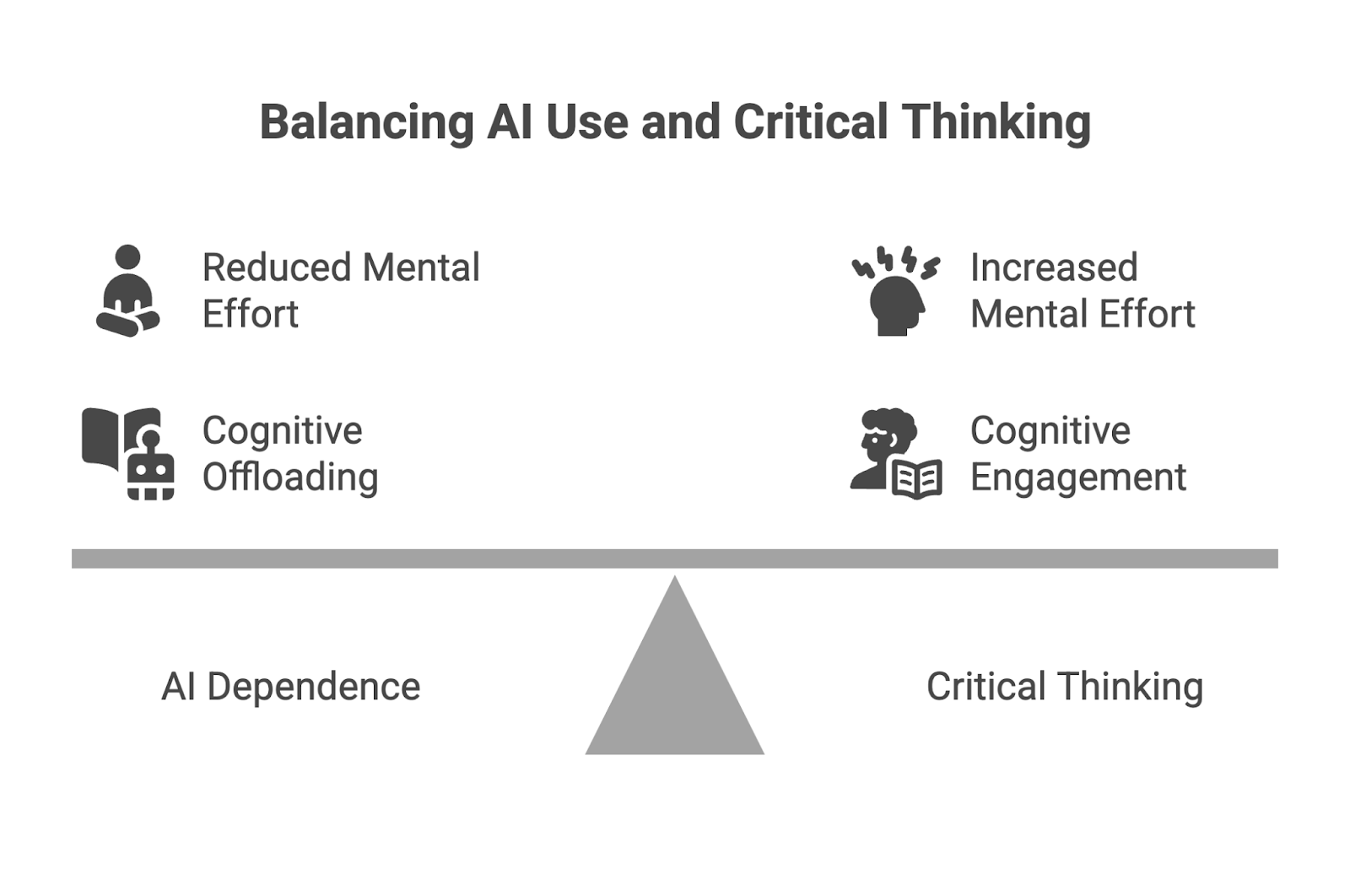
The major danger is, as GPTZero founder Alex Cui has argued, “A growing body of literature shows that if we don't use our critical thinking skills, we lose them.” Specifically, “as the reliance on AI for everyday tasks grows, users may incrementally surrender the mental effort involved in reasoning and analysis.”
In research terms, this is often discussed as cognitive offloading, which refers to using external tools to reduce mental effort. Some recent work specifically links heavier AI tool use, greater cognitive offloading, and lower measured critical thinking in participants.
If you rely on AI too heavily, over time, you can end up with writing that is technically fine but strangely interchangeable, meaning that you lose the very thing that makes your work distinctly yours: your judgement and your opinions.
Another risk worth mentioning is that AI writing is not always accurate, and should be handled with caution. While it can sound very confident, it isn’t always truthful. Hallucinations are far from a quirk and are best seen as a structural limitation of LLMs, which are at best pattern-matchers that make things up from time to time. The risk cannot be entirely eliminated but it can be minimized when you use tools like GPTZero’s Hallucination Checker to verify sources.
How to write with a human voice: examples and useful tips
It’s easy to mistake writing in a human voice for being informal or quirky, but instead, sounding like a human in your writing is about being able to hear a point of view and rhythm. The best examples let you watch someone’s mind at work. Here are some well-known writers who do this exceptionally well.
Strong examples of human-sounding writers
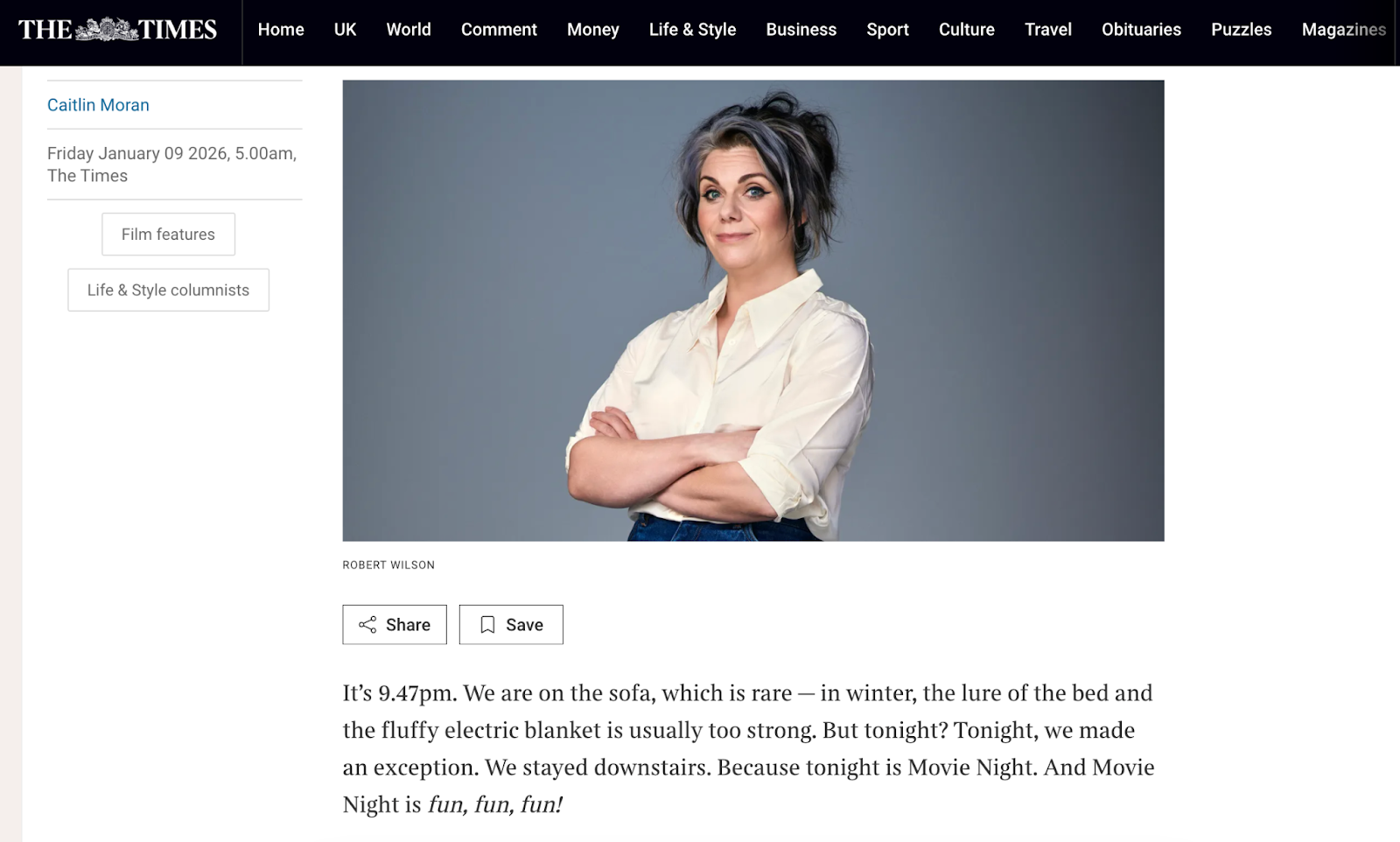
Caitlin Moran, the journalist, broadcaster, and author at The Times, example here:
“It’s 9.47pm. We are on the sofa, which is rare — in winter, the lure of the bed and the fluffy electric blanket is usually too strong. But tonight? Tonight, we made an exception. We stayed downstairs. Because tonight is Movie Night. And Movie Night is fun, fun, fun!”
Paul Graham, co-founder of Y Combinator, example here:
“It seemed curious that the same task could be painful to one person and pleasant to another, but I didn't realize at the time what this imbalance implied, because I wasn't looking for it. I didn't realize how hard it can be to decide what you should work on, and that you sometimes have to figure it out from subtle clues, like a detective solving a case in a mystery novel. So I bet it would help a lot of people to ask themselves about this explicitly. What seems like work to other people that doesn't seem like work to you?”
Miranda July, film director, screenwriter, actress and author, example here:
“A friend of mine was talking to a psychic about her 25 year marriage that was now over. "It was probably a mistake," she said. The psychic said No, it wasn't. That it had given her the stability to become herself, to grow up. So a marriage as a continuation of childhood, and then, at mid-life, you finally leave home.”
Tom Peck, a political sketch author, example here:
“For most of the last ten years, UK politics has been routinely described as a rolling horror show. Rarely has it been more appropriate. The calls are coming from inside the house: Keir Starmer’s house. He would also have to slap down the vicious briefings against his cabinet colleagues, this time Wes Streeting, while simultaneously denying said briefings has ever happened at all.”
Perplexity and burstinessness
As we can see from the examples above, human writing has a shape and an opinion. To get really specific about how and why that occurs, HackerNoon has put together the following analysis on the importance of perplexity and burstiness.
“Perplexity is a metric used to evaluate the performance of language models in predicting the next word in a sequence of words,” they explain. “It measures how well the model can estimate the likelihood of a word occurring based on the previous context. The human mind is so complex compared to current AI models that human-written text has high perplexity compared to AI-generated text.”
As for burstiness, that refers to “variation in the length and structure of sentences within a piece of content. It measures the degree of diversity and unpredictability in the arrangement of sentences. Human writing often exhibits bursts and lulls, with a mix of long and short sentences, while AI-generated content tends to have a more uniform and regular pattern.”
Before you submit
Run your work through GPTZero to see where your writing might sound like AI, even if you haven’t used it in the creation of your work. With sentence-level analysis, GPTZero doesn’t give a single document score and instead highlights which sentences and phrases are influencing the overall result, so you can see where the “AI-like” pattern is coming from.
Besides that, we’ve also put together a writing checklist for freelance writers and writers of other formats, like academic, workplace, and creative. These writing checklists will save you from countless "oops" moments. And if you’re consistent, they’ll also help you build a reputation for being thorough and professional.
Conclusion
Writing like a human is a lot harder than relying on AI, but it’s a skill worth mastering in the long run. It’s about keeping hold of the part of writing that makes it engaging and distinct: a mind with an opinion. AI-writing tends to be generic and slightly interchangeable, whereas human writing is much more unique. To master writing like a human, try to be unexpected where possible, find your rhythm and voice, and above all, be willing to put in the practice.
FAQ questions
- How do I write like a human? Study writers you like, and then lead with the actual point (no warm-up paragraph) and start with a sentence that answers: what are you saying, and why should I care? Mix up your sentence length, and where you can, be unpredictable so a reader can feel there’s a real mind behind the page.
- How can I write without sounding like AI? Watch for repetitive patterns in text and a rigid and formulaic style, because AI-generated writing can get overwhelmingly repetitive and eerily consistent. Read your writing out loud and, if you stumble on your words as you speak, revisit your word choices so it doesn’t feel flat, stripped of emotional energy, or lacking in warmth.
- Why does my writing sound robotic even when it’s mine? If you rely on AI too heavily, over time, you can end up with writing that is technically fine but strangely interchangeable, and you lose what makes your work distinctly yours: your judgment and your opinions. Even without AI, writing can start to feel robotic when it falls into a monotonous tone or passive voice that gets in the way of sounding more human.
- What are common AI-sounding phrases to remove? If your first line could be swapped into any blog post, delete it, because that’s often where “polished yet bland” writing hides. Look for lines that sound like reading the same point expressed in a lot of different ways, and cut the repetitive or stereotypical phrases or patterns.