
Can GPTZero Detect Claude? We Put It to the Test
I tested GPTZero against 3 of the latest Claude models. Read and find out whether GPTZero could detect Claude or whether Claude managed to by-pass it.


In a joint research by GPTZero and Graphite.io, it was revealed that half of all new articles published online are AI-written. In other words, 50% of the articles online are written by humans, and the remaining 50% are written by AI.
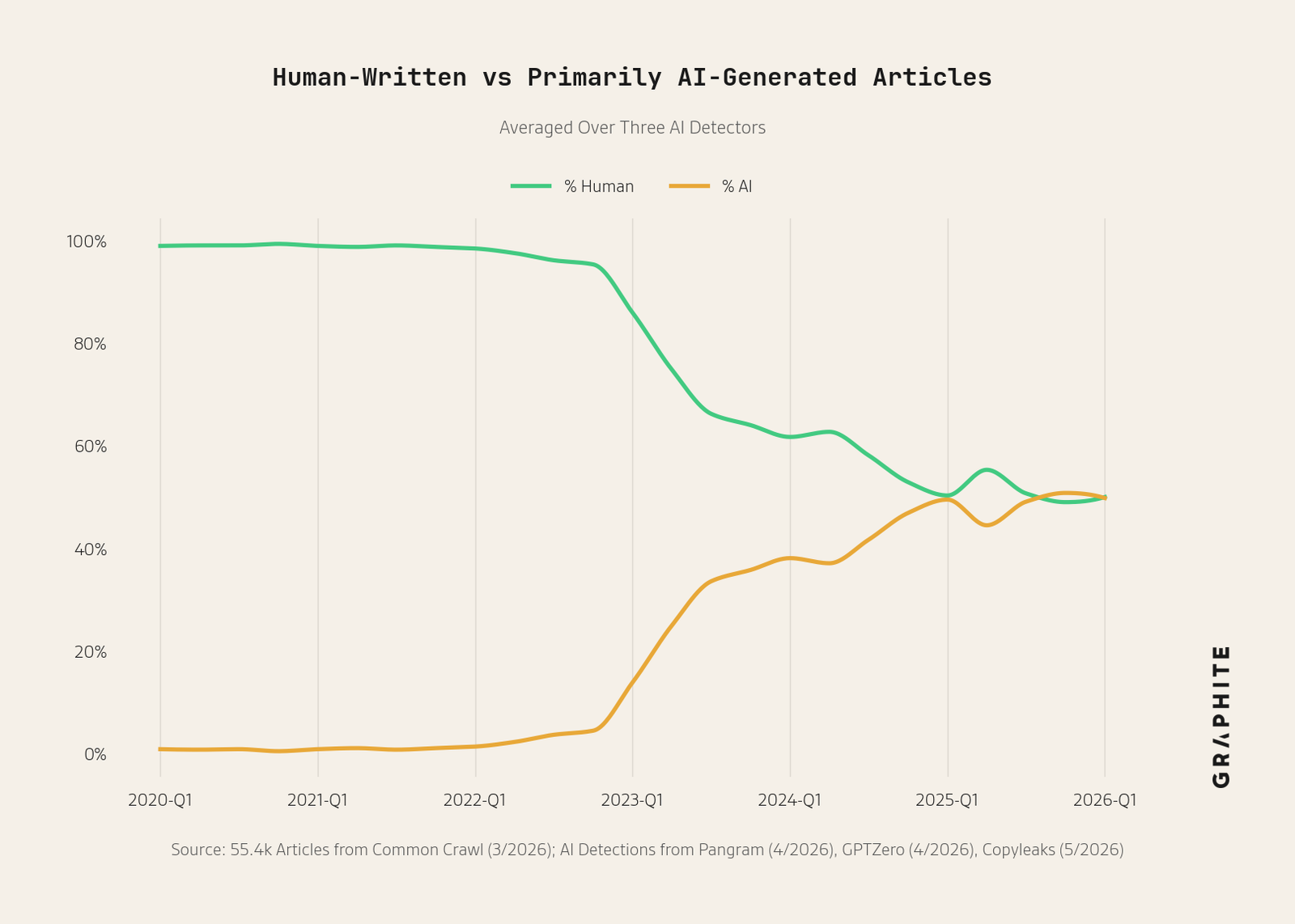
This was anticipated long ago, when only 24 months after the launch of ChatGPT, AI-generated articles comprised 48% of the online published articles.
The trend hasn’t increased much after that point, but the mix behind that number keeps on shifting. A major shift that matters for us is that most expert writers now prefer Claude over ChatGPT for its superior writing quality.
And many AI detectors have already started being fooled by content generated by Claude. As the makers of GPTZero, the important question is, can GPTZero detect Claude content?
I decided to test this myself. My testing strategy included generating 30 text samples using all leading Claude models and running them through GPTZero.
In this article, I'll walk you through the results of the testing.
But first, let's talk about why Claude is even worth testing separately in the first place.
Why is Claude Different from Other AI Models?
If you have used both ChatGPT and Claude for generating write-ups, you’ve probably noticed a clear difference in their outputs.
In Claude’s output, the AI-writing patterns are less obvious compared to ChatGPT’s. You’ll notice that Claude doesn’t insert the notorious em dashes everywhere like ChatGPT (it still uses them, though). It doesn’t coin awkward-sounding neologisms to convey a point either. However, the annoying “rule of three” pattern is still being used by Claude (and other AI models).
This is the major reason why today’s writers gravitate toward Claude more than ChatGPT.
That said, a text that seems human-written to you can still be AI-generated.
Most of us can only look at surface-level attributes of a text. We cannot pick the deeper statistical patterns in the text like an AI detector tool.
What I’m saying is that Claude being a better writer doesn't automatically mean it's a harder model to detect. And we have proven this in the past as well.
When Claude Sonnet 4.5 came out, GPTZero ran its benchmark on the same day, before adding any of that model's output to our training data, and still got over 97% recall at a 1% false positive rate.
But since then, Claude has updated many times. We now have Claude Opus 4.8, Sonnet 4.6, and Haiku 4.5, which are all newer than Sonnet 4.5.
Therefore, another small round of testing was needed to check how GPTZero is holding up against Claude's latest releases.
So let's get into the testing.
Testing Methodology
I kept the testing basic in the sense that the sample size was small. But I strived to make the test challenging for GPTZero.
I tested all three of Claude’s models that I mentioned above. Here’s what Claude says each of these models is best for:
- Opus 4.8: most capable for ambitious work
- Sonnet 4.6: most efficient for everyday tasks
- Haiku 4.5: fastest for quick answers
I used these models to generate text samples in two phases.
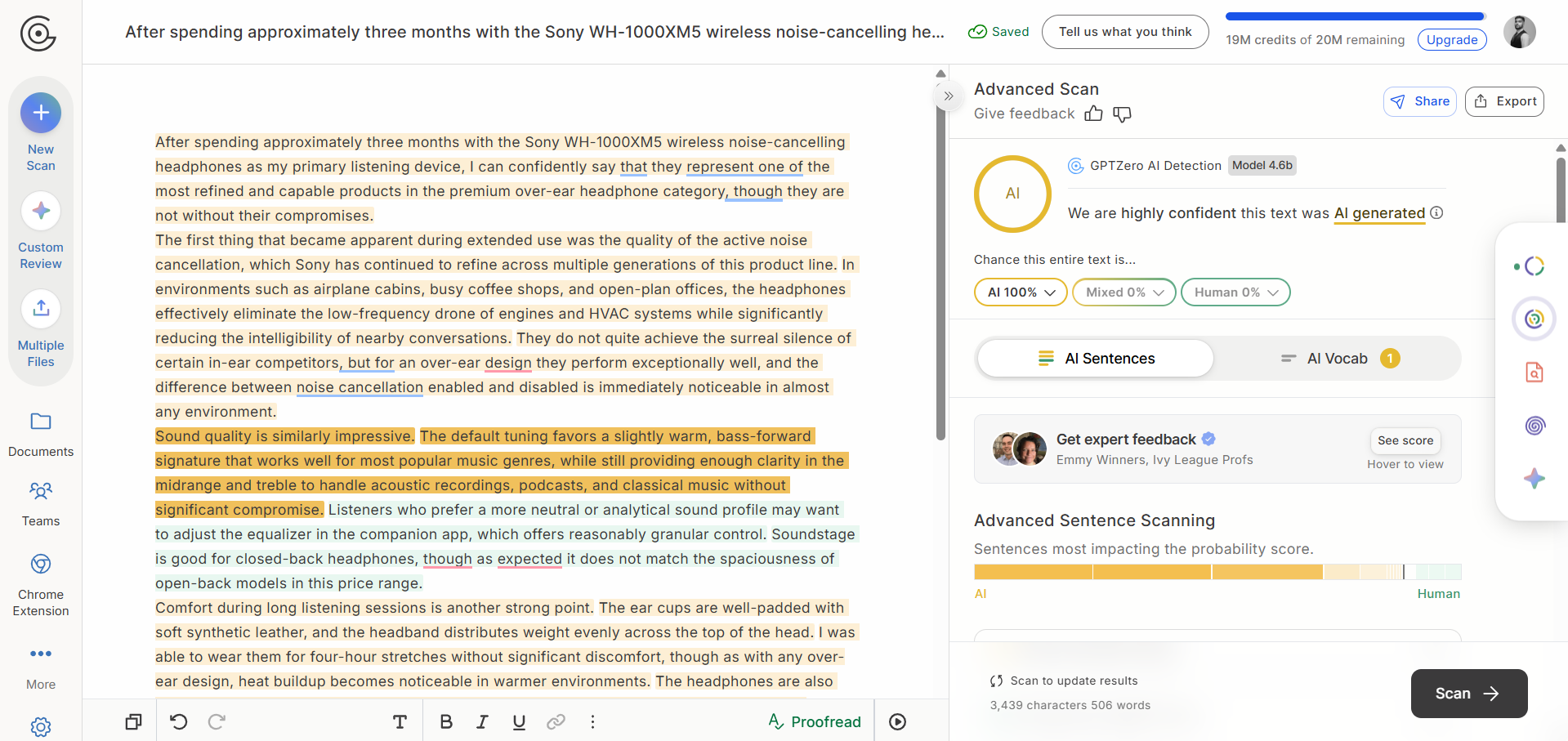
In Phase 1, I gave them a simple and direct prompt to generate five content types:
- An academic essay arguing a position
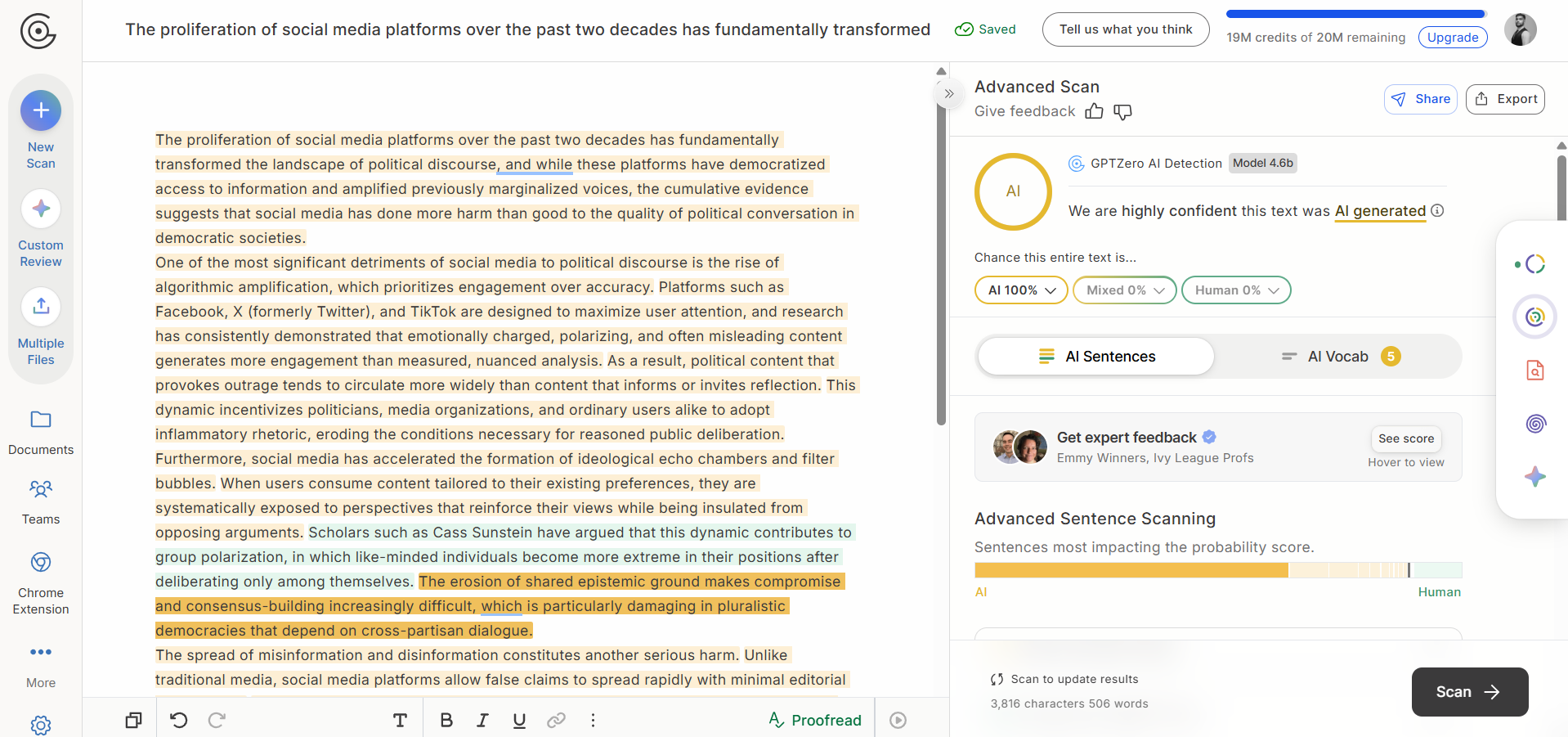
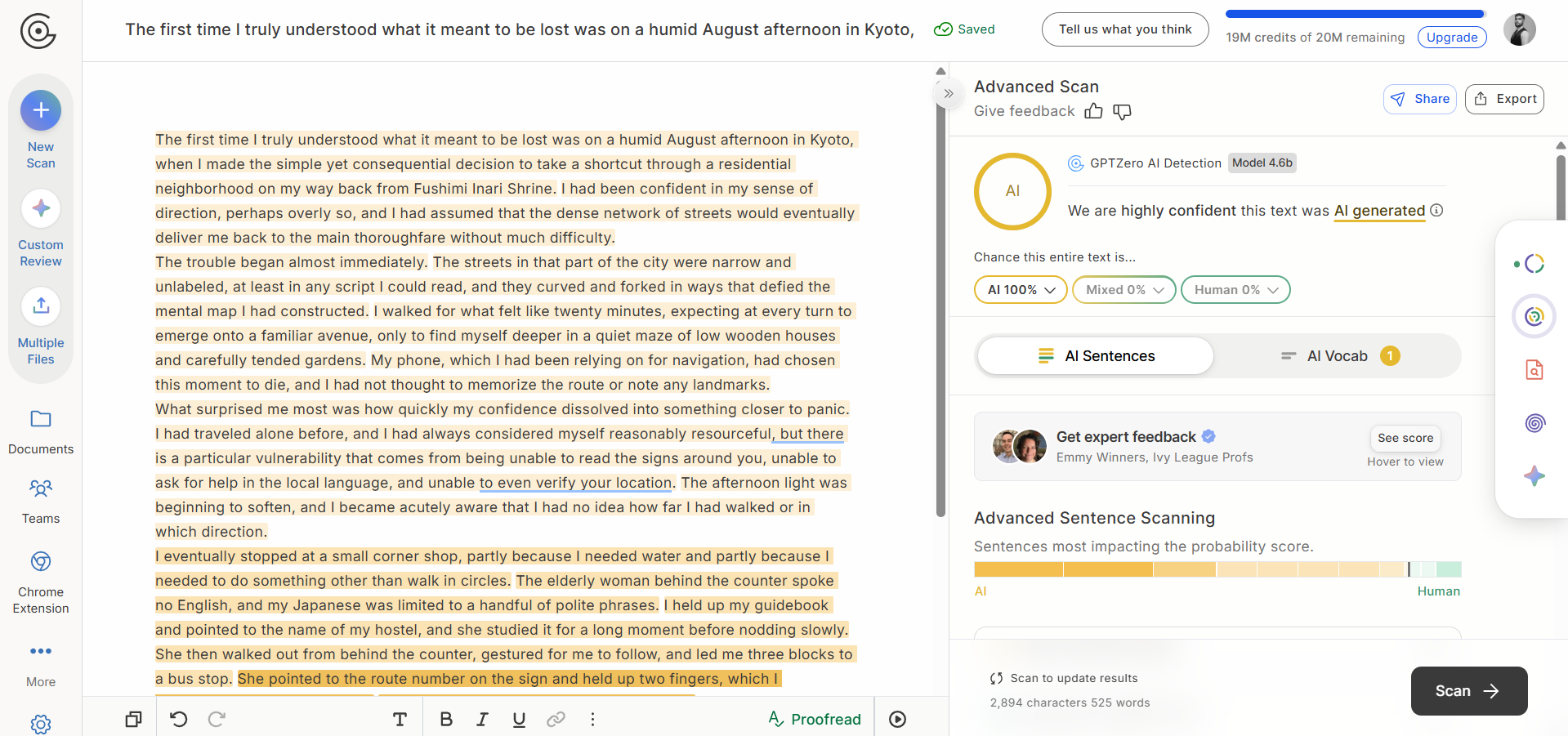
- A personal narrative written in first person
- A news-style article reporting on something
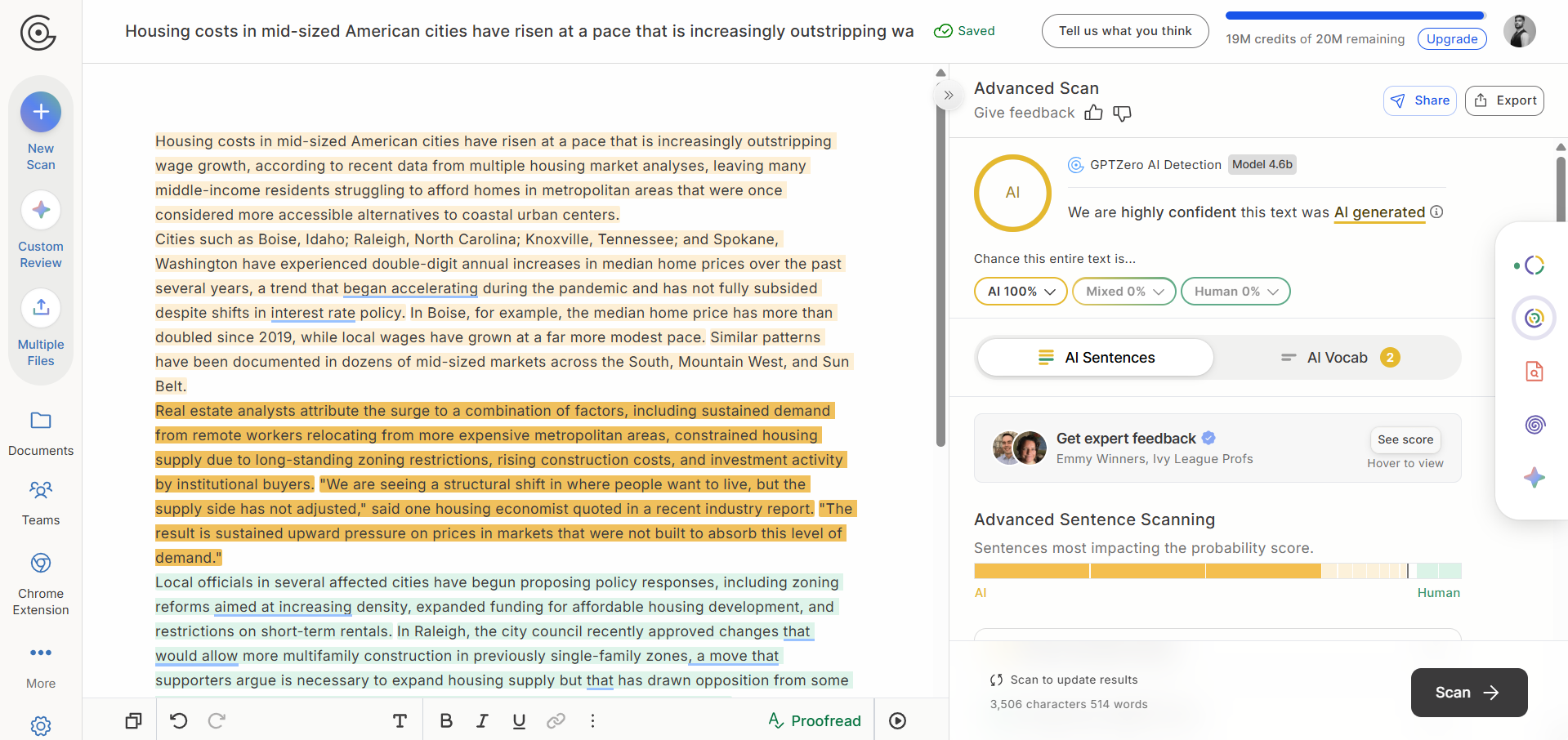
- A product review
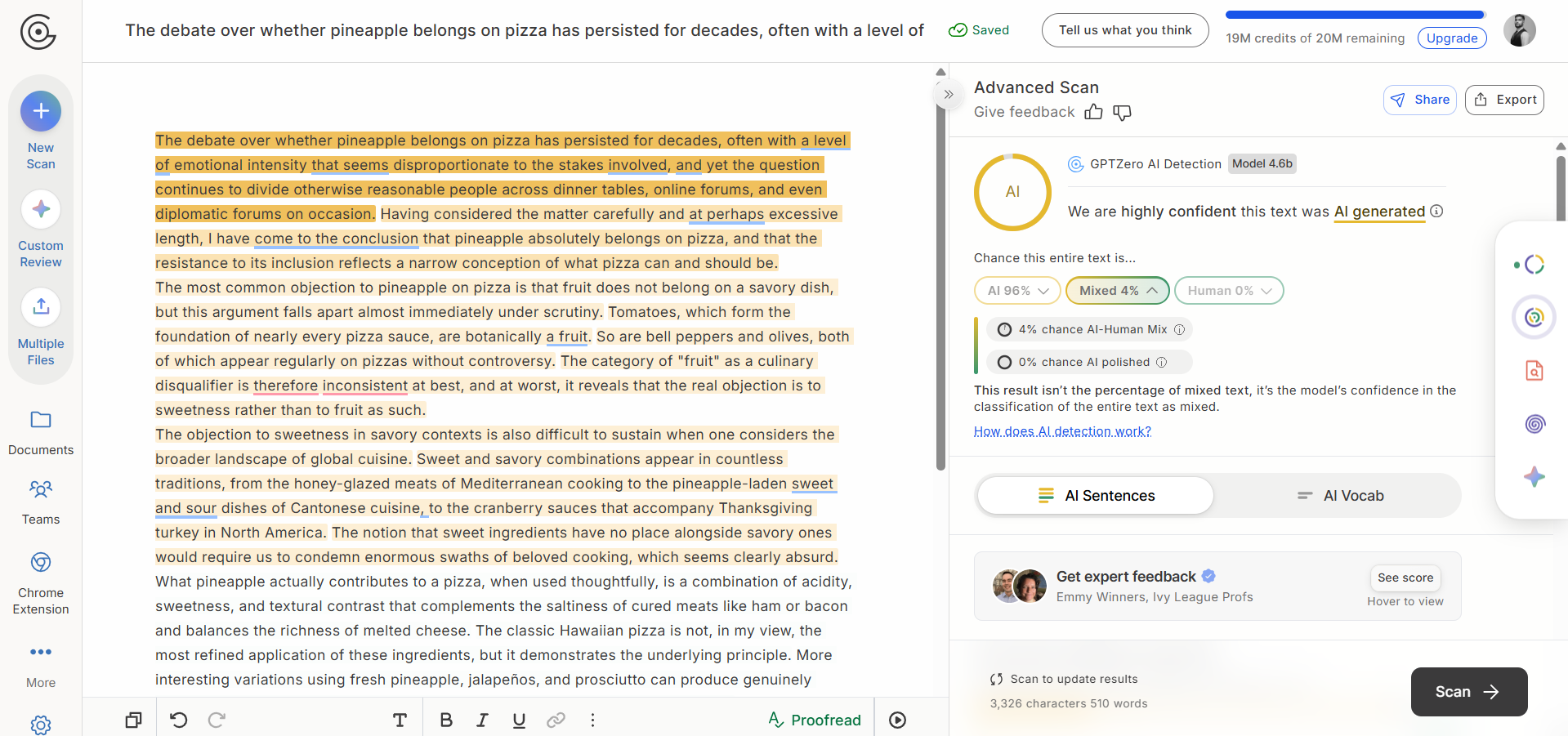
- An opinion piece on a casual topic
That's 5 samples per model, which makes 15 samples in total. 5 content types × 3 models = 15 samples. We will call them our baseline samples.
Then in Phase 2, I used a little prompt engineering. I generated the same five content types, but with two extra instructions:
- Replicate my writing style from one of my past articles, which was 100% written by me.
- A different stylistic twist to each sample (read the 5 prompts in the screenshot below)
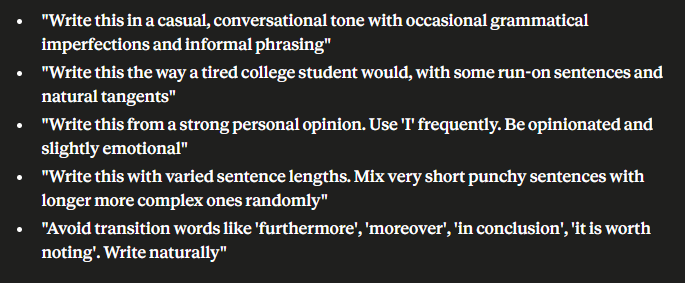
Phase 2 also gave me 15 samples, so my total sample size became 30.
I asked Claude to keep the word count between 400 and 600 words, but Haiku would still go below 300 words sometimes.
Then I ran all 30 samples through GPTZero individually and recorded the verdict and the percentage breakdown. GPTZero gives a verdict plus three percentages: AI written, mixed (human + AI), and human written.
With the testing strategy laid out, let's show you how GPTZero performed on all these samples.
The Result
Before we explain GPTZero’s performance against each model, here’s a table showing GPTZero's overall performance across Claude models:
What this shows is that while GPTZero’s confidence dropped a little at times, its final verdict was correct every time. It didn’t declare any sample to be human. All were flagged as what they were, AI-generated.
GPTZero against Claude Opus 4.8
In theory, Opus 4.8 is supposed to be Claude’s toughest model to beat for GPTZero, being the latest and paid.
But in practice, that didn’t happen. In Phase 1, GPTZero didn't find the samples tough at all.
GPTZero was “highly confident” that all five samples were AI-generated. Four of the five samples got a 100% AI score. The fifth sample scored 96% AI and 4% mixed, which is still a confident flag.
In Phase 2, where all samples were prompt-engineered, GPTZero’s confidence dropped a little. Regarding one sample (the personal narrative), GPTZero was moderately confident that it was AI. That sample scored 77% AI with 23% mixed. All other samples received above 80% AI scores, with one scoring 100% AI.
In all of this, note that GPTZero didn’t give a human score to any of the samples.
Verdict: GPTZero can detect Claude Opus 4.8 with 100% accuracy.
GPTZero against Claude Sonnet 4.6
Sonnet 4.6 is what most people use because it’s available for free. It is not as advanced as Opus 4.8, so most assume it to perform accordingly.
But we saw some surprises. In Phase 1, the personal narrative sample and the opinion piece sample received 84% and 79% AI scores, respectively. However, GPTZero still didn't classify them as human.
All other samples were 100% flagged as AI.
From Sonnet’s performance in Phase 1, you might expect that Phase 2 would push those numbers even lower. But that didn’t happen.
GPTZero got more confident and flagged four of the five samples as 100% AI, the fifth sample as 96% AI, and 4% mixed.
Verdict: GPTZero can detect Claude Sonnet 4.6 with 100% accuracy.
GPTZero against Claude Haiku 4.5
Haiku 4.5 is the oldest of the 3 Claude models we are testing. And it performed against GPTZero as we had expected.
In both phases, GPTZero caught the samples with 100% confidence. It didn't budge even a single percentage point on any sample.
The table below shows how Claude Haiku 4.5 performed against GPTZero in Phase 1:
How Claude Haiku 4.5 performed against GPTZero in Phase 2:
Verdict: GPTZero can also detect Claude Haiku 4.5 with 100% accuracy.
Accurate AI Detectors are The Need of the Time
While Claude couldn’t fool GPTZero even once, it has been able to fool other AI detectors. So it’s important to check an AI detector before subscribing to it.
An accurate AI detector flags AI as AI and human as human. It doesn’t make wrong calls most of the time.
And GPTZero is exactly like that.
In this test, GPTZero’s catch rate of 30 samples was 100%. And this isn't a one-off result.
GPTZero has topped independent benchmarks many times. For example, the massive RAID benchmark (which evaluates AI detectors on 672,000 texts across 11 domains, 12 LLMs, and various adversarial attacks) has ranked it the most accurate commercial AI detector in North America.
On an academic benchmark from the University of Chicago Booth School of Business, GPTZero achieved 99.5% overall accuracy with a false positive rate of just 0.05%. If you do the math, that’s 1 wrong flag out of every 2,000 human documents.
Try GPTZero for free and see how it performs on your own samples.